On this page
A favourite school mensuration question hands you a rectangular sheet and asks you to roll it into a hollow cylinder twice: once along the length and once along the breadth. One cylinder comes out short and wide, the other tall and thin. Here is why, with a one-line rule for comparing them and an NCERT-style example worked both ways.
What happens when you roll a rectangular sheet into a cylinder?
The edge that wraps around becomes the circle at the top and bottom. The edge that stays straight becomes the height. So if a sheet of length L and breadth B is rolled so that L wraps around:
circumference: 2πr = L, so r = L ÷ 2π
height: h = B
The curved surface area of a cylinder is 2πrh and its volume is πr²h, the formulas used in NCERT's Class 10 chapter on surface areas and volumes and listed by Wolfram MathWorld for a right circular cylinder.
Watch the wording. "Rolled along its length" usually means the length wraps round to become the circumference, but question setters do not all phrase it the same way. If a question is unclear, sketch it and write down which edge you took as 2πr.
Rolling along the length or the breadth: which gives more volume?
Put r = L ÷ 2π and h = B into πr²h:
rolled along the length: V = π × (L ÷ 2π)² × B = L²B ÷ 4π
rolled along the breadth: V = π × (B ÷ 2π)² × L = B²L ÷ 4π
Divide one by the other and almost everything cancels. The two volumes are in the ratio L : B, the ratio of the edges that wrap round.
The reason: the radius is squared in πr²h but the height appears only once. Doubling the circumference quadruples the base area, while halving the height only halves the volume. So wrap the longer edge round if you want more volume.
The curved surface area does not change at all. Since 2πr is one edge and h is the other, 2πrh is just L × B, the area of the sheet you started with.
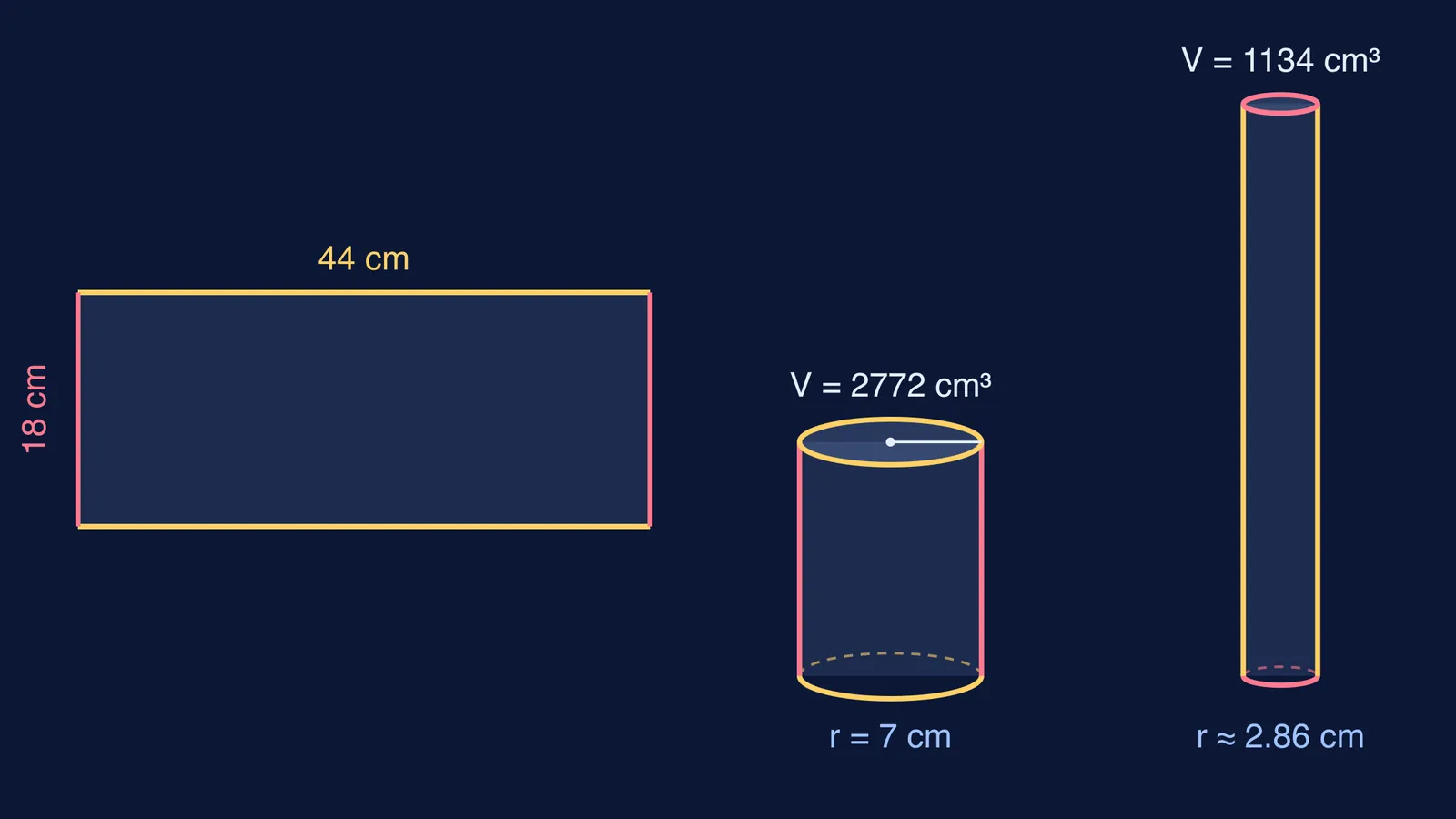
Worked example: a 44 cm × 18 cm sheet rolled both ways
Take π = 22/7, as NCERT's Exercise 12.1 does unless a question says otherwise (NCERT Class 10, Chapter 12).
Rolled along the length (the 44 cm edge wraps round):
2 × 22/7 × r = 44, so r = 7 cm
h = 18 cm
V = 22/7 × 7 × 7 × 18 = 2772 cm³
Rolled along the breadth (the 18 cm edge wraps round):
2 × 22/7 × r = 18, so r = 63/22 cm, about 2.86 cm
h = 44 cm
V = 22/7 × (63/22)² × 44 = 1134 cm³
Check: 2772 ÷ 1134 = 22/9, which is exactly 44 ÷ 18. Both cylinders have a curved surface area of 44 × 18 = 792 cm², the area of the sheet.
Why does the total surface area change if the curved area does not?
A closed cylinder has total surface area 2πr(r + h), which is the curved surface plus two circular ends of area πr² each (Wolfram MathWorld). The ends are extra material, not part of the sheet, and they depend on r.
For the same 44 cm × 18 cm sheet:
rolled along the length: 792 + 2 × 22/7 × 7² = 792 + 308 = 1100 cm²
rolled along the breadth: 792 + 2 × 22/7 × (63/22)² = 792 + 567/11, about 843.5 cm²
So read the question carefully. A paper tube is open and needs only the curved area; a closed tin needs the ends too. Our post on curved vs total surface area sorts out which one a question wants, and the reverse problem, a fixed volume made with the least material, is worked in why a closed can has a minimum surface area.
How do you avoid mistakes in sheet-rolling questions?
Use this checklist every time:
Mark the edge that wraps round. That edge equals 2πr.
The other edge is the height h.
Solve for r before you square it.
Curved surface area is the sheet's area. Do not recompute it.
The ratio of volumes is the ratio of the wrapped edges.
Check whether the cylinder is open or closed before adding 2πr².
To see it, roll two identical sheets of paper different ways, stand each tube on card and fill it with rice. The wide tube holds visibly more. If flattening solids into nets helps you, our post on surface area from the nets of cubes, cylinders and cones takes the same idea further.
If you keep setting the wrong edge equal to 2πr, try a few more questions in the Fermi Problem Library, which has worked problems with a step-by-step solver that explains the reasoning rather than printing an answer. For the formulas themselves, each concept in the Fermi Concept Library has its own lesson.