

On this page
Finding the dimensions of a closed cylinder that holds a specific volume while using the least amount of material is a classic calculus problem. The solution shows how differentiation turns a messy geometrical trade-off into an exact answer.
What is the surface area of a closed cylinder?
The surface area of a closed cylinder is the total area of its circular top, circular bottom, and curved side wall.
Let r be the radius of the base and h be the height of the cylinder.
The area of the top is πr².
The area of the bottom is πr².
If you unroll the curved side wall, it forms a rectangle with a height of h and a length equal to the circumference of the base, 2πr. So, the area of the side is 2πrh.
Adding these together gives the total surface area S: S = 2πr² + 2πrh
To solve the problem, we also need the volume V, which remains constant: V = πr²h
If you are struggling to picture the geometry of the unrolled cylinder or want to explore the relationships between these shapes, the Fermi Concept Library maps out 3D solids before you tackle the calculus.
How do you find the minimum surface area of a closed cylinder?
To find the minimum surface area for a fixed volume, we need to eliminate one of the variables so we can differentiate S with respect to just one variable. We use the volume equation to eliminate h.
First, rearrange the volume equation for h: h = V / (πr²)
Next, substitute this expression for h into the surface area equation: S = 2πr² + 2πr × [V / (πr²)] S = 2πr² + 2V/r
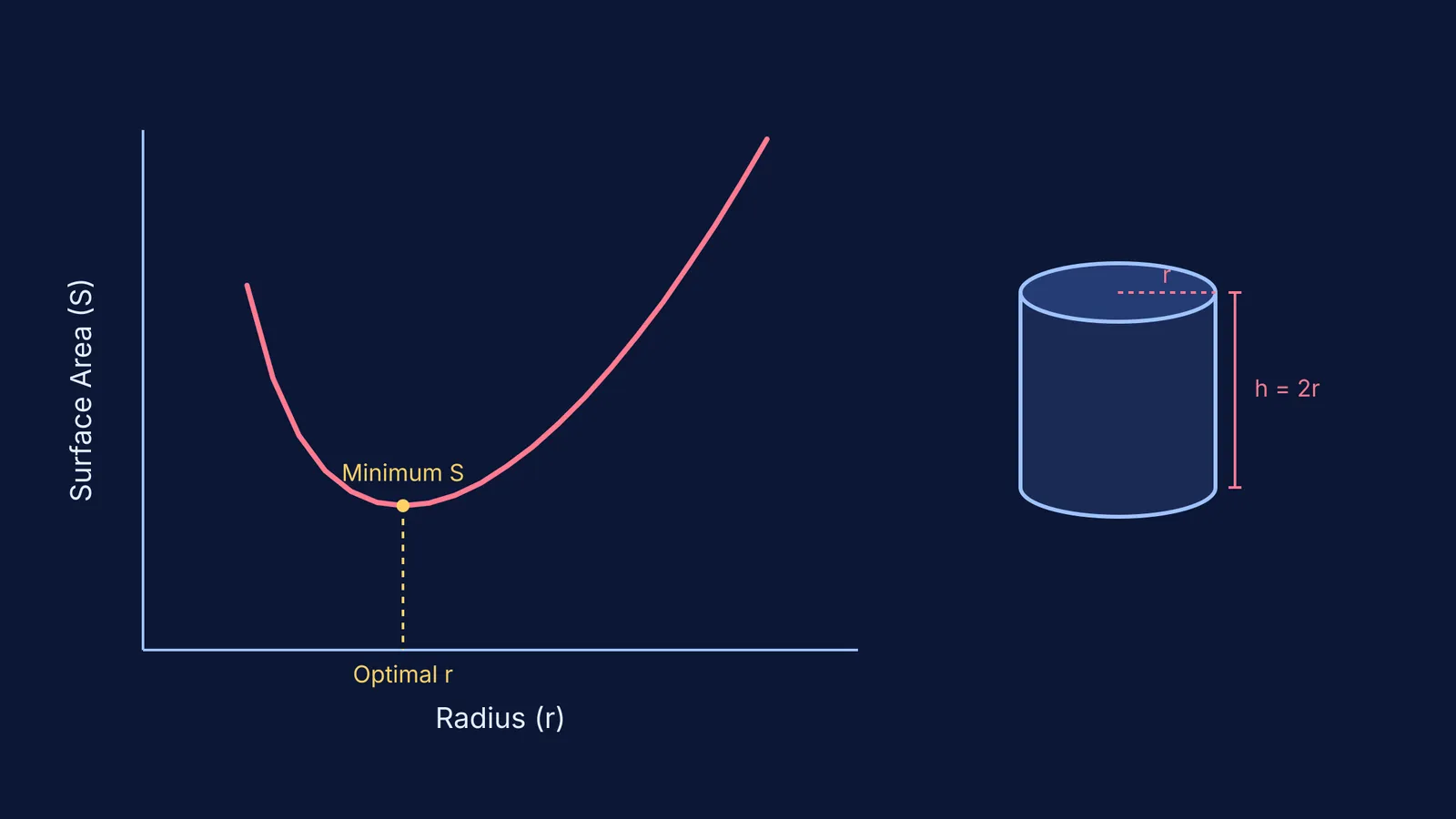
Now we have the surface area entirely in terms of the radius r. To find the minimum, we differentiate S with respect to r and set the derivative to zero.
dS/dr = 4πr - 2V/r²
Set the derivative to zero to find the turning point: 4πr - 2V/r² = 0 4πr = 2V/r²
Multiply both sides by r²: 4πr³ = 2V 2πr³ = V
If you want to understand how second derivatives prove you have found a turning point rather than an inflection, read our guide on Second-order derivatives: proving relations like y″ + y = 0.
Why is height equal to diameter?
We found that the surface area is minimised when the volume satisfies V = 2πr³. But what does this tell us about the dimensions of the cylinder?
Let's substitute our original volume formula (V = πr²h) back into this result: πr²h = 2πr³
Divide both sides by πr²: h = 2r
This is the key rule: a closed cylinder with a fixed volume has the minimum possible surface area when its height is exactly twice its radius, which means its height equals its diameter.
If you make a mistake in a long differentiation sequence like this, the Fermi Problem Library will show you the exact step where you went wrong, explaining the reasoning rather than just printing the final answer.
A worked example: the 500 cm³ can
Let's test this with real numbers. Suppose a manufacturer wants to make a soup can that holds exactly 500 cm³ of liquid.
Using the relationship V = 2πr³: 500 = 2πr³ r³ = 500 / 2π r³ = 250 / π ≈ 79.58
Taking the cube root gives a radius of r ≈ 4.3 cm. Because h = 2r, the ideal height is h ≈ 8.6 cm.
According to Paul's Online Math Notes, a 500 cm³ container mathematically achieves the lowest possible surface area when its radius is 4.3 cm and its height is 8.6 cm.
Why aren't real beverage cans square?
If you look at the cans in your fridge, their heights are usually much greater than their diameters. In North America, the standard beverage can has a volume of 355 ml.
Why do manufacturers ignore the calculus? It comes down to human factors and material costs. The lid of a drink can must be thick and rigid to support the pull-tab opening mechanism, meaning the top uses significantly more expensive aluminium than the paper-thin side walls. When the cost of the top is higher than the sides, the optimal shape shifts to become taller and narrower to shrink the expensive lid. The standard shape is also easier to grip in one hand.
To keep reviewing calculus applications, try our guide on finding the Absolute maximum and minimum on a closed interval: endpoint check.


