On this page
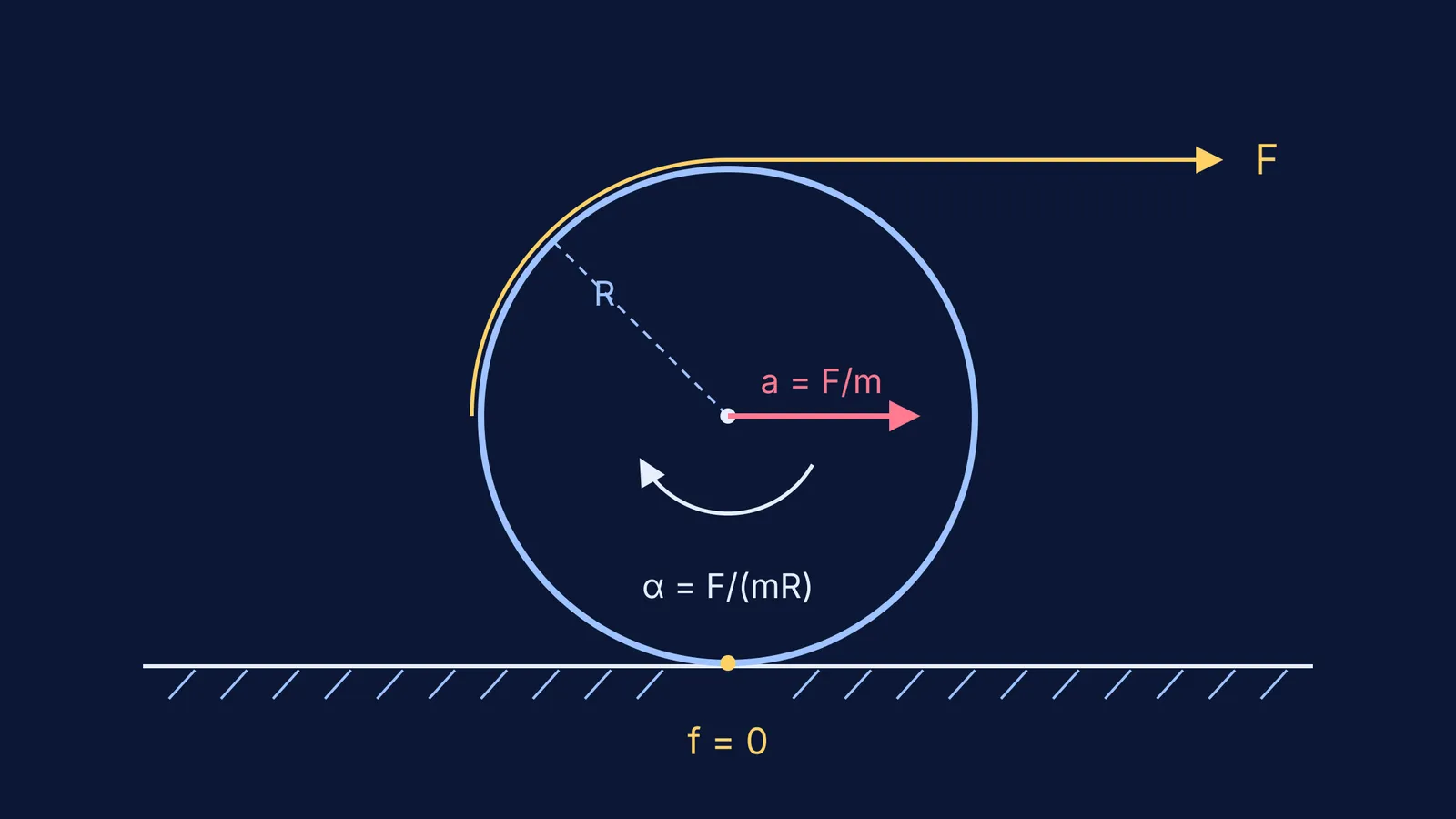
A thin ring of mass m and radius R stands on a rough horizontal floor. A light string is wrapped around it and pulled horizontally with force F, so the string leaves the ring at its very top. You are asked for the acceleration of the centre, the angular acceleration, and the friction force, including its direction.
The answer surprises many students: friction is zero. Here is the working, a numerical example and a quick check.
What equations do you need for a ring pulled by a string?
Newton's second law for the centre of mass: net force = m × a.
Newton's second law for rotation: the sum of the torques equals the moment of inertia times the angular acceleration, τ = Iα, as stated in OpenStax University Physics, section 10.7.
Rolling without slipping: a = Rα, because the contact point is at rest relative to the surface (OpenStax University Physics, section 11.1).
For a thin ring about its central axis, I = mR², because all of the mass sits at the same distance R from the axis (HyperPhysics, moment of inertia of a hoop).
How do you find the linear and angular acceleration?
You do not know which way friction points, so assume it points forward (along F) and call it f. If the answer comes out negative, it points backward.
Forces on the centre of mass: F + f = ma.
Torques about the centre: F at the top turns the ring clockwise with torque FR; a forward f at the bottom turns it anticlockwise with torque fR. So FR − fR = mR²α.
Rolling condition (OpenStax, rolling motion): α = a/R. Put this into step 2 and divide by R: F − f = ma.
Add the equations from steps 1 and 3: 2F = 2ma, so a = F/m.
Then α = a/R = F/(mR).
Put a back into step 1: f = ma − F = 0.
Worked example: take m = 2 kg, R = 0.5 m and F = 10 N. Then a = 10/2 = 5 m/s² and α = 5/0.5 = 10 rad/s². Friction is 0 N, whatever the coefficient of friction is.
Which way does friction act on the ring?
Neither way. With f = 0, the force F alone gives a = F/m, and its torque alone gives α = F/(mR). These two values already satisfy a = Rα, so the floor has nothing to correct.
That has a striking consequence: a ring starting from rest would roll without slipping even on a frictionless floor, such as smooth ice. The equations above never needed friction to be non-zero.
Many students assume friction always opposes motion and draw it backward. Friction opposes the slipping that would happen without it, and here no slipping would happen.
What changes for a disc, cylinder or sphere?
Write the moment of inertia as I = kmR², where k = 1 for a ring. Redo the same steps and you get a = 2F/[(1 + k)m] and f = F(1 − k)/(1 + k).
k = 1 (ring): f = 0.
k less than 1 (any body with mass inside the rim, such as a solid disc, cylinder or sphere): f is positive, so friction points forward, in the same direction as F.
The forward friction case for a solid cylinder is worked through in our post on why friction acts forward on a cylinder pulled at the top. If you want the related incline question, see minimum friction for pure rolling on an incline, shape by shape.
What mistakes cost marks on this problem?
Fixing friction backward before solving. Assume a direction, then let the sign tell you.
Forgetting the torque of F. The string acts at the top, at distance R from the centre, so it both pushes and turns the ring.
Using the wrong moment of inertia. A ring is mR², not the disc value.
Writing μN for friction. Static friction in rolling is whatever value the equations need, up to its maximum. Here that value is zero.
If the matching of force and torque equations still feels shaky, our table of linear and rotational motion analogues, side by side lines up F = ma with τ = Iα. For more practice, the Fermi Problem Library has worked problems with a step-by-step solver that explains the reasoning rather than printing an answer. If it is hard to picture the string unwinding while the ring rolls, the Fermi Simulation Lab has interactive simulations for ideas that are easier to see than to read.
Try the same problem next with the string pulled from the centre instead of the top, and predict the direction of friction before you solve it.