On this page
You are halfway through an electrochemistry question. Your textbook gives zinc as −0.76 V, and a friend's notes say +0.76 V. Neither is wrong. They describe the same half-cell from opposite directions.
What is the difference between reduction potential and oxidation potential?
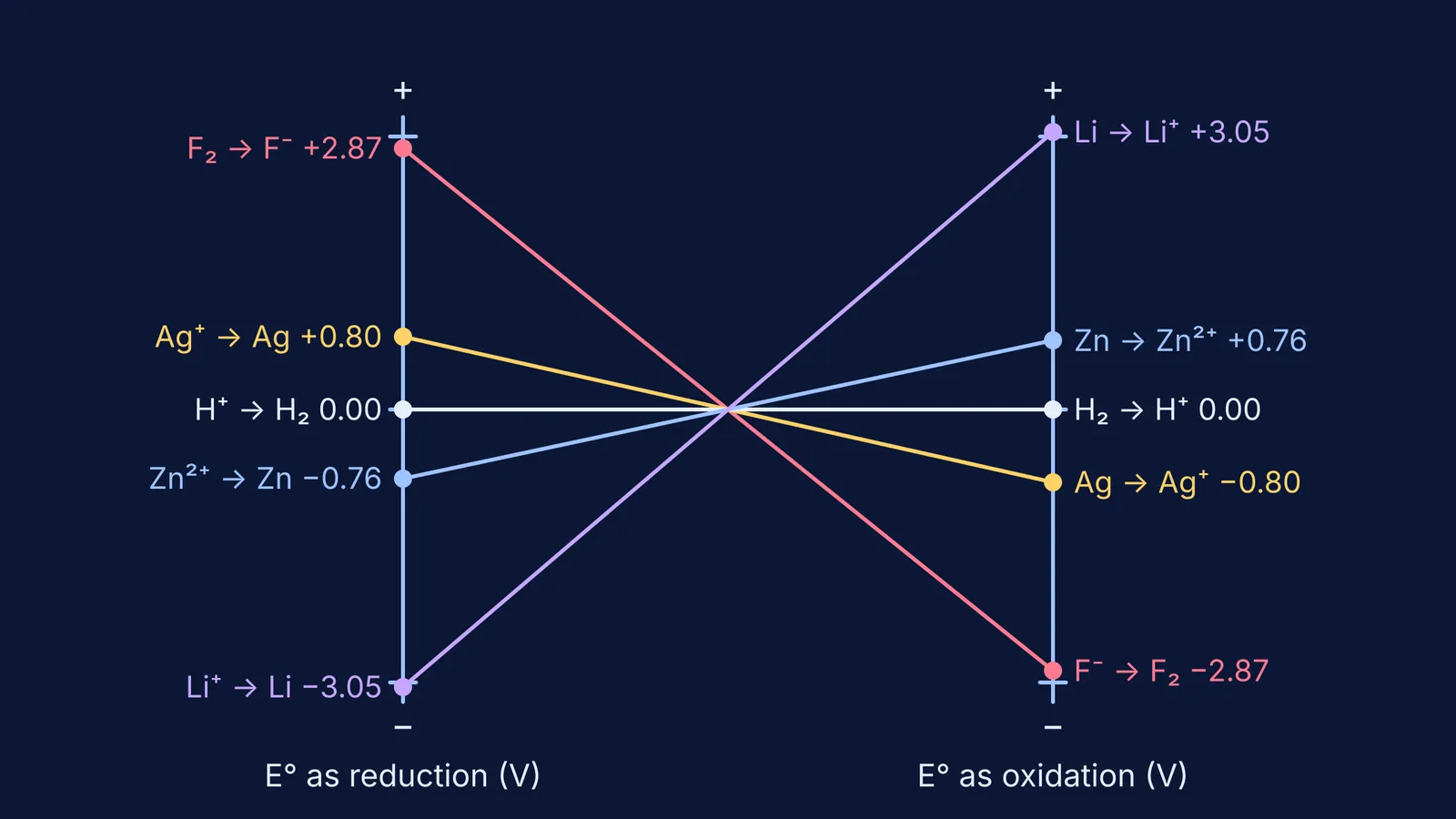
A reduction potential measures how strongly a couple's oxidised form takes in electrons. An oxidation potential describes the same half-reaction run backwards, with electrons given out. For the same couple, the standard oxidation potential and the standard reduction potential are equal in size and opposite in sign: E°(oxidation) = −E°(reduction) (LibreTexts, Standard Reduction Potential/Electrochemistry/Redox_Chemistry/Standard_Reduction_Potential)).
The NCERT Class 12 table lists Zn²⁺ + 2e⁻ → Zn(s) at −0.76 V and Cu²⁺ + 2e⁻ → Cu(s) at +0.34 V, at 298 K (NCERT Class 12 Chemistry, Unit 2: Electrochemistry). So the oxidation potential of zinc, for Zn → Zn²⁺ + 2e⁻, is +0.76 V, and that of copper is −0.34 V. Only the direction of the arrow changed.
Why does reversing the reaction flip the sign?
The link is Gibbs energy. The NCERT chapter gives ΔrG° = −nFE° for a cell reaction (NCERT Class 12 Chemistry, Unit 2). Reverse a reaction and its Gibbs energy change reverses sign. Since n and F stay positive, E° has to change sign too. A general chemistry text states the rule directly: "Whenever a half-reaction is reversed, the sign of E° corresponding to that reaction must also be reversed" (LibreTexts, Standard Reduction Potentials/19%3A_Electrochemistry/19.04%3A_Standard_Reduction_Potentials)).
The same NCERT section notes that cell potential is an intensive quantity while ΔrG is extensive. Doubling a reaction doubles ΔrG but leaves E unchanged. That is why you never multiply E° by 2 when you multiply a half-reaction by 2 to balance electrons in a cell reaction. Combining two half-reactions into a third half-reaction is different: there you add ΔG° values, not E°.
Why do tables list only reduction potentials?
Chemists once worked with two sign conventions. In one, the sign of E switched when you reversed the half-reaction as written; in the other, it did not. In 1953 in Stockholm, IUPAC accepted both but recommended that only the quantity under the Gibbs–Ostwald–Stockholm convention be called "the electrode potential" (Wikipedia, Electrode potential).
Your textbook follows this convention: "According to IUPAC convention, standard reduction potentials are now called standard electrode potentials" (NCERT Class 12 Chemistry, Unit 2). Writing every entry in one direction lets one table rank every couple. In NCERT's Table 2.1, F₂/F⁻ sits at the top at +2.87 V, making fluorine the strongest oxidising agent, and Li⁺/Li sits at the bottom at −3.05 V, making lithium metal the most powerful reducing agent in aqueous solution.
The zero at H⁺/H₂ is itself a convention; see why absolute electrode potential cannot be measured.
How do you convert and use them in a cell?
Take a zinc–silver cell under standard conditions. From NCERT Table 2.1 (NCERT Class 12 Chemistry, Unit 2): Ag⁺ + e⁻ → Ag(s) is +0.80 V, and Zn²⁺ + 2e⁻ → Zn(s) is −0.76 V.
Decide which couple is reduced. The higher reduction potential takes the electrons, so silver (+0.80 V) is the cathode and zinc is the anode.
Method A, both as reductions: E°cell = E°cathode − E°anode = 0.80 − (−0.76) = 1.56 V. This is the form NCERT uses, E° = E°R − E°L.
Method B, one oxidation plus one reduction: convert zinc to its oxidation potential, +0.76 V, then add: 0.80 + 0.76 = 1.56 V.
Balance electrons: Zn + 2Ag⁺ → Zn²⁺ + 2Ag. The silver half-reaction is doubled, but its E° stays 0.80 V.
Check the sign: a positive E°cell means a negative ΔrG°, so the reaction is spontaneous as written under standard conditions.
Both methods agree because subtracting a reduction potential is the same as adding the matching oxidation potential. Mixing them is where marks go. Convert zinc to +0.76 V and then also subtract it, and you get 0.80 − 0.76 = 0.04 V: wrong, but small enough to look believable. The same rule gives NCERT's Daniell cell value: 0.34 − (−0.76) = 1.10 V.
The anode and cathode signs change meaning between cell types, which is covered in electrolytic vs galvanic cells and the anode trap.
What should you check before writing the answer?
Is the value I copied a reduction potential? In NCERT and other IUPAC-style tables, it always is.
Is my half-reaction written in the same direction? If not, flip the sign once.
Am I using one method only: subtract two reduction potentials, or add one oxidation and one reduction?
Did I leave E° unchanged when I multiplied a half-reaction?
Is E°cell positive for the reaction I claim is spontaneous?
More traps are in four common electrochemistry numerical mistakes. To practise, the Fermi Problem Library has worked problems with a step-by-step solver that explains the reasoning rather than printing an answer. If the idea of an electrode potential still feels shaky, the Fermi Concept Library gives each concept in chemistry its own lesson and its place in the map.