On this page
Anhydrous AlCl3 turns up above the arrow in a lot of organic reactions in Class 11 and 12, so it is worth being able to explain its role in two lines. One idea covers almost every case, plus one reason it has to be dry.
What does anhydrous AlCl3 actually do?
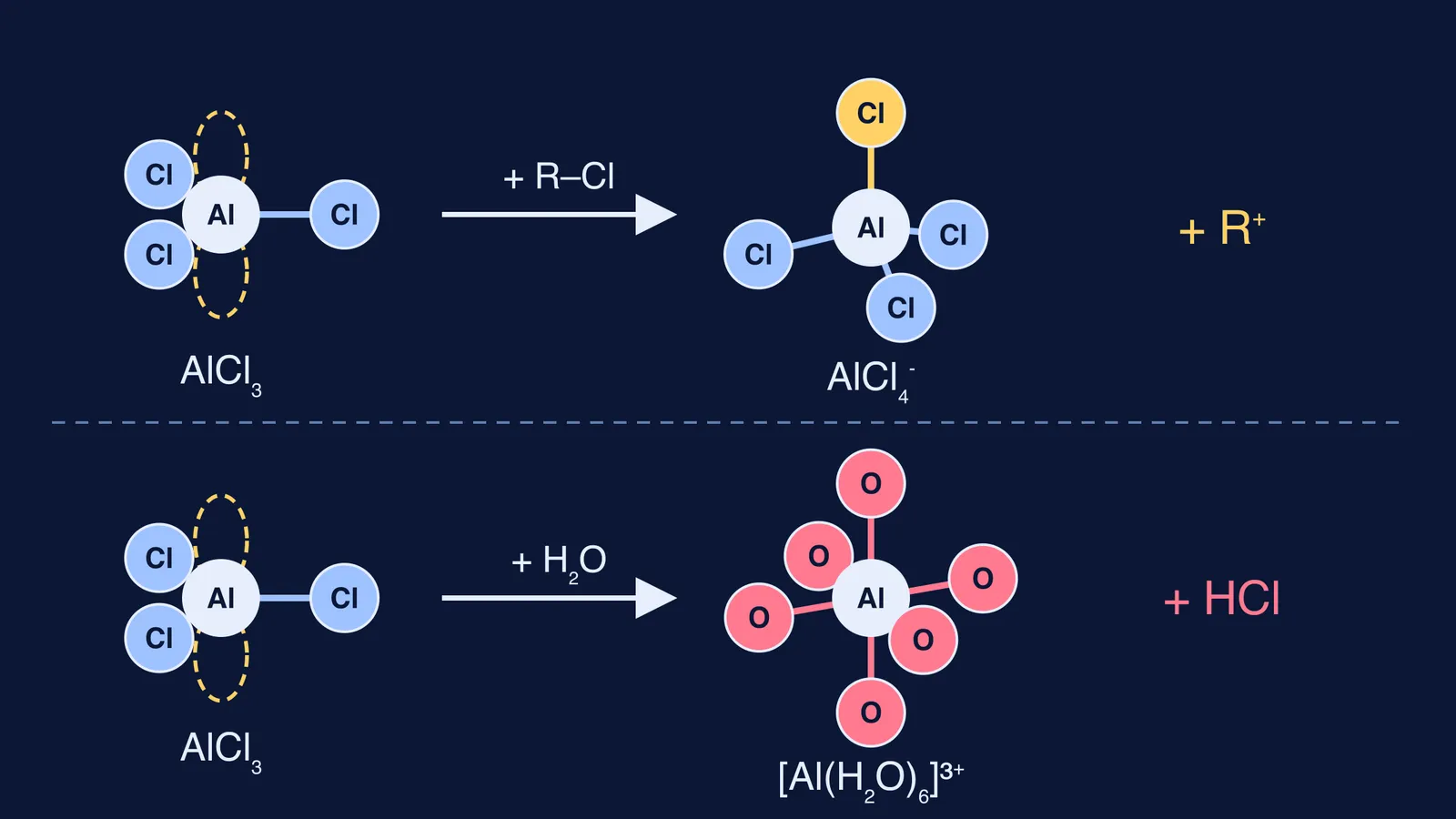
Anhydrous AlCl3 is a Lewis acid: an electron-pair acceptor. Its aluminium has an empty orbital, so it grabs a chloride (or another lone pair) from whatever reagent you add.
The NCERT Class 11 chapter on hydrocarbons says it in one line: during chlorination, alkylation and acylation of benzene, anhydrous AlCl3, being a Lewis acid, helps generate the electrophile Cl+, R+ or RCO+ (the acylium ion) by combining with the attacking reagent. The AlCl4- formed in that step later removes a proton from the ring, which gives back AlCl3 and releases HCl.
So for the benzene reactions the pattern is the same:
AlCl3 takes a chloride from the reagent and becomes AlCl4-.
What is left behind is a strong electrophile, or something that behaves like one.
The electrophile attacks benzene, and AlCl4- removes the extra proton from the ring as HCl.
Which reactions use anhydrous AlCl3?
In Friedel-Crafts alkylation, benzene and chloromethane with anhydrous AlCl3 give toluene and HCl, as the same NCERT hydrocarbons chapter shows. Here AlCl3 makes CH3+. NCERT also asks why 1-chloropropane gives isopropylbenzene, not n-propylbenzene. According to the Friedel-Crafts reaction article, primary alkyl halides undergo carbocation rearrangement and give almost exclusively the rearranged product; here that means the more stable secondary carbocation. The same source notes a second problem: alkyl groups activate the ring, so the product can be alkylated again.
In Friedel-Crafts acylation, benzene and acetyl chloride (or acetic anhydride) with anhydrous AlCl3 give acetophenone. The electrophile is the acylium ion, CH3CO+. One catch is worth knowing: the ketone product forms a complex with AlCl3, so a stoichiometric amount of the "catalyst" is needed, as the Friedel-Crafts reaction article explains. For more on when this reaction fails, read our post on why Friedel-Crafts fails with nitrobenzene and aniline.
In Gattermann-Koch formylation, the NCERT Class 12 chapter on aldehydes, ketones and carboxylic acids says benzene treated with carbon monoxide and hydrogen chloride in the presence of anhydrous aluminium chloride or cuprous chloride gives benzaldehyde. Formyl chloride is too unstable to isolate, so it has to be made in the flask, as the Friedel-Crafts article notes, and AlCl3 activates it like an acyl chloride. Our Gattermann-Koch reaction walkthrough covers it step by step.
In the isomerisation of alkanes there is no benzene at all. NCERT's hydrocarbons chapter states that n-alkanes heated with anhydrous aluminium chloride and HCl gas isomerise to branched alkanes; n-hexane gives 2-methylpentane and 3-methylpentane as major products.
Why must AlCl3 be anhydrous?
The chemistry reason: water is a Lewis base, and it fills the empty orbital. Aluminium chloride fumes in moist air and hisses in water as water molecules replace the chloride ligands to form the hexahydrate [Al(H2O)6]Cl3. Because every site on aluminium is now taken, the hydrate is of little value as a Friedel-Crafts catalyst. Heating does not fix it either: the hydrate loses HCl and breaks down to aluminium hydroxide or alumina rather than going back to anhydrous AlCl3, according to the same source.
The safety reason: the US NOAA's CAMEO Chemicals record for anhydrous aluminium chloride says it fumes in moist air, forming a large amount of hydrogen chloride gas. When it is spilled into an excess of water, half the maximum theoretical yield of HCl gas forms within 0.02 minutes, according to that record. Hence the tightly closed bottle and dry glassware.
The same logic, a reagent destroyed by a stray lone pair or proton, explains why a Grignard reagent must be made in dry ether.
How do you write the answer in an exam?
Use this three-step template for any "role of anhydrous AlCl3" question:
Name it: "AlCl3 acts as a Lewis acid."
Show it: write the equation that makes the electrophile.
Justify "anhydrous": "Water would convert AlCl3 to the hydrated ion, which has no free site to accept an electron pair."
Worked example, benzene to acetophenone:
Step 1: CH3COCl + AlCl3 → CH3CO+ + AlCl4-
Step 2: CH3CO+ attacks benzene to give the arenium ion, a carbocation stabilised by resonance.
Step 3: AlCl4- removes H+, giving acetophenone, HCl and AlCl3 again.
Add one line: the ketone complexes AlCl3, so at least one equivalent is used.
If you keep mixing up which electrophile each reagent makes, the Fermi Problem Library has worked problems with a step-by-step solver that explains the reasoning rather than printing an answer. If the gap is Lewis acids themselves, the Fermi Concept Library gives each concept its own lesson.
Next step: write the template for all four reactions from memory, then check it against NCERT.