On this page
Saying the ray goes straight because it passes through the centre describes the rule but does not explain it. The real reason is geometry you already know from the glass-slab experiment.
What is the optical centre of a lens?
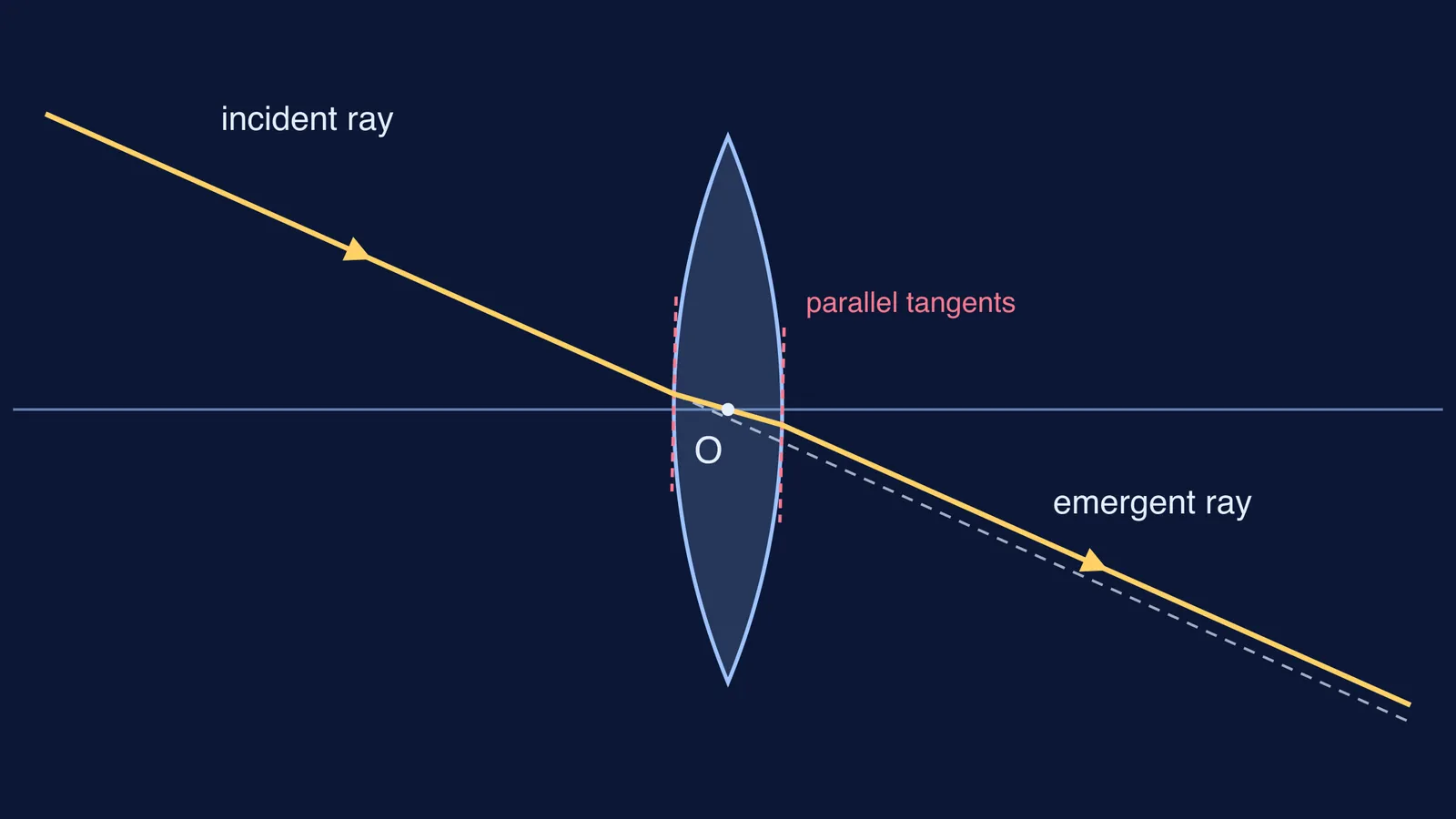
The optical centre is the central point of a lens, usually labelled O, and NCERT states that “a ray of light through the optical centre of a lens passes without suffering any deviation” (NCERT Class 10 Science, Chapter 9). The same chapter deals only with thin lenses, whose aperture is much smaller than their radius of curvature.
University textbooks give the same rule for both lens types: “A ray passing through the center of either a converging or a diverging lens is not deviated” (OpenStax University Physics Volume 3, Thin Lenses).
Why does the ray through the optical centre go undeviated?
Start with the slab. When light crosses a rectangular glass slab, NCERT explains that the bending at the two opposite parallel faces is “equal and opposite”, so the ray emerges parallel to the incident ray but “shifted sideward slightly” (NCERT Class 10 Science, Chapter 9).
Now look at a lens near its middle. Each face is part of a sphere, and where the principal axis crosses them, both faces are perpendicular to that axis. That makes the two surfaces parallel to each other there. If you zoom in on the thin sliver of glass around O, you are looking at a tiny parallel-sided slab.
So a ray aimed at O bends towards the normal as it enters, then bends away from the normal by the same amount at the parallel exit face. The two bends cancel, and the ray leaves in its original direction. HyperPhysics describes the ray as “jogged downward on the near side of the lens and back up on the exit side”, adding that the slight offset “is neglected for thin lenses” (HyperPhysics, Ray Diagrams).
How small is the sideways shift?
For a slab of thickness t, the lateral shift is d = t sin(i − r) / cos r, where i is the angle of incidence and r is the angle of refraction (Vedantu, lateral displacement). To find r, use Snell's law, n1 sin θ1 = n2 sin θ2 (OpenStax, Refraction). NCERT's table gives crown glass a refractive index of 1.52 (NCERT Class 10 Science, Chapter 9).
Worked example: a crown-glass lens is 4 mm thick at the centre, and a ray reaches its middle at 30 degrees to the normal.
sin r = sin 30° / 1.52 = 0.329, so r ≈ 19.2°
i − r ≈ 10.8°, and sin 10.8° ≈ 0.187
cos 19.2° ≈ 0.944
d = 4 mm × 0.187 / 0.944 ≈ 0.79 mm
At a gentler 10 degrees, the same lens shifts the ray by only about 0.24 mm. When the object and image distances in your problem are tens of centimetres, a shift of under a millimetre will not show on your diagram. The shift grows in proportion to thickness, though, so thick-lens problems cannot use this shortcut. For the full derivation, see our walkthrough of lateral shift in a glass slab.
How do you use the optical-centre ray in a ray diagram?
The central ray needs no focal point, so draw it first. For any thin lens:
Draw the principal axis and the lens as a thin vertical line. Mark O, F1 and F2.
From the top of the object, draw a straight ruled line through O and carry it on. Do not bend it at the lens.
Draw a second ray parallel to the axis. After a convex lens, it passes through F2. After a concave lens, it travels as if it came from F1.
The top of the image is where the two rays meet. For a virtual image, it is where their backward extensions meet.
Check that the object top, O and the image top lie on one straight line.
The undeviated ray also explains magnification: the two triangles on either side of O are similar, so image height divided by object height equals image distance divided by object distance.
Common slips: kinking the central ray at the lens, spreading it outward for a concave lens, and using the shortcut on a thick lens. To practise, see our guides to convex lens image positions in Class 10 and Class 12 ray diagrams for the board exam.
If the slab picture is still hard to imagine, the Fermi Simulation Lab has interactive simulations for the ideas that are easier to see than to read. For lens numericals, the Fermi Problem Library has worked problems with a step-by-step solver that explains the reasoning rather than printing an answer.
The reason in one line: two parallel faces, two equal bends, no net turn.