On this page
In 1747 a ship's surgeon tested six cures for scurvy, and one clearly won. He also picked who got which cure, and that detail explains why modern trials leave the choice to chance.
What is a randomised controlled trial?
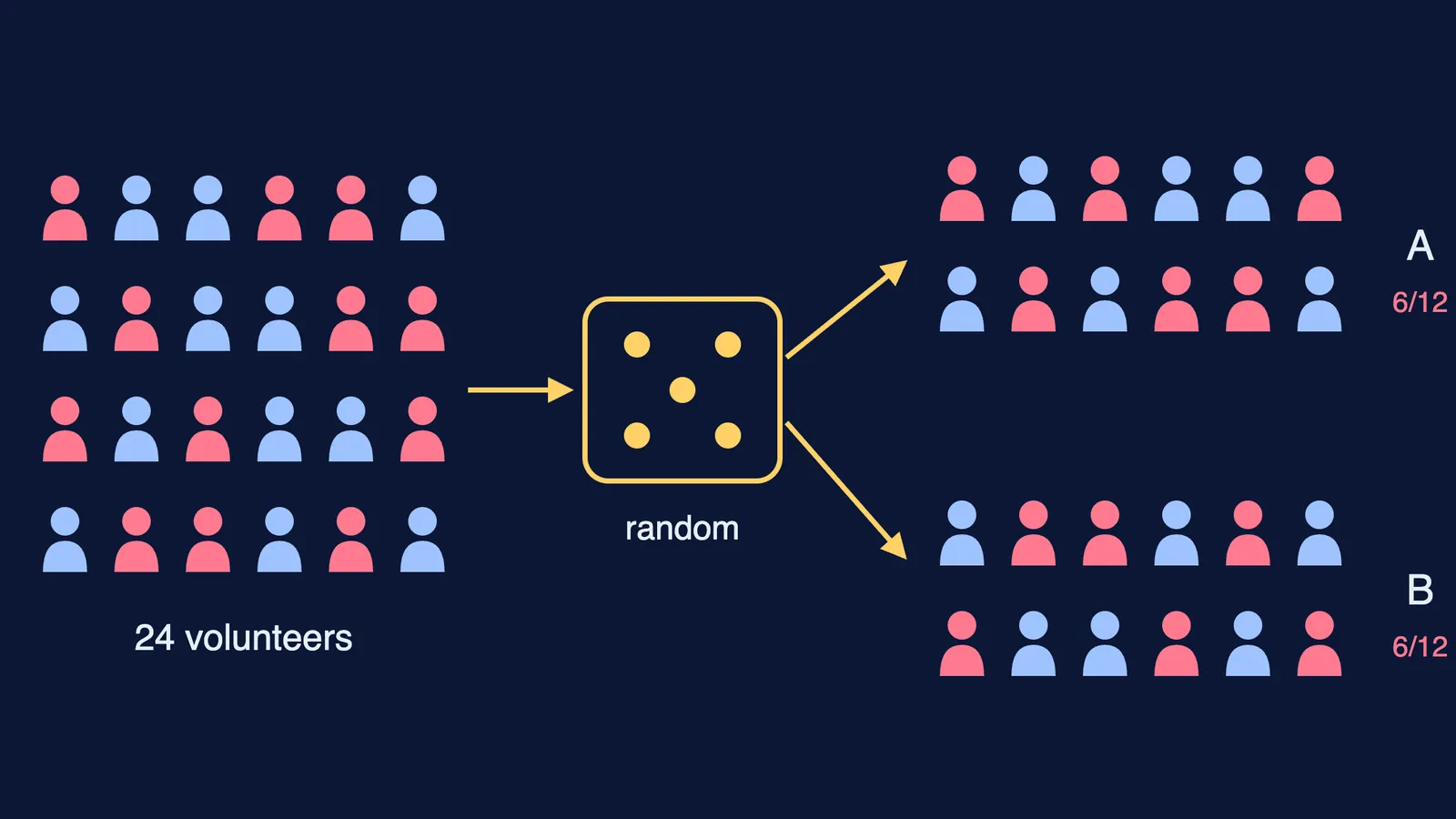
A randomised controlled trial, or RCT, is an experiment that splits volunteers into groups by chance, gives one group the treatment and the other a comparison, and measures both the same way. The comparison group is the "controlled" part; our post on why experiments need a control group explains it with biology practicals.
Kenneth Schulz and David Grimes, writing in The Lancet in 200207683-3), call the RCT "the gold standard of clinical research" and say participants "should be assigned to comparison groups based on a random process", the simplest being like repeated fair coin-tossing.
What did James Lind's scurvy trial show?
On 20 May 1747, the naval surgeon James Lind chose twelve sailors with scurvy on board the Salisbury, as he recorded in his 1753 Treatise of the Scurvy. He wrote that "their cases were as similar as I could have them", kept them on one diet, and gave each pair a different remedy: cider, elixir of vitriol, vinegar, sea water, two oranges and one lemon a day, or a paste recommended by a hospital surgeon. The citrus pair did best, and one of them was "fit for duty" after six days, according to the passage reproduced in Arun Bhatt's history of clinical research.
For 1747, comparing remedies side by side in similar patients was a well-controlled test. But read one more line: "Two of the worst patients were put on a course of sea-water." Lind, not chance, decided who got what. If the sickest men all receive one remedy, it can look worse for reasons that have nothing to do with the remedy.
Why does random assignment matter?
People who choose groups bring patterns with them, even honest people. A doctor may give a new drug to patients who look strong; a teacher may put the keenest students into a new study method. Then the groups differ before the test begins. Chance has no favourites, so in a large enough trial the differences you know about, and ones nobody thought to measure, tend to even out.
Randomisation only works if nobody can see the next allocation coming, a safeguard called allocation concealment. In the Medical Research Council's streptomycin trial for tuberculosis, published in the BMJ in 1948, each patient's group came from "random sampling numbers" drawn up by the statistician Austin Bradford Hill and kept in "sealed envelopes", as quoted in Bhatt's review, which calls it the first randomised controlled trial.
Skipping this step distorts results. A 1995 JAMA study of 250 controlled trials in pregnancy and childbirth research found that trials with inadequately concealed allocation exaggerated treatment effects (measured as odds ratios) by 41% compared with trials that concealed allocation properly.
What is blinding in a clinical trial?
Blinding means keeping trial participants, the people giving treatment, or the people measuring outcomes unaware of who received which treatment, so that knowing cannot influence them, as Schulz and Grimes define it in their 2002 Lancet paper on blinding07816-9). Because "double blind" means different things to different people, they ask researchers to state exactly who was blinded.
Blinding matters most when judging an outcome takes judgement. A 2012 BMJ systematic review of 21 trials with blinded and non-blinded assessors of the same, mostly subjective, outcome found that the non-blinded assessors exaggerated treatment effects (as odds ratios) by 36% on average. Blinding also separates a treatment's effect from people's expectations, which our explainer on the placebo effect, blinding and nocebo covers.
How do you run a fair test of a study habit?
Say your class wants to know whether a short quiz at the start of each maths lesson raises unit-test marks.
Unfair: the teacher picks students who "will take it seriously" for the quiz group. They might have scored higher anyway.
Fair: write every roll number on a chit, shuffle, and draw half for the quiz group.
Concealed: one person keeps the list, and nobody swaps students after the draw.
Blinded where possible: whoever marks the test should not know who took the quizzes. Students cannot be blinded, so note that as a limit.
Measured the same way: same test, same day, same marking scheme.
When a headline says a habit, food or app "works", ask five questions:
Was there a comparison group?
Did chance decide who went into which group?
Could anyone predict or change the next allocation?
Who was blinded: participants, the people giving treatment, the people measuring?
Was the outcome measured in the same way for every group?
These questions also guard against confirmation bias, the pull to believe results that match what you already thought. If the probability behind a coin toss feels shaky, the Fermi Concept Library covers every concept in physics, chemistry, biology, mathematics and computing, each with its own lesson, so you can close that gap first.
Try the five questions on the next health claim shared in your family group.