On this page
Before glass pH meters were common, a quick way to measure pH was to stir a pinch of quinhydrone into a solution, dip in a platinum wire and read a voltage. It still turns up in Class 12 electrochemistry problems. Here is how it works and why it stops working above pH 8.
What is a quinhydrone electrode?
Quinhydrone is a crystalline addition compound of benzoquinone (Q) and hydroquinone (QH₂), and dissolving it gives the two in equal proportions, as LaMer and Parsons described in Experimental Biology and Medicine in 1923. The method itself came from E. Biilmann, whose 1921 paper in Annales de Chimie they cite.
The reaction at the wire is:
Q + 2H⁺ + 2e⁻ ⇌ QH₂
The platinum only carries electrons (LaMer and Parsons actually preferred gold). Because two H⁺ ions go with every two electrons, the potential tracks pH like a hydrogen electrode, with no hydrogen gas needed.
Write the Nernst equation at 25 °C: E = E° − (0.059/2) log([QH₂]/([Q][H⁺]²)). Quinhydrone keeps [Q] = [QH₂], so those terms cancel and you are left with E = E° − 0.059 pH. If that step feels shaky, our post on the Nernst equation and the hydrogen electrode builds it from scratch.
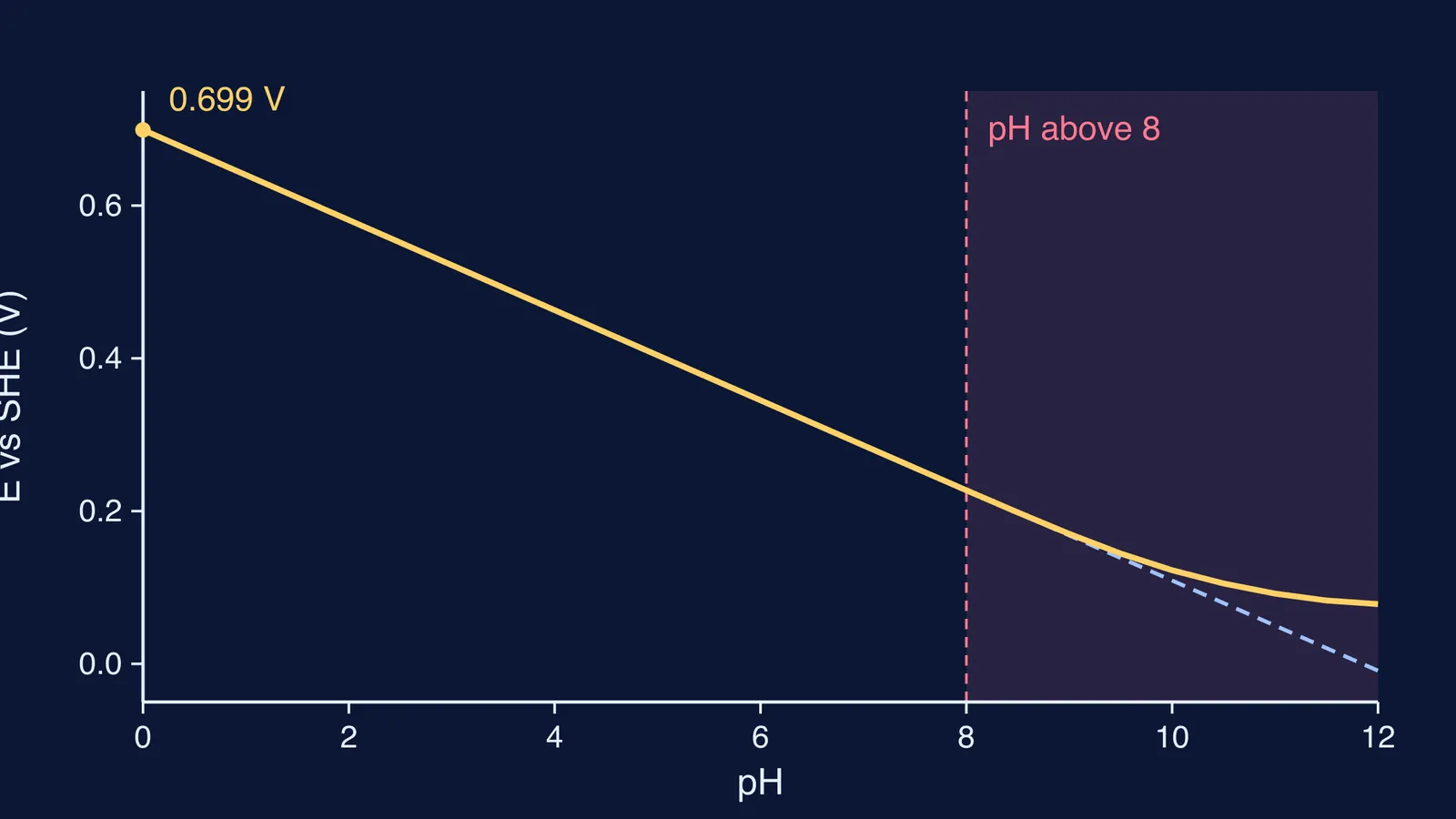
LaMer and Parsons gave the normal potential of the quinhydrone system as +0.6990 V on the hydrogen-electrode scale at 25 °C (LaMer and Parsons, 1923). In the same paper they gave a temperature coefficient of −0.77 mV per degree, so E° is about 8 mV lower at 35 °C.
How do you calculate pH from a quinhydrone electrode reading?
Take a typical textbook cell, with a saturated calomel electrode (SCE) as the reference on the left:
Hg | Hg₂Cl₂ | KCl (sat) || test solution + quinhydrone | Pt
Suppose the problem gives E(SCE) = 0.242 V and a measured emf of 0.280 V, with platinum as the positive terminal.
Write E(cell) = E(right) − E(left) = (0.699 − 0.059 pH) − 0.242.
Simplify: E(cell) = 0.457 − 0.059 pH.
Substitute: 0.280 = 0.457 − 0.059 pH, so 0.059 pH = 0.177.
Solve: pH = 3.0.
Now ask where the cell changes sign. E(cell) = 0 when pH = 0.457/0.059, about 7.7. Above that, the quinhydrone side becomes the negative terminal, close to where the electrode stops being trustworthy. The 0.242 V term depends on your reference; see calomel and silver/silver chloride reference electrodes.
For practice, the Fermi Problem Library has worked problems with a step-by-step solver that explains the reasoning rather than printing an answer, which helps when the mistake is a sign, not a number.
Why does the quinhydrone electrode fail above pH 8?
The whole method rests on [Q] = [QH₂]. In alkaline solution, two things break that ratio, and both are set out in the 1923 paper.
First, hydroquinone is a weak acid with two OH groups. LaMer and Parsons used ionisation constants of 1.8 × 10⁻¹⁰ and 4 × 10⁻¹² and showed the correction is less than 0.2 mV in solutions more acid than pH 8.0, then grows rapidly. Putting those constants into their equation, we get about 2 mV of error at pH 9 (0.04 pH units), 14 mV at pH 10 (0.23 pH) and 42 mV at pH 11 (0.71 pH), as the diagram above shows.
Second, air oxidises hydroquinone to quinone. LaMer and Parsons found this becomes appreciable on vigorous shaking in air above about pH 7.8, and in their titrations the gap from the hydrogen electrode was negligible up to pH 8.0. They also report that Biilmann found the potential stable in a phosphate buffer at pH 6.81 but unstable in a borate solution at pH 9.24.
Both effects leave less free QH₂ than Q. The potential rises, and the electrode reads a pH lower than the true one.
Oxidising and reducing substances upset the ratio too. Dean and Walker (1934) noted the method was restricted to soils below pH 8.0 to 8.5; other workers had found that large amounts of manganese dioxide caused errors. A US Bureau of Standards study dated December 1929 found the errors in tanning extracts, which contain polyphenols, too great to disregard.
Can you trust this quinhydrone reading?
Is the pH below about 8? If not, switch to a glass electrode; here is how a glass-electrode pH meter works.
Is the solution free of strong oxidising or reducing agents?
Is it free of polyphenols such as tannins, which can upset the quinone ratio?
Did you read it quickly, without shaking the solution in air?
Did you note the temperature and correct E° (about −0.77 mV per degree, per LaMer and Parsons)?
If Nernst or electrode potentials still feel loose, the Fermi Concept Library gives each concept its own lesson; then try one cell problem with a calomel reference and one with a hydrogen reference.