On this page
Most students learn "arteries carry oxygenated blood, veins carry deoxygenated blood" in middle school. Then they meet the pulmonary vein, which does the opposite. The rule was never really about oxygen. It is about direction, and once you see that, the "exception" stops being one.
Why does the pulmonary vein carry oxygenated blood?
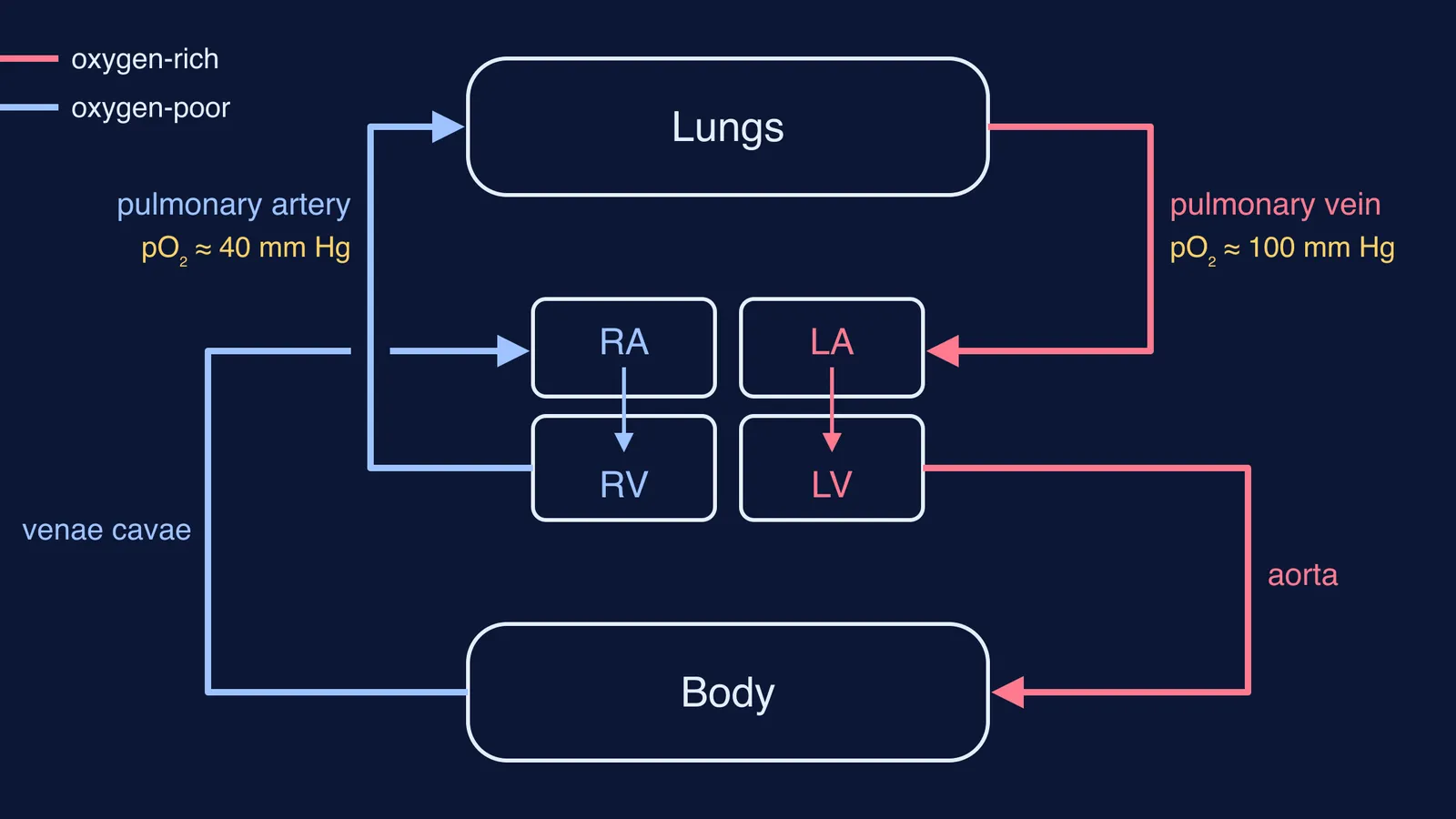
It is the vessel that brings blood back to the heart from the lungs, and the lungs are where blood picks up oxygen. In OpenStax Anatomy and Physiology 2e, blood "returns to the left atrium high in oxygen via one of the four pulmonary veins." The left atrium passes it to the left ventricle, which pumps it into the aorta and out to the body.
So the pulmonary vein does what every vein does: it carries blood back to the heart. This return trip just starts right after the blood has been oxygenated.
Are arteries and veins named by oxygen or by direction?
By direction. OpenStax defines an artery as "a blood vessel that carries blood away from the heart" and a vein as a vessel "that returns blood to the heart". Neither definition mentions oxygen.
The oxygen pattern you learnt holds for the systemic circuit, the loop out to the body, and that loop holds most of your blood. The same chapter says systemic veins alone contain about 64 percent of the blood volume at any given time. In the pulmonary circuit the pattern flips: pulmonary arteries carry blood low in oxygen to the lungs, and pulmonary veins "return freshly oxygenated blood from the lungs to the heart".
A handy way to hold it: A for artery, A for away. Direction is the definition. Oxygen content depends on which loop the vessel belongs to.
Follow one red blood cell from the lungs to the left atrium
Here is the trip, step by step. The route comes from the OpenStax heart anatomy chapter, and the oxygen partial pressures (pO2, in mm Hg) come from the OpenStax gas exchange chapter.
The right ventricle pumps deoxygenated blood into the pulmonary trunk, which splits into the left and right pulmonary arteries. They carry blood away from the heart, so they are arteries. Blood reaching the lung capillaries has a pO2 of about 40 mm Hg.
In the lung capillaries, the blood meets alveolar air with a pO2 of about 104 mm Hg. Oxygen diffuses from high to low pressure, into the blood.
The capillaries join into larger vessels and then into the pulmonary veins. They carry blood towards the heart, so they are veins. Blood in the pulmonary veins has a pO2 of about 100 mm Hg.
The four pulmonary veins empty into the left atrium.
The left atrium sends the blood to the left ventricle, which pumps it into the aorta. Away from the heart, so an artery, and oxygen-rich, which fits the rule you knew.
Look at what changed the oxygen in step 2: the capillaries, not the type of vessel. The name changes at the heart; the oxygen changes at the capillaries.
To see both loops as one figure of eight, read our explainer on double circulation and why your heart runs two loops. For wall thickness, valves and pressure, see the key differences between arteries, veins and capillaries.
Which other veins carry oxygen-rich blood?
The umbilical vein, before birth. In a foetus, the placenta handles gas exchange. OpenStax describes the umbilical vein as carrying "oxygen-rich blood" from the placenta towards the fetal heart, while two umbilical arteries carry oxygen-depleted fetal blood to the placenta. It is the same logic again. The umbilical vein heads towards the heart, so it is a vein, whatever it carries. Our post on how the placenta and umbilical cord exchange materials covers the rest of that system.
This also answers the mirror-image question, "Which artery carries deoxygenated blood?" The pulmonary artery, and in a foetus, the umbilical arteries.
How should you answer this in an exam?
For a two- or three-mark answer, write four sentences in this order:
Definition: "Arteries carry blood away from the heart; veins carry blood towards the heart."
Direction: "The pulmonary vein carries blood from the lungs to the left atrium."
Reason for the oxygen: "Blood is oxygenated in the lung capillaries just before it enters the pulmonary veins."
The pair: "So the pulmonary vein carries oxygenated blood and the pulmonary artery carries deoxygenated blood."
Then test yourself. Cover this page and, for each vessel, say its direction first and its oxygen second: aorta, venae cavae, pulmonary artery, pulmonary vein, umbilical vein. If you started with oxygen, go back and start with direction.
If the two loops are hard to picture, Fermi's AI tutor can draw the figure and check your understanding as it goes. The Fermi Concept Library gives each biology concept its own lesson and a place in the map, so you can see how circulation links to gas exchange.
Next time you trace any vessel, ask one question first: is it leaving the heart or coming back?