On this page
Most stereochemistry questions are about a carbon with four different groups, labelled R or S. A pseudo-asymmetric carbon is the odd one out: two of its groups are built the same way but are mirror images, and it gets a lowercase r or s. The cleanest example is 2,3,4-trihydroxyglutaric acid, HOOC–CH(OH)–CH(OH)–CH(OH)–COOH, which is also a counting question worth getting right before JEE Advanced.
What is a pseudo-asymmetric carbon atom?
IUPAC defines a pseudo-asymmetric carbon atom as a tetrahedral carbon bonded to four different entities, "two and only two of which have the same constitution but opposite chirality sense" (IUPAC stereochemistry glossary).
Its r/s descriptor does not change when the molecule is reflected in a mirror, but it switches between r and s when any two groups are exchanged (IUPAC stereochemistry glossary).
IUPAC's own examples are C-3 of ribaric acid, which is r, and C-3 of xylaric acid, which is s. Both are stereoisomers of 2,3,4-trihydroxypentanedioic acid, the systematic name of trihydroxyglutaric acid (PubChem entry for 2,3,4-trihydroxypentanedioic acid).
Why is C-3 of trihydroxyglutaric acid pseudo-asymmetric?
C-3 carries H, OH and two CH(OH)COOH arms, one through C-2 and one through C-4. The arms have the same constitution, so everything depends on C-2 and C-4.
If C-2 and C-4 have opposite configurations (one R, one S), the two arms are mirror images. C-3 now has four different groups and is pseudo-asymmetric.
If C-2 and C-4 have the same configuration (both R or both S), the two arms are identical. C-3 carries two identical groups, so it is not a stereocentre at all.
PubChem shows the second case clearly: D-arabinaric acid is named (2S,4S)-2,3,4-trihydroxypentanedioic acid, with no descriptor at C-3 (PubChem entry for D-arabinaric acid).
How do you assign r or s to C-3?
You use the usual CIP method with one extra tie-breaker: Sequence Rule 5 says a group with descriptor R ranks above its enantiomorph S (IUPAC 2013 recommendations, P-92.1.3.5).
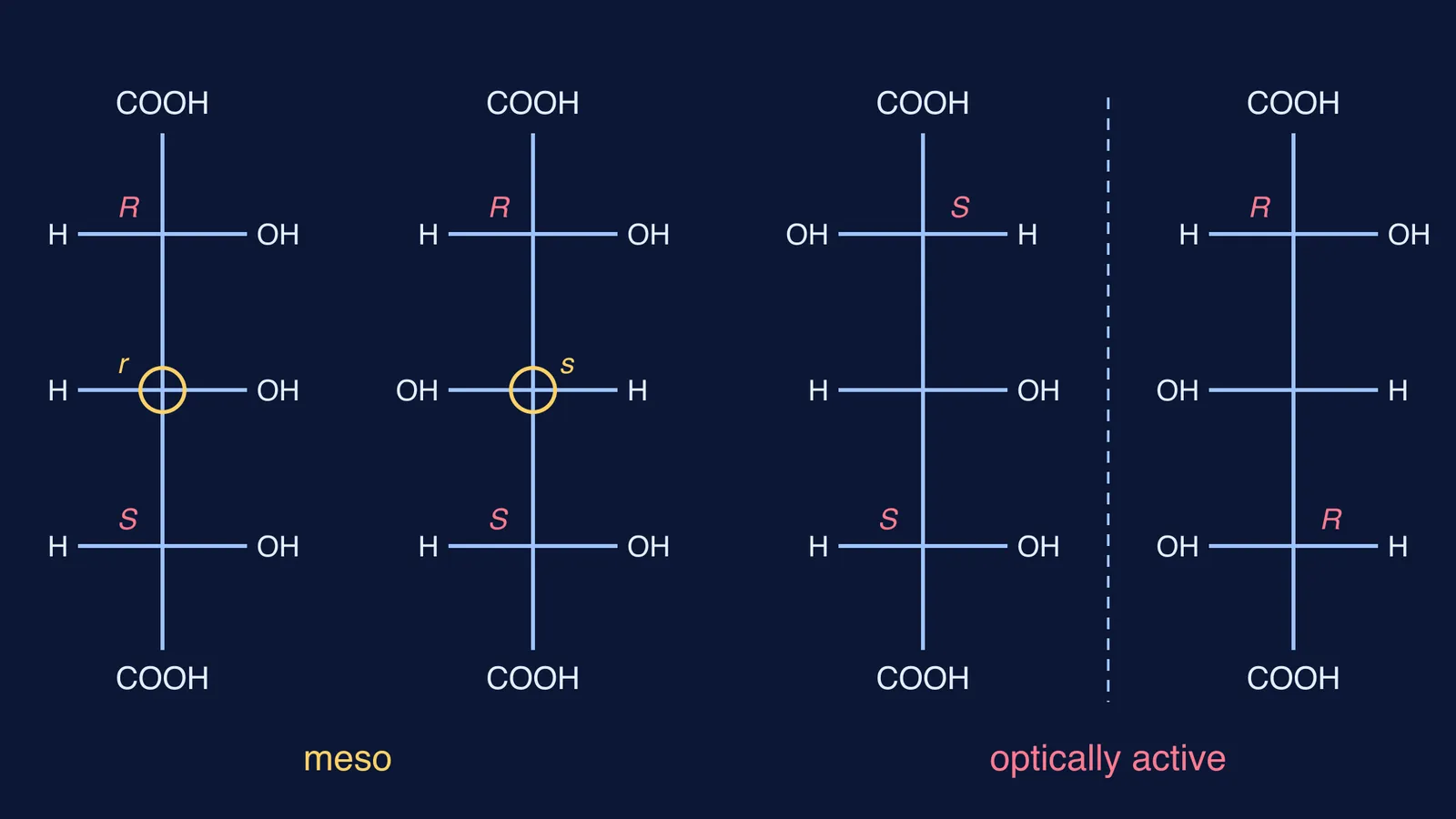
Worked example: ribaric acid in a Fischer projection, COOH at top and bottom, all three OH groups on the right. C-2 is R and C-4 is S.
Rank the groups on C-3: OH first, the C-2 arm (R) second, the C-4 arm (S) third, H fourth.
Read positions: OH is on the right, the C-2 arm points up, the C-4 arm points down, H is on the left.
Trace 1 → 2 → 3: right, top, bottom. That is anticlockwise.
H sits on a horizontal bond, which points towards you, so reverse the answer: clockwise, r.
That matches IUPAC's r for ribaric acid. Now move the C-3 OH to the left. You have exchanged two groups, so r becomes s, and the molecule is xylaric acid, which IUPAC labels s.
How many meso and optically active forms are there?
Spot the candidates: C-2, C-3 and C-4 each carry an OH, and both ends are COOH, so the molecule reads the same from either end.
List the C-2/C-4 pairs: (R,R), (S,S) and (R,S). (S,R) is the same molecule as (R,S), numbered from the other end.
(R,R) and (S,S): C-3 is not a stereocentre, so each combination is one compound. The two are mirror images with no internal mirror plane, so they form one pair of enantiomers, both optically active. PubChem lists them as (2S,4S) D-arabinaric acid and (2R,4R) L-arabinaric acid (PubChem entry for L-arabinaric acid).
(R,S): C-3 is pseudo-asymmetric and can be r or s, giving two compounds. Each has a mirror plane through C-3, so each is meso and optically inactive. IUPAC carbohydrate nomenclature lists these as meso-ribaric acid and meso-xylaric acid (IUPAC carbohydrate nomenclature, 2-Carb-23).
Total: 4 stereoisomers, 2 meso and 2 optically active.
Where do students slip on this question?
Writing 2³ = 8 because three carbons carry OH groups.
Giving C-3 a descriptor in the (R,R) and (S,S) forms, where it has two identical arms.
Using capital R or S at C-3 instead of r or s.
Calling the two meso forms enantiomers. Each is its own mirror image, so ribaric and xylaric acid are diastereomers of each other.
For background, see what makes tartaric acid meso, counting stereoisomers from the number of chiral centres and assigning R or S from a wedge-dash structure.
If CIP ranking itself is the gap, the Fermi Concept Library gives each chemistry concept its own lesson. When your count keeps coming out wrong, the Fermi Problem Library has worked problems with a step-by-step solver that explains the reasoning rather than printing an answer, so you can see the exact step where your listing went off.
Next, try the same five steps on pentane-2,3,4-triol, which has the same symmetric pattern.