On this page
Here is a classic of JEE and board-exam practice: a proton, a deuteron and an alpha particle start from rest and are accelerated through the same potential difference. Which is fastest, and by how much? It all rests on one line: KE = qV.
What does a particle gain when it is accelerated through a potential difference?
When a charge q moves through a potential difference ΔV, its potential energy changes by ΔU = qΔV, as set out in OpenStax University Physics, Volume 2. If the particle starts at rest and nothing else does work on it, all of that energy becomes kinetic energy.
One electron volt is the energy a single elementary charge gains when it is accelerated through 1 V, which is about 1.60 × 10⁻¹⁹ J (OpenStax). So through V volts, a proton gains V electron volts, and an alpha particle, with twice the charge, gains 2V electron volts. For more practice with the unit, see our guide to converting electron volts to joules.
Set ½mv² = qV and you get three results to keep in mind:
Kinetic energy: K = qV, so it depends only on charge.
Speed: v = √(2qV/m), so v ∝ √(q/m).
Momentum: p = √(2mqV), so p ∝ √(mq).
What is the ratio of speeds of a proton and an alpha particle?
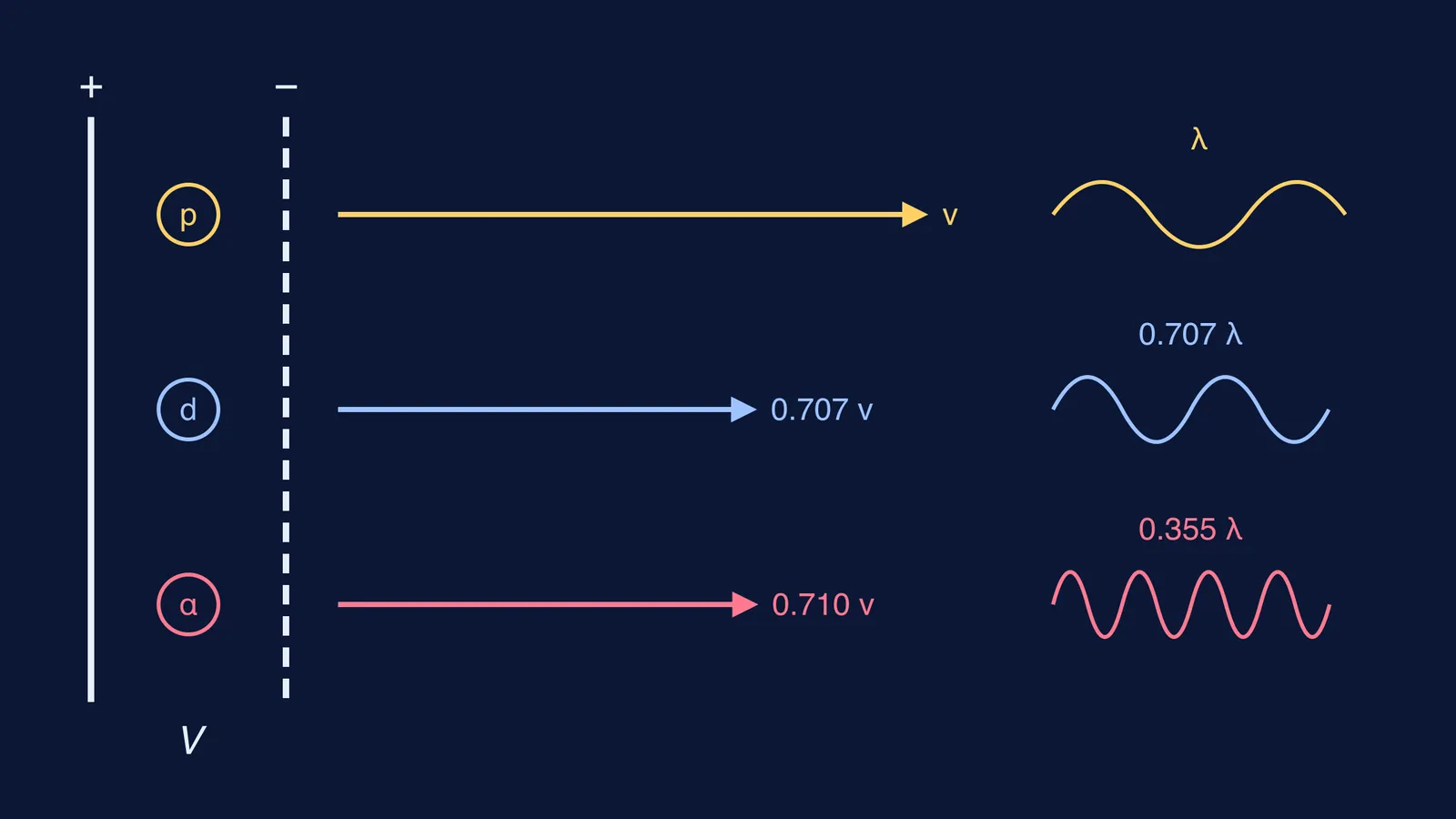
Use v ∝ √(q/m). A proton has charge e and mass m. An alpha particle has charge 2e and mass close to 4m. So v_p / v_α = √[(e/m) ÷ (2e/4m)] = √2. The speed ratio is √2 : 1, and the proton is faster.
The deuteron has charge e and mass about 2m, so v_p / v_d is also √2. In the textbook model, where every nucleon weighs the same, the deuteron and alpha particle reach exactly the same speed: both have q/m = e/2m.
Real masses change the last decimal places. According to CODATA 2022, the proton mass is 1.67262192595 × 10⁻²⁷ kg, the deuteron mass is 3.3435837768 × 10⁻²⁷ kg and the alpha particle mass is 6.6446573450 × 10⁻²⁷ kg. That makes the alpha 3.9726 proton masses, not 4, because binding energy makes the nucleus lighter than its parts. With these values, v_p / v_α = √(m_α / 2m_p) = 1.409 and v_p / v_d = 1.414. Write √2 : 1 in an exam unless the question gives you exact masses.
How do the de Broglie wavelengths compare?
The de Broglie wavelength is λ = h/p. For an electron accelerated through ΔV, OpenStax University Physics, Volume 3 gives eΔV = p²/2m, so p = √(2meΔV). Swap e for any charge q and p = √(2mqΔV), so λ ∝ 1/√(mq).
Proton : deuteron: √(2m·e) / √(m·e) = √2, so λ_p : λ_d = √2 : 1.
Proton : alpha: √(4m·2e) / √(m·e) = √8, so λ_p : λ_α = 2√2 : 1.
Deuteron : alpha: √8 / √2 = 2, so λ_d : λ_α = 2 : 1.
With the CODATA masses, λ_p / λ_α = √(2m_α / m_p) = 2.819, against the textbook 2.828. Notice the trap: deuteron and alpha have almost the same speed but different wavelengths, because the alpha carries twice the mass and so twice the momentum. Our de Broglie wavelength problem set has more of these.
Worked example: all three particles through 1000 V
Using the exact elementary charge e = 1.602176634 × 10⁻¹⁹ C, the Planck constant h = 6.62607015 × 10⁻³⁴ J s and the CODATA masses above:
Kinetic energy: proton 1 keV, deuteron 1 keV, alpha 2 keV.
Proton: v = √(2 × 1.602 × 10⁻¹⁶ J ÷ 1.6726 × 10⁻²⁷ kg) ≈ 4.38 × 10⁵ m/s.
Deuteron: v ≈ 3.10 × 10⁵ m/s.
Alpha: v ≈ 3.11 × 10⁵ m/s, very slightly faster than the deuteron.
Proton wavelength: p = √(2m_p eV) ≈ 7.32 × 10⁻²² kg m/s, so λ ≈ 9.05 × 10⁻¹³ m, about 0.905 pm.
Deuteron λ ≈ 0.640 pm; alpha λ ≈ 0.321 pm.
Is the non-relativistic formula safe here? The proton's rest energy is about 938 MeV, so 1 keV is around one millionth of it, and ½mv² is fine.
Where do students lose marks on this question?
Using the same kinetic energy for all three. The alpha gets 2qV-worth because its charge is 2e.
Writing v ∝ 1/√m and forgetting the charge.
Using λ = h/√(2mK) with K equal for every particle.
Mixing up the radius question. In a magnetic field after the same voltage, r ∝ √(m/q), which gives a different pattern; see radii of proton, deuteron and alpha in a magnetic field.
If you keep slipping on which quantity goes with which power of q and m, the Fermi Problem Library has worked problems with a step-by-step solver that explains the reasoning rather than printing an answer. To revise potential, energy and matter waves from the ground up, each idea has its own lesson in the Fermi Concept Library.
Next time you see this question, write K = qV, v ∝ √(q/m) and λ ∝ 1/√(mq) before you touch a number.