On this page
Propene and propyne both have three carbons. The alkene has the formula C3H6 and the alkyne C3H4, according to their PubChem record for propene and PubChem record for propyne. You can't simply pull two hydrogens off a double bond in one step. Instead you take a detour: put two bromine atoms on, then take two HBr off. Each HBr you remove adds one more pi bond.
This is a standard conversion in Class 11 organic chemistry and JEE Main preparation, and it rewards students who can say why each reagent is there, not just name it.
What are the steps to convert propene to propyne?
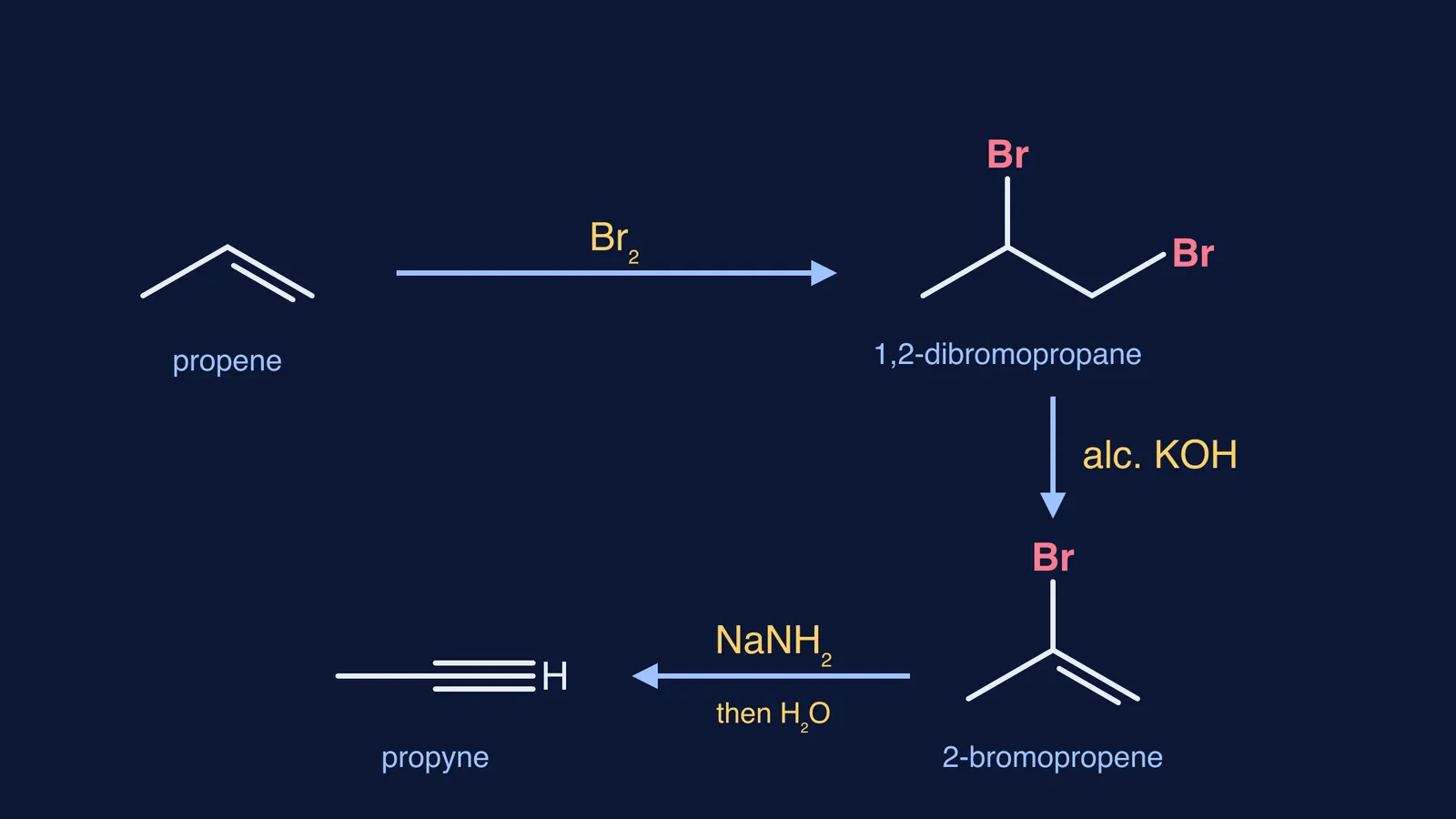
Bromination: CH3-CH=CH2 + Br2 gives CH3-CHBr-CH2Br (1,2-dibromopropane).
First elimination with alcoholic KOH: CH3-CHBr-CH2Br gives a bromopropene (CH3-CBr=CH2 or CH3-CH=CHBr) + KBr + H2O.
Second elimination with NaNH2: the bromopropene gives CH3-C≡CH (propyne) + NaBr + NH3, followed by a water or dilute-acid workup.
The dibromide in step 1 has the formula C3H6Br2 and a molar mass of 201.89 g/mol, according to its PubChem entry for 1,2-dibromopropane. The two bromines sit on neighbouring carbons, which makes it a vicinal dihalide. That arrangement is exactly what a double elimination needs. Our explainer on preparing alkynes from vicinal dihalides with KOH and NaNH2 covers the general case.
Why does bromine go on first?
The double bond is electron-rich, so bromine adds across it. Chemguide notes that the reaction happens at room temperature and that the reddish-brown bromine is decolourised as it reacts. That colour loss is also the classic test for unsaturation. LibreTexts/11%3A_Alkynes/11.05%3A_Preparation_of_Alkynes) describes this first step as making a vicinal dihalide from an alkene with bromine or chlorine in an inert halogenated solvent.
If you're asked about the mechanism, the two bromines add from opposite faces through a cyclic intermediate. Our post on why bromine adds anti through the bromonium ion walks through it.
Why do you need alcoholic KOH and then NaNH2?
The two eliminations aren't equally easy. The first one removes HBr from an ordinary alkyl bromide, and alcoholic KOH handles that. Use alcoholic KOH, not aqueous: in water, hydroxide tends to substitute rather than eliminate, and you get alcohols.
The second elimination starts from a vinyl bromide, where the bromine sits on a double-bonded carbon. This step needs a much stronger base. According to LibreTexts (Vollhardt and Schore)/13%3A_Alkynes%3A_The_Carbon/13-04_Preparation_of__Alkynes_by__Double___Elimination), hydroxide or alkoxide bases can shift the triple bond to another position, so the stronger base sodium amide in ammonia is commonly used. The same page says that with KOH and heat, 1-pentyne rearranges to the more stable 2-pentyne. With NaNH2, a terminal alkyne is trapped as its sodium salt and then released by mild acid treatment.
Worked example: how much propyne from 8.42 g of propene?
Use the PubChem molar masses: propene is 42.08 g/mol, 1,2-dibromopropane is 201.89 g/mol and propyne is 40.06 g/mol.
Moles of propene: 8.42 g divided by 42.08 g/mol gives 0.200 mol.
Each step is 1:1 in carbon skeletons, so at most 0.200 mol of dibromide forms. That is 0.200 x 201.89, or about 40.4 g.
Theoretical propyne: 0.200 x 40.06, or about 8.01 g.
Bromine used: the dibromide is heavier than propene by 201.89 - 42.08 = 159.81 g per mole. That is the mass of one mole of Br2, about 32.0 g for 0.200 mol.
Bromine that leaves: two HBr per molecule, so all of the bromine ends up as KBr and NaBr, and none of it stays in the product.
That last step is a quick self-check. The product has the same three-carbon skeleton as propene but 2 fewer hydrogens and no bromine. If your final structure still has a Br on it, you've stopped one elimination too early.
If you want to practise this chain with different alkenes, the Fermi Problem Library has worked problems with a step-by-step solver that explains the reasoning rather than printing an answer.
Where do students lose marks on this conversion?
Writing the product of step 2 as an alkyne. One elimination gives a bromopropene, not propyne.
Writing aqueous KOH for step 2, which gives substitution instead of elimination.
Forgetting the workup after NaNH2, so the answer ends at the sodium salt (CH3-C≡C⁻ Na⁺) instead of propyne.
Drawing the bromines on carbons 1 and 3. Bromine adds across the double bond, so it goes on carbons 1 and 2.
Confusing propyne with its isomers. Our guide to the isomers of C3H4: propyne, allene and cyclopropene shows how to tell them apart.
Propyne is a gas at room temperature, with a boiling point of -23.2 °C according to PubChem.
If the idea of a vinyl halide or an acidic terminal hydrogen is still fuzzy, the Fermi Concept Library has a lesson for each chemistry concept and shows where it fits on the map. Then try writing the chain from 1-butene to 1-butyne without looking.