

On this page
C3H4 is a common formula in JEE Main and school chemistry questions, because one formula hides three quite different molecules: an alkyne, a cumulated diene and a strained ring. If you can draw all three and label every carbon's hybridisation, you have practised the two skills these questions test.
What are the isomers of C3H4?
Start with the degree of unsaturation, which tells you how many rings plus π bonds the formula allows. For CxHy it is (2x + 2 − y) ÷ 2, so for C3H4 it is (6 + 2 − 4) ÷ 2 = 2. If that formula is new to you, our explainer on working out the degree of unsaturation walks through it.
Two units can be spent in three ways on a three-carbon chain:
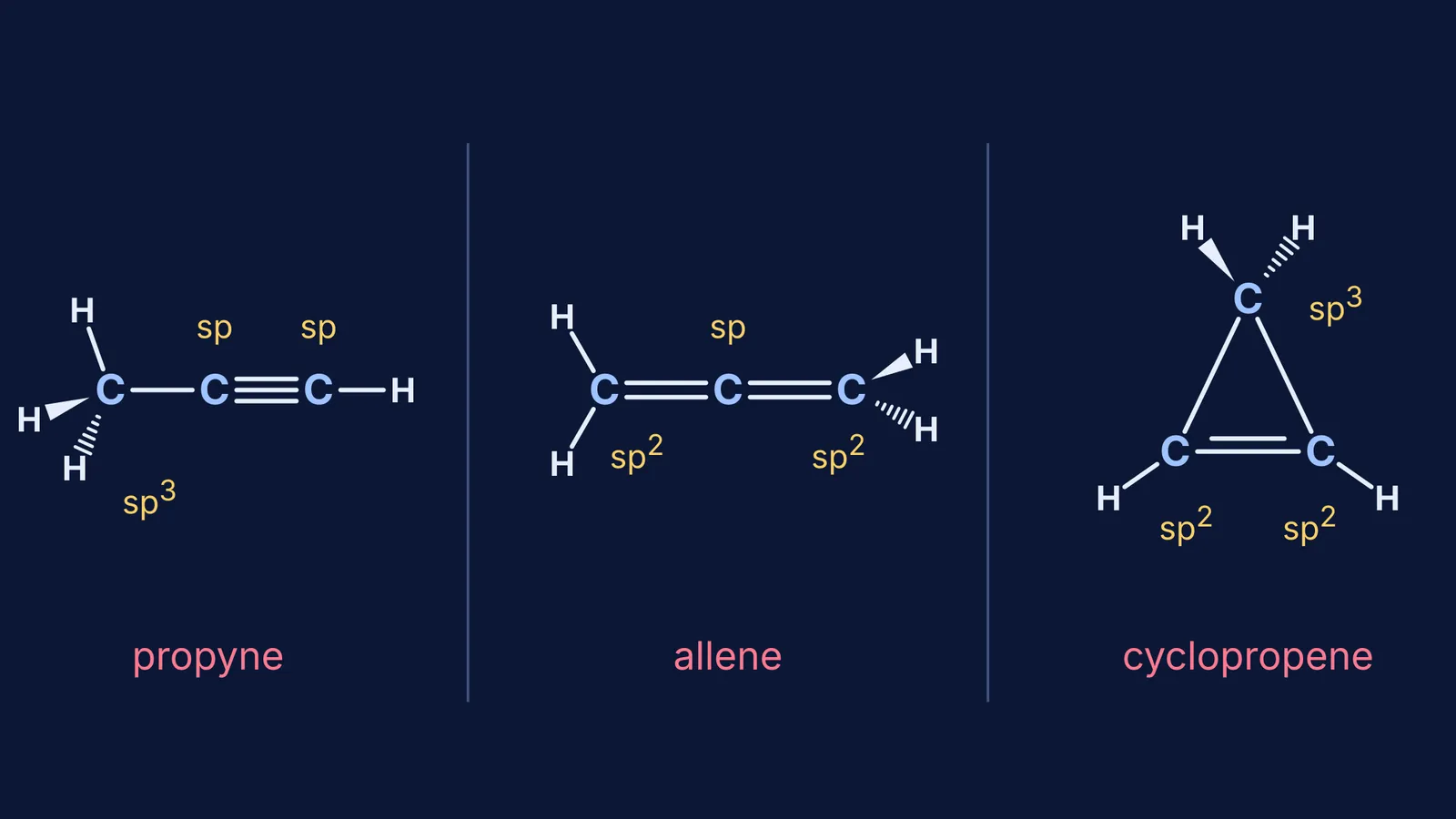
One triple bond: propyne, CH3–C≡CH, also called methylacetylene (Wikipedia: Propyne).
Two double bonds: with only three carbons, both must share the middle carbon, giving propadiene, H2C=C=CH2, the simplest allene (Wikipedia: Propadiene).
One ring plus one double bond: cyclopropene, a triangle of carbons with one C=C (Wikipedia: Cyclopropene).
Those are the three structures exam questions on C3H4 expect. The same counting, done for four carbons, gives many more options; see how it plays out in the isomers of C4H6, from alkynes to dienes.
What is the hybridisation of each carbon in propyne, allene and cyclopropene?
A fast rule for carbon: count its π bonds. No π bond means sp3, one π bond means sp2, two π bonds (a triple bond, or two double bonds) means sp.
Propyne: the CH3 carbon is sp3; both triple-bonded carbons are sp, so the C–C≡C–H chain is a straight line.
Allene: the central carbon is sp and the two end carbons are sp2, and the C=C=C angle is 180° (Wikipedia: Allenes).
Cyclopropene: the CH2 carbon is sp3 and the two double-bonded carbons are sp2.
The allene case is where marks are lost. The central carbon uses two different p orbitals for its two π bonds, and those orbitals sit at right angles. As a result, the planes of the two terminal CH2 groups are twisted 90° from each other (Wikipedia: Allenes). That twist is why allenes with two different groups on each end are chiral without any chiral carbon, which our post on axial chirality in allenes and biphenyls explains.
Cyclopropene has the opposite problem: its geometry is squeezed. The angle at the CH2 carbon, opposite the double bond, narrows to about 51°, compared with the 60° angles of cyclopropane (Wikipedia: Cyclopropene). An sp2 carbon prefers 120° and an sp3 carbon about 109.5°, so every ring angle is badly bent.
Which C3H4 isomer is most stable?
Propyne is the lowest in energy, allene is close behind, and cyclopropene is far above both. The NIST Chemistry WebBook lists the gas-phase enthalpy of formation of propyne as 185.4 kJ/mol and of cyclopropene as 277 kJ/mol. Much of that gap of roughly 92 kJ/mol comes from ring strain.
NIST also lists the reaction allene → propyne in the gas phase as releasing 3.8 kJ/mol (NIST: allene reaction thermochemistry). The two interconvert: the equilibrium constant for propyne ⇌ allene is 0.22 at 270 °C and 0.1 at 5 °C, so propyne dominates (Wikipedia: Propadiene). Their mixture, called MAPD, was commonly used in gas welding (Wikipedia: Propyne). Cyclopropene, by contrast, converts to propyne at 425 °C, and even trying to distil it at its predicted boiling point of about −36 °C makes it polymerise (Wikipedia: Cyclopropene).
How do you answer a C3H4 question in under a minute?
Use this five-step check on any isomer or hybridisation question:
Work out the degree of unsaturation. For C3H4 it is 2.
List every way to spend it: one triple bond, two double bonds, or one ring plus one double bond.
Draw each structure with all hydrogens shown, then confirm every carbon has four bonds.
Label each carbon by its π bonds: zero is sp3, one is sp2, two is sp.
Count σ and π bonds last, remembering that a ring adds one σ bond.
A common trap: a question asks how many sp carbons C3H4 isomers contain. Propyne has two, allene has one, cyclopropene has none. Writing the three labels under your sketches, as in the diagram above, makes that a lookup rather than a guess.
If hybridisation itself still feels shaky, the Fermi Concept Library covers every concept in chemistry, each with its own lesson and its place in the map. For practice, the Fermi Problem Library has worked problems with a step-by-step solver that explains the reasoning rather than printing an answer, so you can check where your count went wrong.


