

On this page
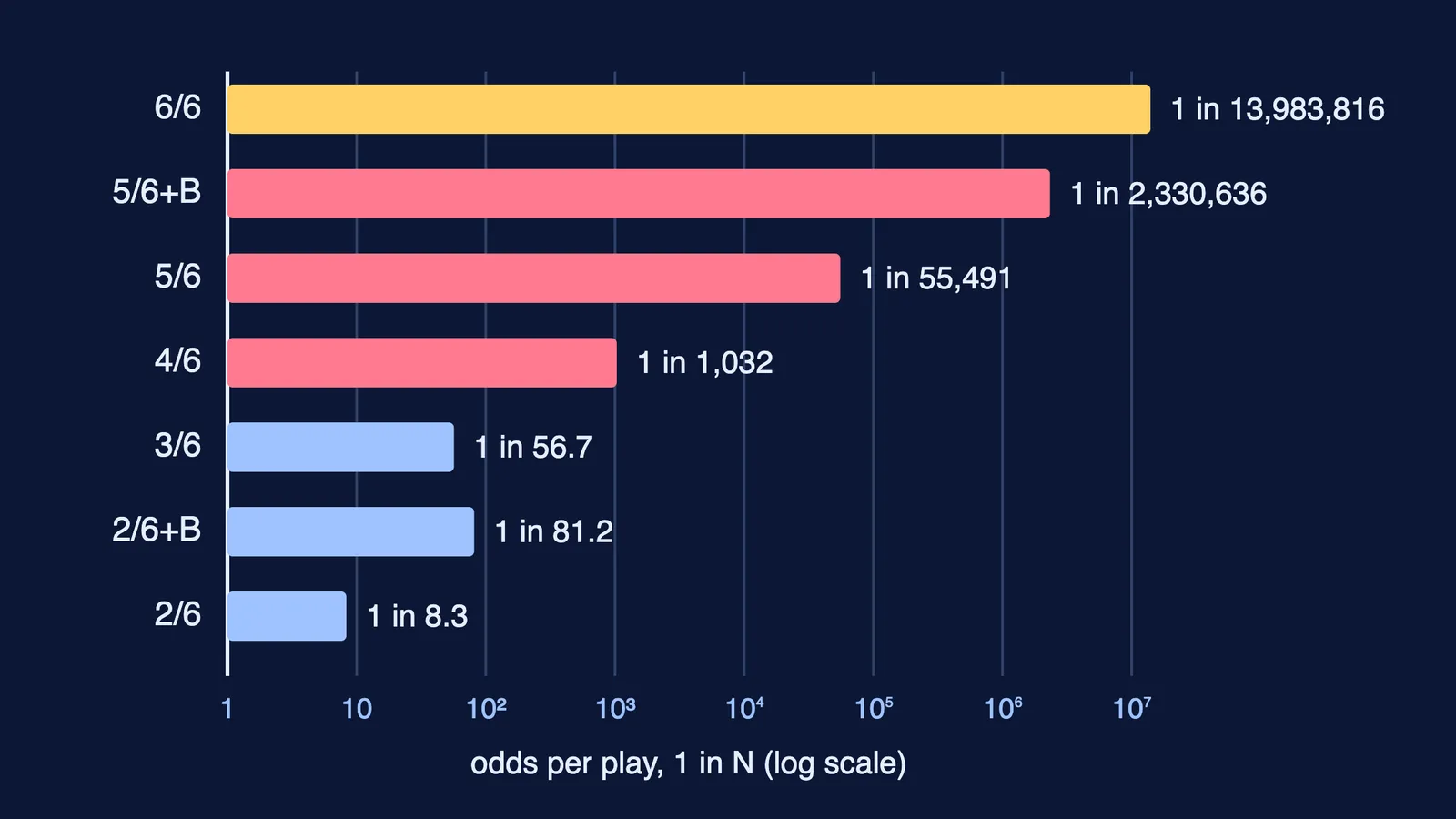
A 6-from-49 lottery asks you to pick six numbers from 1 to 49. Your chance of matching all six with one ticket is 1 in 13,983,816, and that number is simply how many different sets of six you could pick. Ontario's lottery operator prints exactly these odds for the Lotto 6/49 jackpot (OLG, Lotto 6/49 odds and payouts). Below we work it out, do the same for the smaller prizes, and show why the average ticket loses money.
What is the probability of winning a 6-from-49 lottery?
The order of your numbers does not matter: 4, 9, 17, 23, 31, 40 is the same ticket however you write it. So you count combinations, not arrangements. The number of ways to choose r things from n is C(n, r) = n! / (r! (n − r)!).
Count ordered picks: 49 × 48 × 47 × 46 × 45 × 44 = 10,068,347,520.
Each set of six turns up in 6! = 720 different orders.
Divide: 10,068,347,520 ÷ 720 = 13,983,816.
One ticket covers one set, so the jackpot probability is 1/13,983,816, roughly 0.000007%, which matches the 1 in 13,983,816 that OLG publishes.
How do you work out the odds of matching 3, 4 or 5 numbers?
Split the 49 numbers into the 6 that are drawn and the 43 that are not. A ticket with exactly k correct numbers picks k from the drawn 6 and the other 6 − k from the 43. So the number of such tickets is C(6, k) × C(43, 6 − k).
Exactly 3 correct: 20 × 12,341 = 246,820 tickets, so 1 in about 56.7.
Exactly 4 correct: 15 × 903 = 13,545 tickets, so 1 in about 1,032.
Exactly 5 correct: 6 × 43 = 258 tickets, so 1 in about 54,200.
OLG's odds table lists 1 in 56.7 for three numbers and 1 in 1,033 for four (it rounds up). It splits five numbers into two prizes. If your sixth number is the bonus ball, which happens on 6 of the 258 tickets, the odds are 1 in 2,330,636. The other 252 tickets give 1 in 55,492.
What is the expected value of a lottery ticket?
Expected value is each prize times its probability, summed over all prizes, then compared with the ticket price. Each Lotto 6/49 play costs $3, and OLG's prize page says "a total of $1.44 is allocated to prizes for every $3 play issued." So the prizes are worth $1.44 on average, and the average ticket loses $3 − $1.44 = $1.56, or 52% of what you paid.
The fixed prizes on the odds table show where some of that money goes:
Jackpot: $5,000,000 × 1/13,983,816 ≈ $0.36.
Three numbers, $10: $10 × 246,820/13,983,816 ≈ $0.18.
Two numbers plus the bonus, $5: $5 × 172,200/13,983,816 ≈ $0.06.
The headline prize is worth about 36 cents of a $3 ticket. It is worth less in practice, because the jackpot is a "share of $5,000,000" and two winners would split it. The rest of the $1.44 goes to the free plays, the shared pools for four and five numbers, and the separate Gold Ball Draw that every $3 play also enters. Whatever the details, the operator has set prizes below sales, so the average ticket has negative expected value. That is the same test you would use to check whether a dice game is fair using expected value.
Do more tickets or lucky numbers improve your chances?
Ten different tickets give you 10 chances in 13,983,816, or about 1 in 1.4 million. They also mean ten times the average loss: $15.60 on $30, using OLG's $1.44 prize figure. Every set of six is equally likely in every draw, so a "lucky" or "overdue" set has the same 1 in 13,983,816 chance as any other.
Try it yourself: a four-step check for any lottery
A combinations drill for Class 11 and JEE Main practice that works on any draw:
Write down n (how many numbers) and r (how many you pick). Work out C(n, r). That is your 1 in N jackpot odds.
For each prize, count the matching tickets: C(r, k) × C(n − r, r − k).
Multiply each prize by its count divided by C(n, r), then add the results.
If that total is below the ticket price, the ticket loses on average.
Check yourself on a 5-from-35 draw. C(35, 5) = 324,632, so the jackpot odds are 1 in 324,632. Then try three correct: C(5, 3) × C(30, 2) = 10 × 435 = 4,350 tickets.
If step 2 is where you get stuck, the Fermi Problem Library has worked problems with a step-by-step solver that explains the reasoning rather than printing an answer. To refresh the idea of choosing without order, the Fermi Concept Library gives every mathematics concept its own lesson. For more counting, try probability with a deck of 52 cards or a four-week plan to start olympiad combinatorics.


