On this page
The method for card questions in Class 10 probability is short. The hard part is counting the right cards: it is easy to count 16 face cards instead of 12, or to forget a card that belongs to two groups. Here is what is in the deck, a counting list to learn, and the textbook's own exercise worked through.
What is in a standard deck of 52 cards?
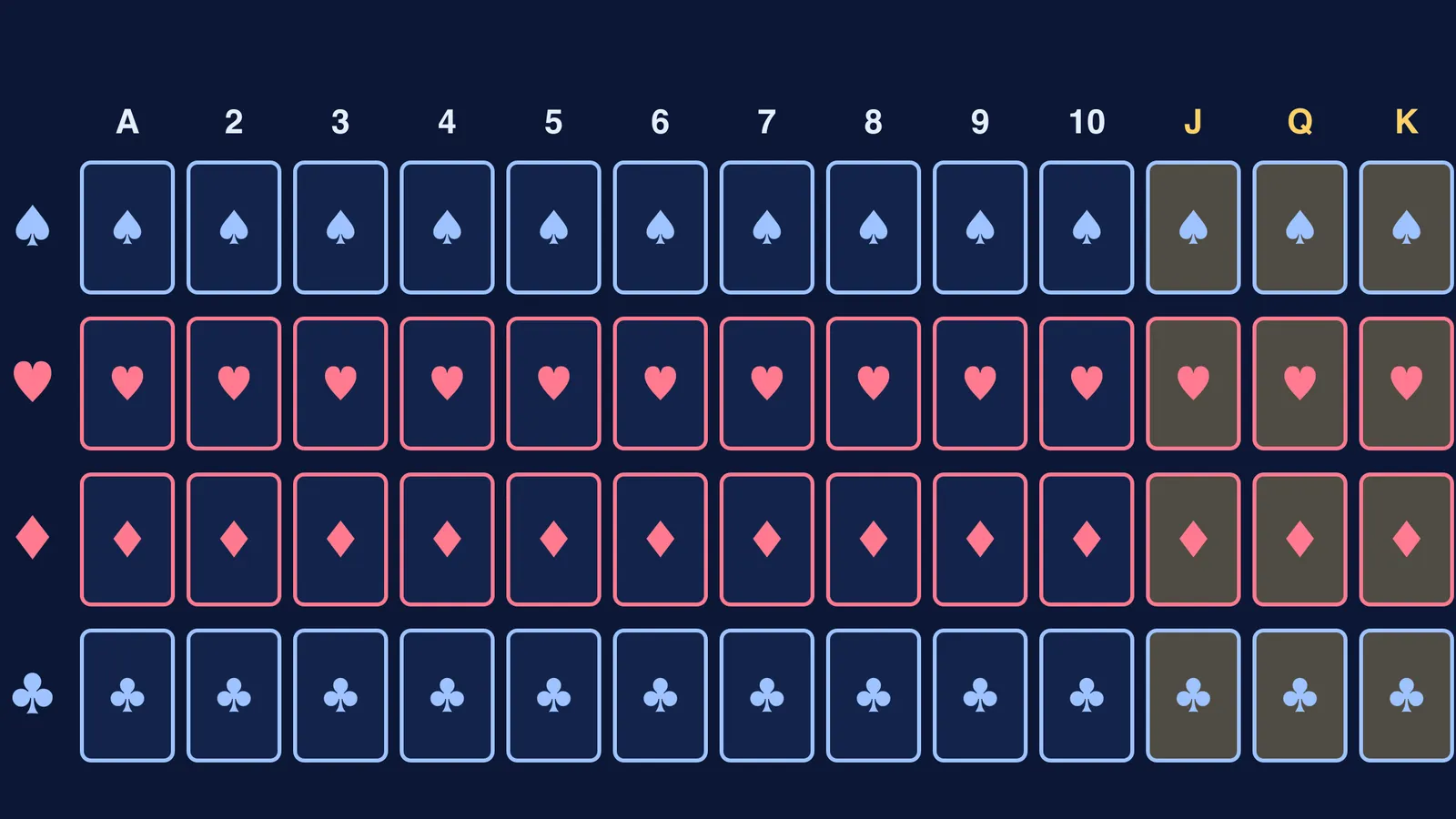
NCERT's Class 10 chapter on probability says a deck "consists of 52 cards which are divided into 4 suits of 13 cards each": spades, hearts, diamonds and clubs (NCERT Mathematics Class 10, Chapter 14). The same page says clubs and spades are black and hearts and diamonds are red. Each suit has the ace, king, queen, jack and the cards 10 down to 2, and kings, queens and jacks are called face cards.
Jokers are not part of the standard 52 cards. Some packs include them, but they are only used in games that ask for them (Standard 52-card deck, Wikipedia). If a question says "a deck of 52 cards", leave the jokers out.
These are the counts to learn, all worked out from that description:
Suits: 4, each with 13 cards
Colours: 26 red (hearts and diamonds) and 26 black (spades and clubs)
Each rank (all the aces, all the kings, all the 7s): 4 cards, one per suit
Face cards: 3 per suit, so 12 in all
Red face cards: 6. Black face cards: 6
Aces: 4. Aces are not face cards
Number cards from 2 to 10: 9 per suit, so 36 in all
Any single named card, such as the jack of hearts: 1
How do you find the probability of drawing one card?
NCERT defines theoretical probability as P(E) = number of outcomes favourable to E ÷ number of all possible outcomes, on the assumption that every outcome is equally likely (NCERT Class 10, Chapter 14). The chapter credits this definition to Pierre Simon Laplace in 1795. In its own card example it notes that "well-shuffling ensures equally likely outcomes". So for one card drawn from a full deck, the bottom of the fraction is always 52.
Use three steps every time:
Name the event in words ("the card is a red face card").
Count the favourable cards from the list above. Write the count down before you divide.
Divide by 52 and simplify.
The same chapter shows the shortcut for "not" questions: P(not E) = 1 − P(E). In its Example 4 the probability of an ace is 4/52 = 1/13, so the probability of not getting an ace is 1 − 1/13 = 12/13. You can check that by counting too: 48 cards are not aces.
Worked example: NCERT Exercise 14.1, Question 14
Question 14 in NCERT's Exercise 14.1 asks for the probability that one card drawn from a well-shuffled deck of 52 is each of these:
A king of red colour: the king of hearts and king of diamonds, so 2/52 = 1/26.
A face card: 12/52 = 3/13.
A red face card: 6/52 = 3/26.
The jack of hearts: 1/52.
A spade: 13/52 = 1/4.
The queen of diamonds: 1/52.
Try this yourself: what is the probability that the card is not a face card? There are 52 − 12 = 40 cards that are not face cards, so it is 40/52 = 10/13. That equals 1 − 3/13, as the complement rule says it should.
Where do students lose marks on card questions?
These are the common counting traps. Check each one against the deck description in the NCERT chapter:
Counting aces as face cards. That gives 16 instead of 12.
Double-counting an "or". "A red card or a king" is not 26 + 4. The king of hearts and the king of diamonds are already among the 26 red cards, so it is 26 + 4 − 2 = 28 cards, and the probability is 28/52 = 7/13.
Mixing up "and" and "or". "Red and a face card" is 6 cards. "Red or a face card" is 26 + 12 − 6 = 32 cards, so 8/13.
Adding jokers. A deck of 52 has none.
Leaving the fraction unsimplified. 13/52 is correct, but NCERT's worked examples simplify it to 1/4, so give the simplest form as your final answer.
If the count keeps slipping, practise a few more problems. The Fermi Problem Library has worked problems with a step-by-step solver that explains the reasoning rather than printing an answer. If the gap is the idea itself, such as complementary events or why outcomes must be equally likely, the Fermi Concept Library gives each mathematics concept its own lesson.
Tonight, take NCERT's Question 14, cover the answers above and write the count for each part before you write any fraction.