On this page
A question gives you a position vector like r(t) = x(t)i + y(t)j and asks for speed and acceleration at a particular instant. It looks like a vectors problem, but it is really two ordinary differentiation problems running side by side. Once you see that, these become some of the quickest marks in a kinematics paper, from school exams to JEE Main.
How do you find velocity from a position vector?
Differentiate each component with respect to time. The unit vectors i and j are fixed in direction, so they ride along unchanged.
The instantaneous velocity is defined as v(t) = dr/dt, which in components is vx = dx/dt and vy = dy/dt (OpenStax University Physics Volume 1, section 4.1).
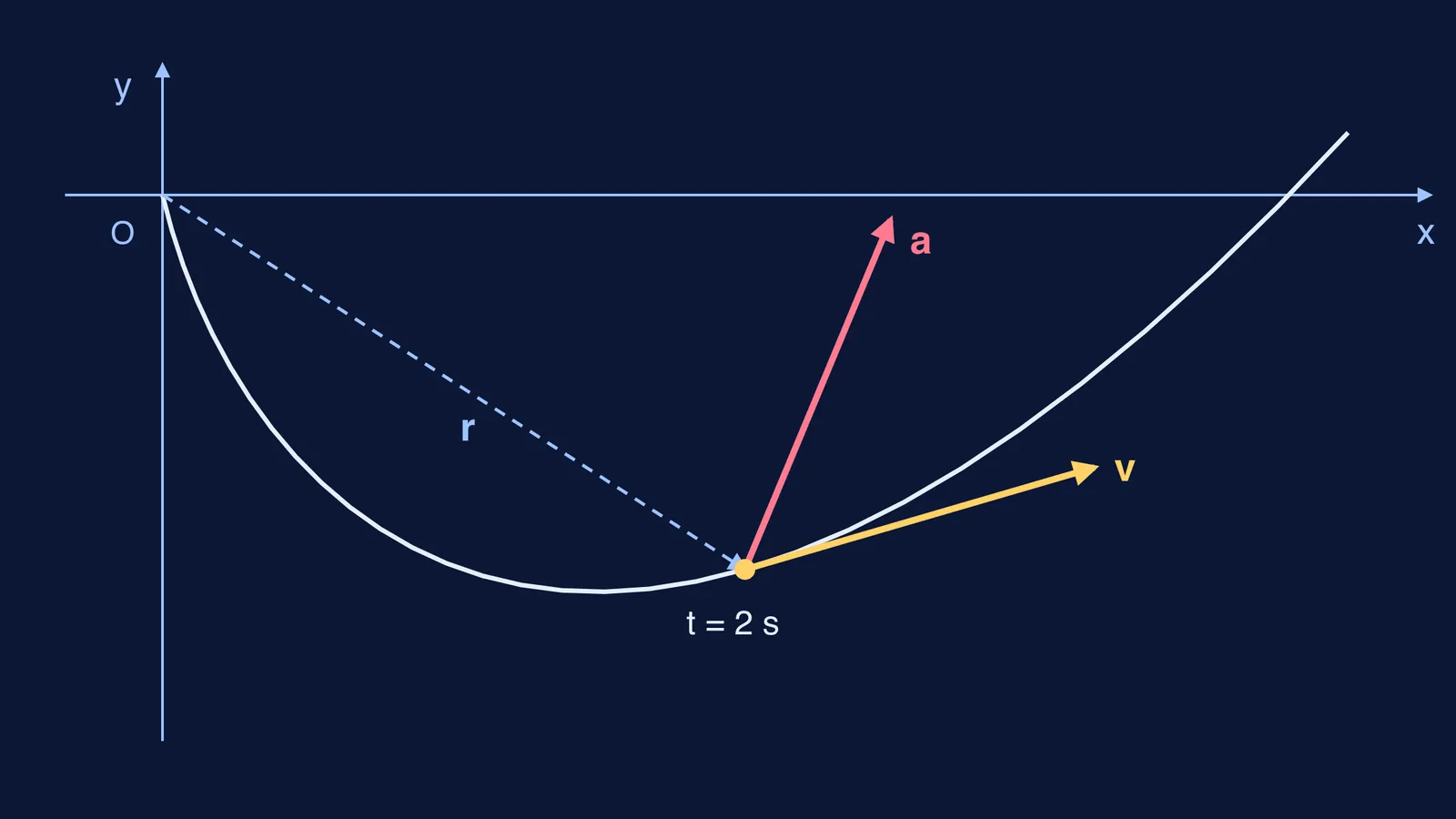
The same section shows that the velocity vector is tangent to the particle's path at every instant. That gives you a free check: the direction of v should run along the curve, never across it.
Speed is just the magnitude of that vector: |v| = √(vx² + vy²). Speed is a number; velocity is the arrow.
How do you find acceleration from a position vector?
Differentiate again. Acceleration is the derivative of velocity, which makes it the second derivative of position, again component by component: ax = d²x/dt² and ay = d²y/dt² (OpenStax University Physics Volume 1, section 4.2).
If you are shaky on differentiating powers of t, our post on the calculus you actually need for JEE physics covers it in one sitting.
Worked example: speed and acceleration at t = 2 s
A particle moves in the xy-plane with r(t) = (5t² + 4t)i + (2t³ − 17t)j, where r is in metres and t in seconds. Find its speed and the magnitude of its acceleration at t = 2 s.
Write the components: x = 5t² + 4t and y = 2t³ − 17t.
Differentiate once: vx = 10t + 4 and vy = 6t² − 17.
Substitute t = 2: vx = 24 m/s and vy = 24 − 17 = 7 m/s, so v = 24i + 7j.
Find the speed: |v| = √(24² + 7²) = √(576 + 49) = √625 = 25 m/s.
Differentiate again: ax = 10 and ay = 12t.
Substitute t = 2: ax = 10 m/s² and ay = 24 m/s², so a = 10i + 24j.
Find the magnitude: |a| = √(10² + 24²) = √676 = 26 m/s².
The particle is at r(2) = 28i − 18j metres, moving at 25 m/s in a direction about 16° above the x-axis (tan θ = 7/24). Its acceleration points much more steeply, about 67° above the x-axis (tan φ = 24/10).
Notice the order: substitute t = 2 only after differentiating. Plug in first and you are differentiating constants, which gives zero.
Why isn't the rate of change of speed equal to |a|?
This is the trap. Many students assume that if |a| = 26 m/s², the speed must be growing at 26 m/s every second. It is not, because the velocity and acceleration arrows point in different directions.
Only the part of a along v changes the speed. That part is the tangential acceleration, defined as aT = d|v|/dt (OpenStax University Physics Volume 1, section 4.4); the rest turns the velocity's direction.
For our particle, aT = (a · v) / |v| = (10 × 24 + 24 × 7) / 25 = 408/25 = 16.32 m/s². So the speed is rising at 16.32 m/s per second, while the remaining part of the acceleration, √(26² − 16.32²) ≈ 20.2 m/s², bends the path. The same idea is behind why average and instantaneous acceleration can differ so sharply on curved paths.
What mistakes cost marks in these questions?
Run this checklist before you move on:
Did you differentiate before substituting the time?
Did you keep i and j terms separate until the last step?
Did you give speed as a positive number with units (m/s), and acceleration in m/s²?
Does your velocity direction match the slope of the path? The slope dy/dx equals vy/vx, the same trick used for derivatives of parametric functions.
If asked for the rate of change of speed, did you use the tangential component?
Want more practice? The Fermi Problem Library has worked problems with a step-by-step solver that explains the reasoning rather than printing an answer, which helps when you got a number but are not sure the method was right. If the gap is the idea itself, such as what a vector derivative means, the Fermi Concept Library gives each physics and mathematics concept its own lesson.
Try it now: change the 17 in y(t) to 20 and redo the example. You should get vy = 4 m/s at t = 2 s, a speed of √592 ≈ 24.3 m/s, and an unchanged acceleration of 26 m/s².