

On this page
A stopwatch and a speedometer are enough to find a car's average acceleration. Its acceleration at one exact moment needs a different tool: the tangent. Mixing the two up can cost marks on velocity-time graph questions in Class 11 physics and JEE Main.
What is the difference between instantaneous and average acceleration?
Average acceleration is the change in velocity divided by the time interval, a = Δv/Δt = (v_f − v_0)/(t_f − t_0), as defined in OpenStax University Physics Volume 1. Instantaneous acceleration is the derivative of velocity, a(t) = dv/dt: the acceleration at one moment. Both are measured in metres per second squared (m/s²).
Average acceleration sums up a whole interval in one number and ignores what happened in between; instantaneous acceleration describes one moment. OpenStax connects them: average acceleration approaches instantaneous acceleration as Δt approaches zero.
If rates of change still feel slippery, our post on average speed versus average velocity covers the same averaging idea one step earlier, for position.
How do you read each one from a velocity-time graph?
On a v-t graph, both are slopes, but of different lines.
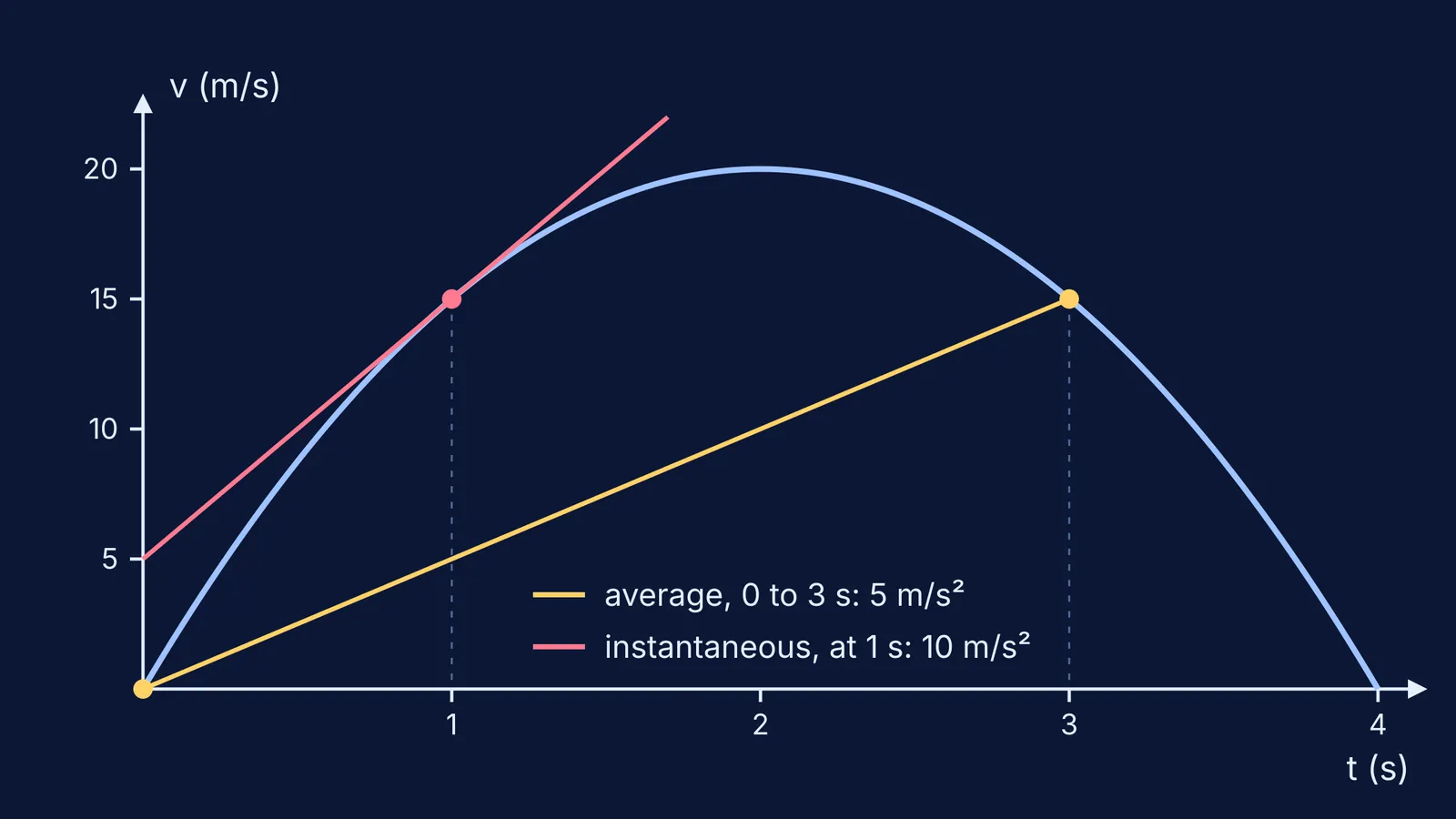
Average acceleration over an interval is the slope of the secant: the straight line joining the points at the start and end of the interval.
Instantaneous acceleration at time t is the slope of the tangent to the curve at that point, as OpenStax states.
On a straight-line v-t graph, the secant and the tangent are the same line, so the two values agree everywhere.
Robert Beichner of North Carolina State University collected data from 895 high school and college students on a test of kinematics graphs. The difficulties his paper lists include slope/height confusion and trouble finding the slopes of lines that do not pass through the origin (American Journal of Physics, 1994). Lillian McDermott, Mark Rosenquist and Emily van Zee had earlier described common graphing errors in kinematics from a multi-year study of several hundred university students in a preparatory physics course (American Journal of Physics, 1987).
Worked example: one motion, three accelerations
Take the velocity function OpenStax uses in its own worked example, v(t) = 20t − 5t², with v in m/s and t in s (OpenStax, Example 3.6). Differentiating gives a(t) = 20 − 10t.
Average acceleration from 0 to 3 s: v(0) = 0 and v(3) = 60 − 45 = 15 m/s, so the average is 15/3 = 5 m/s².
Instantaneous acceleration at t = 1 s: a(1) = 20 − 10 = 10 m/s², twice the average.
Instantaneous acceleration at t = 3 s: a(3) = 20 − 30 = −10 m/s². The object is still moving forward, but slowing down.
Now watch the average turn into the instantaneous value. Start at t = 1 s, where v = 15 m/s, and shrink the interval:
From 1 s to 1.1 s: v rises to 15.95 m/s, so Δv/Δt = 0.95/0.1 = 9.5 m/s².
From 1 s to 1.01 s: Δv/Δt = 9.95 m/s².
From 1 s to 1.001 s: Δv/Δt = 9.995 m/s².
The secant swings round into the tangent, and the numbers close in on 10 m/s². That limit is the derivative; our interactive post on the derivative as the slope of a tangent lets you zoom in and see it happen.
When are average and instantaneous acceleration equal?
Under constant acceleration, they are always equal, because the v-t graph is a straight line. For a smooth velocity curve, they match at least once in every interval: by the mean value theorem, some tangent between the endpoints is parallel to the secant. In the example above, 20 − 10t = 5 gives t = 1.5 s. Our post on the mean value theorem, visualised shows why that tangent must exist.
The flip side is a classic trap. An average acceleration of zero does not mean the object never accelerated. A scooter that starts and ends at 10 m/s, speeding up and braking through traffic in between, has zero average acceleration for the trip.
A four-step check for v-t graph questions
Underline the time words. "Between", "during" or "over" signals average; "at" or "at the instant" signals instantaneous.
For average, read two velocities and two times, then divide Δv by Δt. Do not use the slope of the curve at either end.
For instantaneous, draw the tangent at that point, pick two far-apart points on the tangent (not the curve), and find its slope. If you are given v(t) as a formula, differentiate instead.
Check the sign. A falling v-t curve means negative acceleration, even while v is still positive.
If you keep reaching for the wrong slope, the Fermi Problem Library has a step-by-step solver that explains the reasoning rather than printing an answer, so you can see where a secant should have been a tangent. For the definitions themselves, the Fermi Concept Library gives each concept in physics and mathematics its own lesson.
Next time you meet a v-t graph, ask one question before you calculate anything: over an interval, or at an instant?


