

On this page
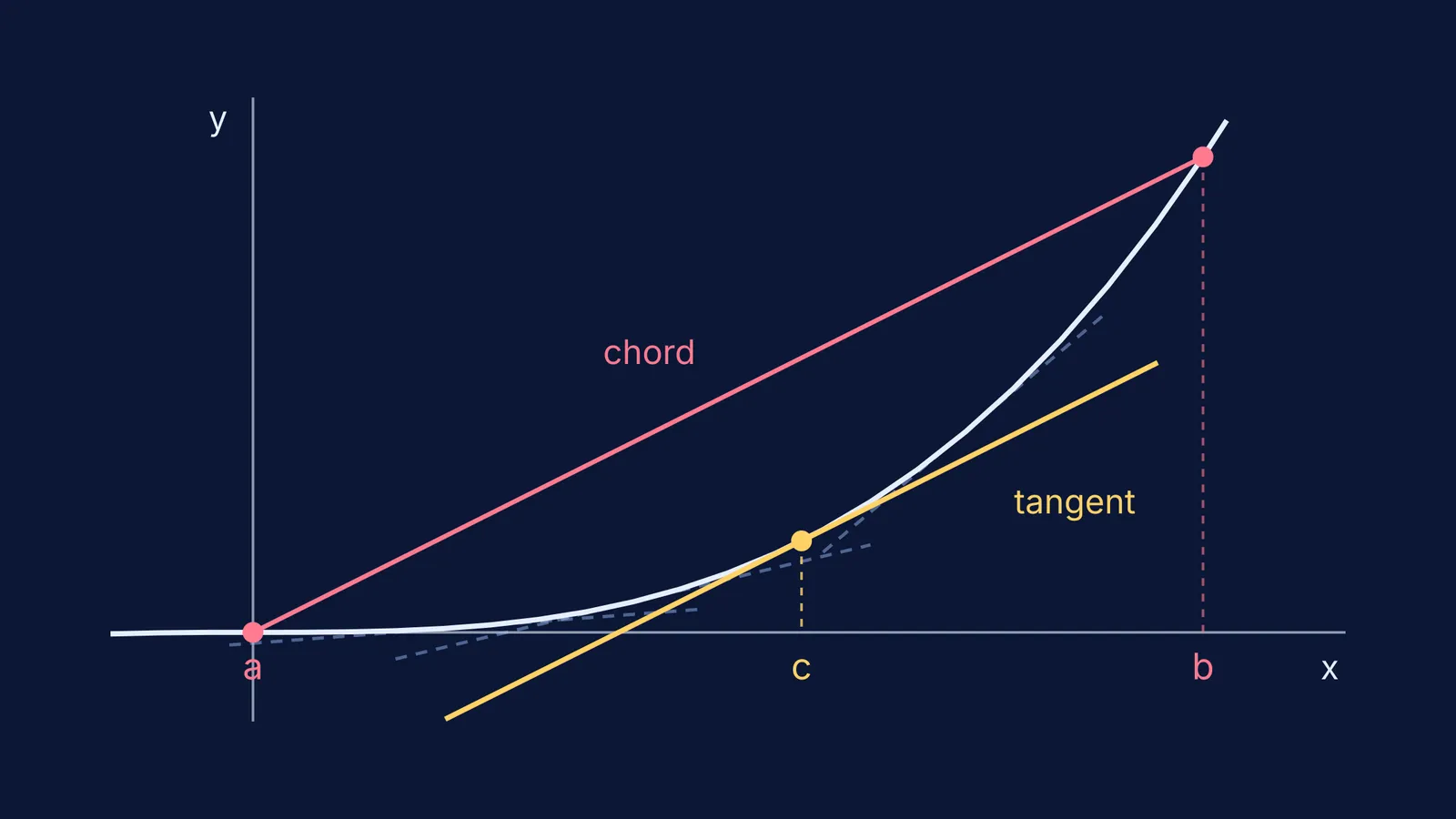
You can check the mean value theorem with a graph and one moving line. Join two points on a smooth curve with a chord, then slide a tangent along the curve between them. Somewhere in between, the tangent lines up exactly parallel to the chord. That point is called c, and the theorem promises it exists as long as the curve has no breaks and no sharp corners.
What does the mean value theorem say?
The OpenStax *Calculus Volume 1* textbook by Gilbert Strang and Edwin Herman states it like this: if f is continuous on the closed interval [a, b] and differentiable on the open interval (a, b), then there is at least one c in (a, b) with f′(c) = (f(b) − f(a))/(b − a).
The left side is the slope of the tangent at c. The right side is the slope of the chord from (a, f(a)) to (b, f(b)). Equal slopes mean parallel lines, so the same book puts it geometrically: the tangent at c is parallel to the secant line joining the two endpoints.
In words: the average rate of change over the interval equals the instantaneous rate of change at some point inside it.
How do you find where the tangent is parallel to the chord?
Open any graphing tool (we compared a few in our post on using graphing tools to learn calculus, not skip it) and build this:
Plot f(x) = x³ and mark the endpoints a = 0 and b = 2.
Draw the chord from (0, 0) to (2, 8). Its slope is (8 − 0)/(2 − 0) = 4.
Make a slider for c between 0 and 2.
Draw the tangent at c: y = 3c²(x − c) + c³.
Before you touch the slider, write down where you think the tangent will match the chord.
Now slide. To find the exact match, set f′(c) equal to the chord slope: 3c² = 4, so c = 2/√3, about 1.155.
Most people guess the midpoint, c = 1. But f′(1) = 3, still flatter than the chord, so the slider has to go further right: the curve keeps getting steeper. For f(x) = x², by contrast, c is always exactly (a + b)/2, because the chord slope (b² − a²)/(b − a) = a + b and f′(c) = 2c.
Predicting first is worth the extra step. Catherine Crouch, Adam Fagen, Paul Callan and Eric Mazur compared ways of showing physics demonstrations in the American Journal of Physics in 2004.
For other ideas that are easier to see than to read, the Fermi Simulation Lab has interactive simulations, and the same predict-then-check habit works there.
Why is Rolle's theorem a special case of the mean value theorem?
Rolle's theorem adds one condition: f(a) = f(b). Then the chord is horizontal, its slope is 0, and a tangent parallel to it must also be flat. So f′(c) = 0 for some c in (a, b), which is Rolle's theorem as usually stated.
Example: f(x) = x² − 4x on [0, 4]. Both ends give 0, so f′(c) = 2c − 4 = 0 and c = 2, the bottom of the parabola.
The link also runs the other way, which is how the mean value theorem is usually proved. Subtract the chord's line from the curve: g(x) = f(x) − [f(a) + m(x − a)], where m is the chord slope. Now g(a) = g(b) = 0, so Rolle's theorem gives g′(c) = 0, which means f′(c) = m. Tilt the picture until the chord is level and you are looking at Rolle's theorem.
According to Wikipedia's account of the mean value theorem, Michel Rolle proved a restricted form in 1691, only for polynomials, and Augustin-Louis Cauchy stated and proved the modern form in 1823.
When does the tangent never become parallel to the chord?
When a condition fails, the slider has nowhere to stop. Try these:
A corner. f(x) = |x| on [−1, 1] has a flat chord, but the slope is only ever −1 or +1, because f is not differentiable at x = 0. Our guide to differentiability for JEE, with corners and modulus functions covers how to spot these.
A break. Let f(x) = x on [0, 1) and f(1) = 0. The chord is flat, but every slope inside is 1, because f jumps at x = 1.
More than one answer. f(x) = sin x on [0, 2π] has a flat chord and two flat tangents, at π/2 and 3π/2. The theorem says at least one c, not exactly one.
A checklist for mean value theorem questions
Check continuity on the closed interval [a, b].
Check differentiability on the open interval (a, b): look for modulus signs, cusps and piecewise joins.
Work out the chord slope (f(b) − f(a))/(b − a).
Solve f′(c) = chord slope.
Keep only values of c strictly between a and b.
For more solved examples, read our post on Rolle's theorem and the mean value theorem.


