On this page
Burn carbon-rich fuel without enough oxygen and you get soot, smoke and a family of molecules built from benzene rings fused edge to edge. A few are well-studied cancer-causing chemicals, and the route one of them takes to DNA links Class 11 hydrocarbons to Class 12 molecular biology.
What are polynuclear aromatic hydrocarbons?
A polynuclear (or polycyclic) aromatic hydrocarbon, PAH for short, is a molecule of only carbon and hydrogen in which two or more benzene rings share edges. Naphthalene has two fused rings, anthracene and phenanthrene have three, and benzo[a]pyrene has five.
PAHs are a group of over 100 chemicals that form during the incomplete burning of coal, oil, gas, garbage, tobacco or charbroiled meat, according to the US Agency for Toxic Substances and Disease Registry. The same fact sheet lists cigarette smoke, wood smoke, vehicle exhaust and grilled or charred meat as everyday sources.
The conditions are the ones behind why unsaturated hydrocarbons burn with a sooty flame: too little oxygen for the carbon present.
Which aromatic hydrocarbons are carcinogenic?
The reference list is kept by the International Agency for Research on Cancer (IARC), part of WHO. Its main groups are Group 1, "carcinogenic to humans", 2A "probably", 2B "possibly" and 3 "not classifiable" (IARC classifications).
Here is where benzene and common PAHs sit on IARC's list of classified agents, with their ring counts:
Benzene (1 ring): Group 1.
Naphthalene (2 rings): Group 2B.
Phenanthrene (3 rings): Group 3.
Anthracene (3 rings): Group 2B since March 2023, on evidence from experimental animals (IARC Monographs volume 133).
Benz[a]anthracene (4 rings): Group 2B.
Dibenz[a,h]anthracene (5 rings): Group 2A.
Benzo[a]pyrene (5 rings): Group 1.
IARC's list notes that benzo[a]pyrene was "upgraded to Group 1 based on mechanistic and other relevant data", so the way it damages DNA was part of the case (IARC list). For how such chemicals fit alongside radiation and viruses, see physical, chemical and biological carcinogens.
How does benzo[a]pyrene damage DNA?
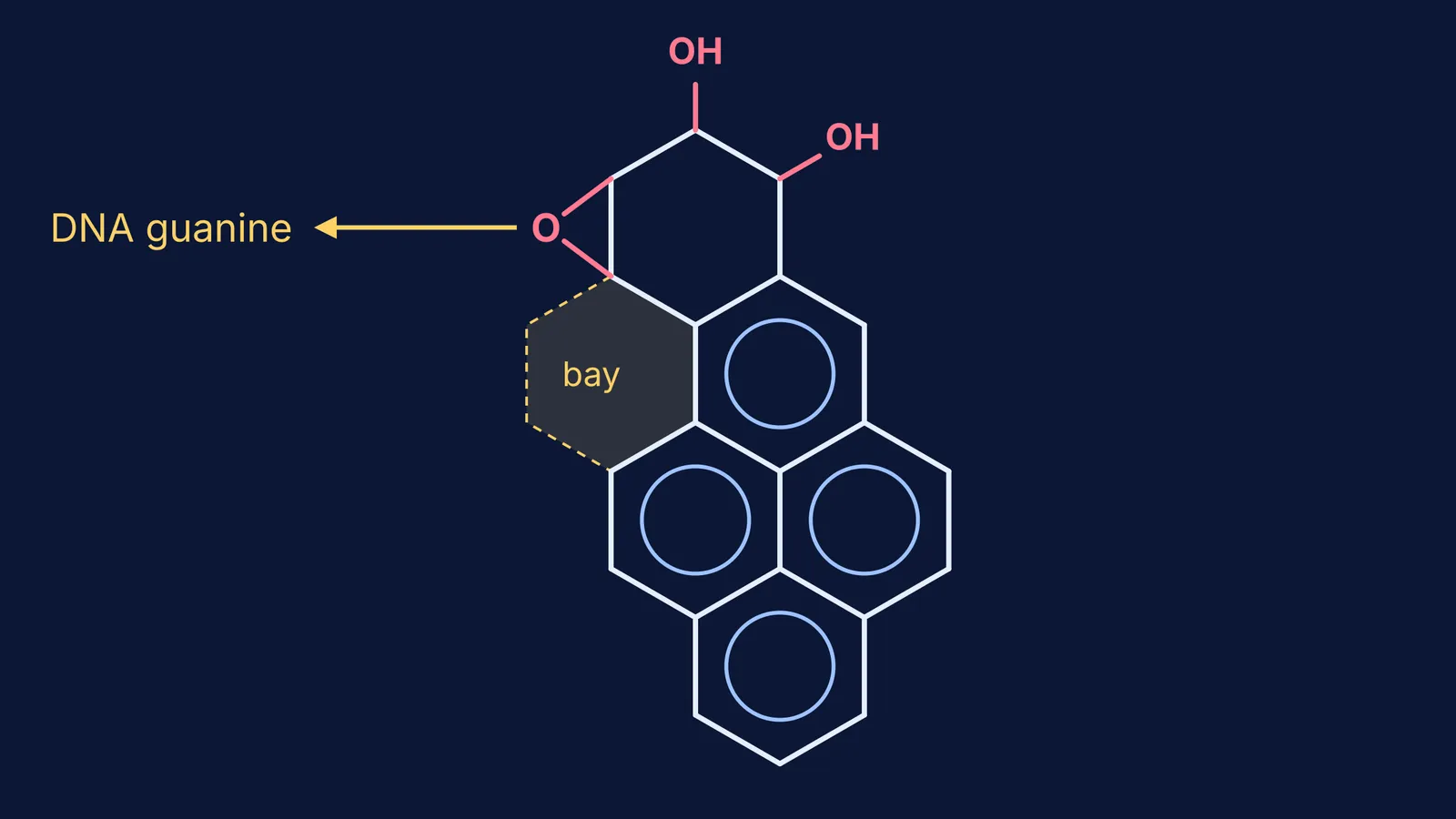
The danger comes after the body's enzymes work on benzo[a]pyrene. Shiizaki, Kawanishi and Yagi (2017, Genes and Environment) describe the route: CYP1A1 or CYP1B1 makes benzo[a]pyrene-7,8-epoxide, epoxide hydrolase turns it into a 7,8-dihydrodiol, and CYP1A1 or CYP1B1 then converts that into benzo[a]pyrene-7,8-diol-9,10-epoxide, called BPDE. They call BPDE "the ultimate carcinogenic intermediate" of benzo[a]pyrene.
The epoxide in BPDE sits beside the bay region, the notch between angled rings shown in the diagram above. Jerina and colleagues (1981) wrote that in its first four years the "bay-region theory" had proved highly successful at predicting which diol epoxide of a PAH is the most tumour-causing.
A direct link to human cancer came from Denissenko, Pao, Tang and Pfeifer (1996, Science). They mapped where BPDE attaches along the P53 gene, which normally helps stop damaged cells from dividing, in BPDE-treated human cell lines. It bound strongly to guanines in codons 157, 248 and 273, the same positions that are the main mutation hotspots in human lung cancers. That gives a molecular mechanism to the population evidence from Doll and Hill's 1950 study of smoking and lung cancer.
Do more fused rings always mean more danger?
Not reliably. Ring count is a rough guide, but the IARC list above has exceptions: naphthalene, with two rings, is in Group 2B, while phenanthrene, with three, is in Group 3. Shape matters too. Jerina's team found that benzo[c]phenanthrene, a weak carcinogen, forms bay-region diol epoxides that were the most tumour-causing diol epoxides yet tested on mouse skin (Jerina et al., 1981).
How do you write a 3-mark answer on this?
Try this question: "Name a carcinogenic polynuclear hydrocarbon, give one source of it, and explain how it damages DNA."
Name it: benzo[a]pyrene, five fused benzene rings.
Give a source: incomplete combustion, for example tobacco smoke, vehicle exhaust or charred meat.
Explain in one chain: enzymes convert it into a diol epoxide (BPDE), and the epoxide bonds to guanine in DNA, including at mutation hotspots of the P53 gene.
Check yourself: can you say why an epoxide, a strained three-membered ring, reacts so readily? If not, the gap is in organic chemistry, not biology. The Fermi Concept Library gives each idea here, from aromaticity to epoxides to DNA, its own lesson and its place in the map. For practice, the Fermi Problem Library has worked problems with a step-by-step solver that explains the reasoning rather than printing an answer.
How do you cut everyday exposure?
The sources in the ATSDR fact sheet point to the obvious steps. Stay away from tobacco smoke, including other people's. Keep kitchens ventilated where wood, coal or kerosene is burnt. Scrape off blackened char rather than eating it.
India also regulates benzo[a]pyrene in outdoor air: the National Ambient Air Quality Standards notified by the Central Pollution Control Board in November 2009 set an annual limit of 1 ng/m3 for benzo[a]pyrene in the particulate phase.