On this page
Pollen carries a flowering plant's male gametes, and most of it never bothers anyone. A small group of plants, though, fills the air with grains that set off sneezing, itchy eyes and wheezing. India has a well-known example that your biology textbook names directly: Parthenium, or carrot grass, a weed that arrived as a stowaway in imported wheat.
Why does some pollen cause allergies and asthma?
NCERT's Class 12 chapter on flowering plants says that "pollen grains of many species cause severe allergies and bronchial afflictions in some people often leading to chronic respiratory disorders – asthma, bronchitis, etc." (NCERT Biology, Chapter 1).
Which pollen does this depends mostly on how the plant is pollinated. The same chapter explains that wind pollination needs pollen grains that are light and non-sticky so they can travel on air currents, while in animal-pollinated flowers the pollen is generally sticky and coats the visiting animal. Light, loose pollen is the kind you end up breathing in.
The American Academy of Allergy, Asthma & Immunology says the same: wind-pollinated plants have small, inconspicuous flowers and produce "enormous quantities of lightweight pollen", while "generally the pollen from entomophilous plants is non-allergenic" (AAAAI). Being airborne is not enough on its own: AAAAI notes that even among wind-pollinated plants, ragweed pollen is highly allergenic while pine pollen rarely is.
Inside the body, an allergy is the immune system treating harmless proteins on the pollen as a threat. If that part of the syllabus is hazy, read our explainer on how IgE, mast cells and histamine cause allergies.
How did Parthenium (carrot grass) reach India?
NCERT states that Parthenium, or carrot grass, "came into India as a contaminant with imported wheat, has become ubiquitous in occurrence and causes pollen allergy" (NCERT Biology, Chapter 1).
A 2011 review in 3 Biotech by Seema Patel describes the route: the weed is believed to have arrived in wheat imported from the USA in the 1950s under PL 480, a 1954 US law that supplied food grain to developing countries (Patel, 2011). An ICAR report on an awareness week run by its Directorate of Weed Research says Parthenium has since invaded about 35 million hectares of land across India (ICAR).
A 2014 review by Manpreet Kaur and colleagues reports that one Parthenium plant produces about 624 million wind-dispersed pollen grains, and that the weed grows on wastelands, roadsides, railway tracks and residential plots (Kaur et al., 2014). Patel's review adds that a single plant can produce 10,000 to 15,000 viable seeds. To see how other newcomers take over, read about invasive alien species in India and why they win.
How common is carrot grass allergy?
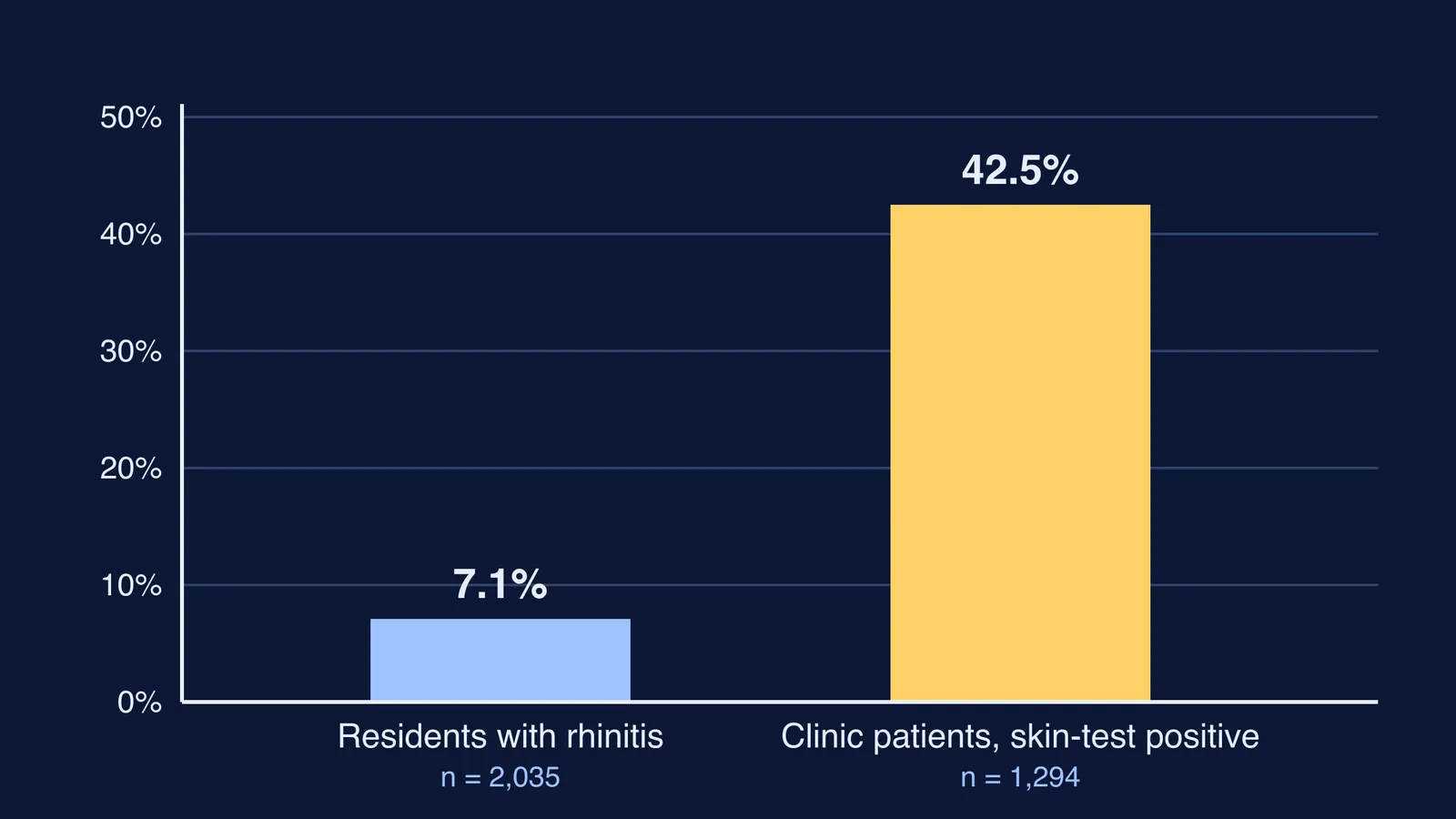
In a 1991 study in Clinical & Experimental Allergy, P. Sriramarao and colleagues surveyed 2,035 Bangalore residents and found that 7.1% had allergic rhinitis caused by Parthenium pollen (Sriramarao et al., 1991).
Among 1,294 clinic patients with nose and chest allergies, the same study found that 42.5% reacted to Parthenium pollen on skin-prick tests. Antibodies specific to Parthenium pollen allergens, both IgE and IgG, were found in the blood of Parthenium-sensitive rhinitis patients. The authors wrote that, to their knowledge, nowhere in the world had "such a high incidence of allergic rhinitis due to a single pollen" been reported.
Pollen is not the only route. Kaur's review says the pollen, airborne dried plant parts and roots of Parthenium cause contact dermatitis, hay fever, asthma and bronchitis (Kaur et al., 2014).
Will this pollen cause allergies? A four-question test
Built from the NCERT, AAAAI and Kaur points above:
Is it wind-pollinated? Look for small, dull flowers, no nectar and well-exposed stamens.
Does it release a lot of pollen?
Is the pollen light, dry and non-sticky?
Does it grow where people live, such as roadsides and empty plots?
Four yeses make a likely allergy plant, and Parthenium fits all four. A large, colourful, nectar-rich flower usually fails question 1, because its sticky pollen travels on insects, not air. Remember the limit: pine passes the first three and is still rarely allergenic, so the test flags suspects rather than giving a diagnosis.
Here is how this could look as a 3-mark answer to the question "Why do some pollen grains cause allergies? Give one Indian example."
Wind-pollinated plants produce large amounts of light, non-sticky pollen that stays in the air and is inhaled.
In sensitive people, proteins on the pollen trigger an allergic response, causing rhinitis, asthma or bronchitis.
Example: Parthenium (carrot grass), which entered India as a contaminant in imported wheat and causes pollen allergy.
If one link in that chain feels shaky, the Fermi Concept Library gives every biology concept its own lesson and shows its place in the map.
What can you do if pollen season hits you?
Note when and where symptoms start; AAAAI says pollen levels are highest from late morning to mid-afternoon (AAAAI).
Take those notes to a doctor, who can decide whether a pollen is the cause and what to do about it.
If breathing becomes hard, get medical help at once rather than waiting it out.
For the plant side of the story, compare adaptations of wind and water pollinated flowers.