

On this page
Planning in sports is taught in the first unit of Class 12 Physical Education, and drawing fixtures is the part that needs the most practice. The unit is still in the syllabus: CBSE's Physical Education curriculum for 2026-27 lists Unit 1, Management of Sporting Events, at 05 + 04b* marks, where b* marks concept-based questions, such as tactile diagrams, for visually impaired candidates. Its fixture topics are knockout (byes and seeding), league (staircase, cyclic and tabular methods) and combination tournaments.
The fixture rules below come from the CBSE Class 12 Physical Education textbook.
What is the difference between a knockout and a league tournament?
In a knockout, a team plays until it loses once, according to the CBSE textbook. It saves time and money, but a strong team can go out early by bad luck. In a league, or round robin, every team plays every other team: a fairer winner and a full ranking, but more time, money and facilities, and no seeding. A combination tournament joins the two.
How do you draw a knockout fixture with byes?
A bye lets a team skip the first round without playing. The CBSE textbook gives these rules for n teams:
Total matches = n − 1.
Byes = the next power of two minus n (none for 8, 16 or 32 teams).
Halves: n/2 each if n is even; if odd, (n + 1)/2 upper and (n − 1)/2 lower.
Byes per half: equal if even; if odd, (byes − 1)/2 upper and (byes + 1)/2 lower.
Bye order: last team of the lower half, first of the upper half, last of the upper half, first of the lower half, then repeat.
Not a textbook rule, but useful: rounds = the number of 2s multiplied to reach that power, and 16 = 2 × 2 × 2 × 2, so 9 to 16 teams need 4 rounds.
Worked example: a knockout for 11 teams
Matches = 11 − 1 = 10.
Byes = 16 − 11 = 5.
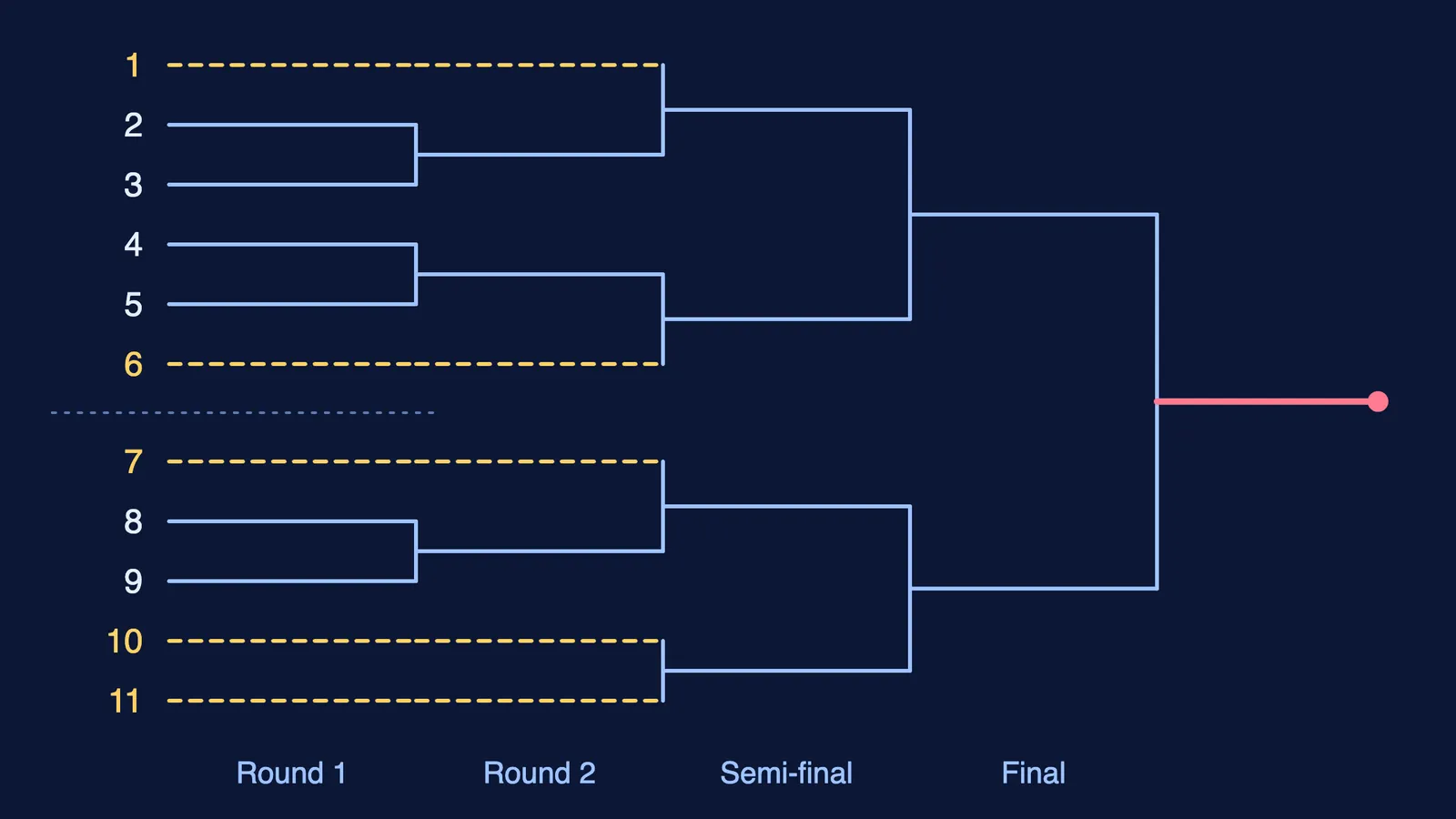
Upper half = (11 + 1)/2 = 6 teams (1 to 6); lower half = (11 − 1)/2 = 5 teams (7 to 11).
Byes in the upper half = (5 − 1)/2 = 2; lower half = (5 + 1)/2 = 3.
Byes go, in order, to teams 11, 1, 6, 7 and 10.
Round 1: 2 vs 3, 4 vs 5, 8 vs 9 (3 matches).
Round 2: 1 vs winner of 2-3, winner of 4-5 vs 6, 7 vs winner of 8-9, 10 vs 11 (4 matches).
Semi-finals (2 matches) and final (1 match).
Check: 3 + 4 + 2 + 1 = 10 matches, over 4 rounds. This is Illustration 3 in the textbook and the bracket at the top of this page.
How does seeding work in a knockout?
Seeding places strong teams so they do not meet early, and the CBSE textbook allots seeded positions the same way as byes. In the 11-team draw, two seeds would take positions 11 and 1, one per half, so they could meet only in the final.
How do you draw a league fixture?
The CBSE textbook gives total matches in a single league as n(n − 1)/2: 15 for 6 teams and 21 for 7. In the cyclic method, an even number of teams needs n − 1 rounds; an odd number needs n rounds, with one bye each round.
Worked example: a cyclic league for 6 teams
Matches = 6 × 5 / 2 = 15, in 5 rounds of 3. Keep team 1 fixed and rotate the other five one place clockwise each round:
Round 1: 1 vs 6, 2 vs 5, 3 vs 4
Round 2: 1 vs 5, 6 vs 4, 2 vs 3
Round 3: 1 vs 4, 5 vs 3, 6 vs 2
Round 4: 1 vs 3, 4 vs 2, 5 vs 6
Round 5: 1 vs 2, 3 vs 6, 4 vs 5
Each team plays 5 matches and no pair repeats.
The staircase method writes pairs as steps. For 7 teams, A plays B to G on the top step, B plays C to G, down to F vs G: 6 + 5 + 4 + 3 + 2 + 1 = 21.
How do you write a fixture answer for full marks?
Write the working first: matches, byes, teams and byes in each half.
Number the teams down the page and mark the two halves.
Label every round and check the match total.
Add date, time and venue, as the textbook does.
If powers of two or n(n − 1)/2 feel shaky, the Fermi Concept Library covers every concept in mathematics, each with its own lesson and its place in the map.
Revise this unit alongside training methods for strength, endurance and speed and physical education and sports for CWSN. If running tournaments appeals, read about sports management courses after Class 12.
Tonight, draw one 11-team knockout and one 6-team league from a blank page, and check both totals.


