
On this page
A standard Class 12 and JEE Main 3D geometry question gives you a line and a point off it, and asks for the plane that holds both. You need no new formula: one cross product gives the normal.
Why does a line and a point fix exactly one plane?
OpenStax Calculus Volume 3 states that "given any three points that do not all lie on the same line, there is a unique plane that passes through these points" (OpenStax Calculus Volume 3, section 2.5). A line plus a point off it gives you three such points: any two on the line, and the point itself.
The same section gives the scalar equation of a plane through P0(x0, y0, z0) with normal vector n = (n1, n2, n3): n1(x − x0) + n2(y − y0) + n3(z − z0) = 0. So the whole job is finding n.
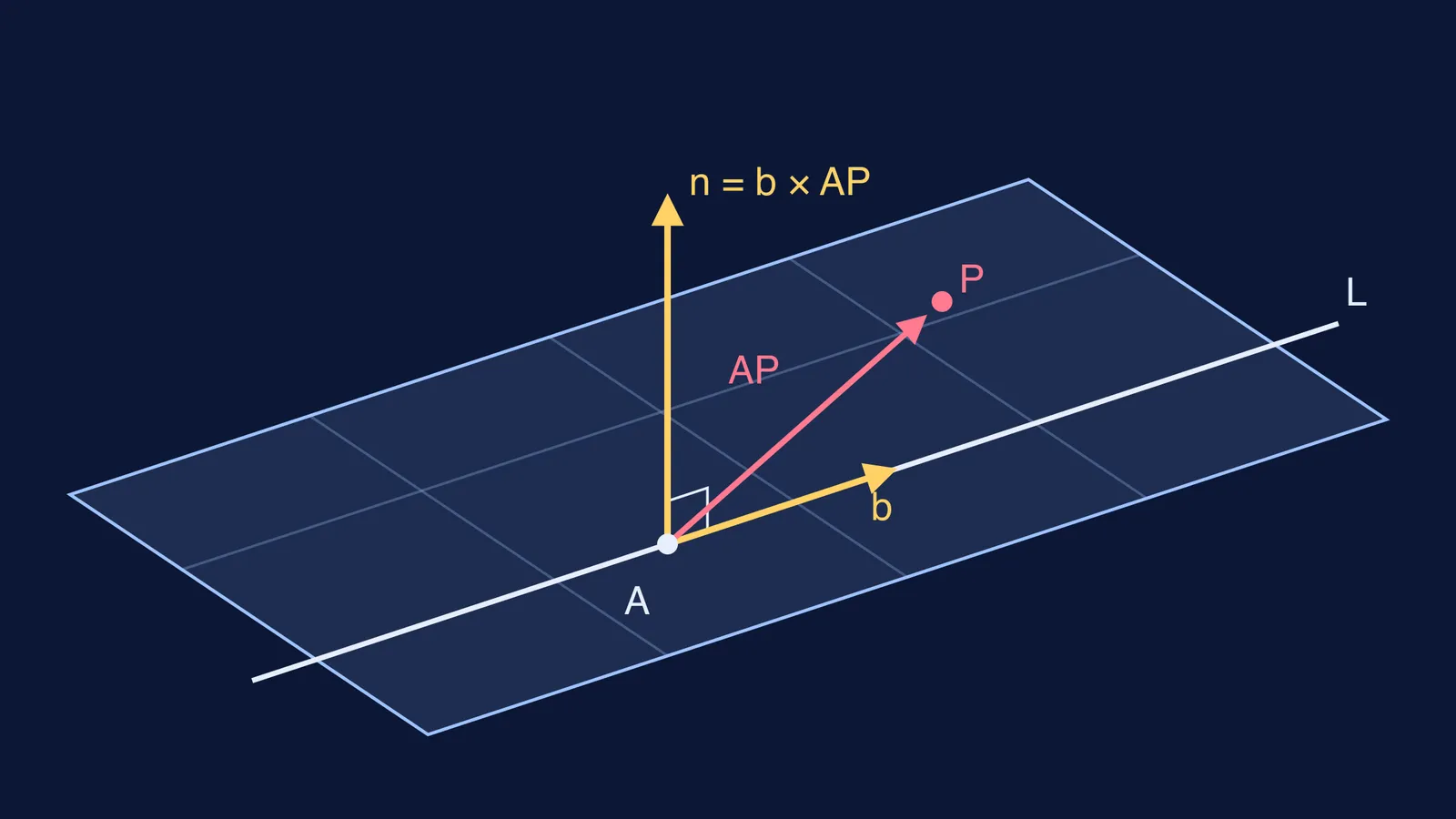
The plane contains the line's direction b and the vector AP from a point A on the line to P. The normal is perpendicular to both, so it is their cross product. OpenStax's Example 2.50 takes exactly this route.
How do you find the equation of a plane containing a line and a point?
Read a point A and the direction b from the line. For (x − x1)/b1 = (y − y1)/b2 = (z − z1)/b3, A = (x1, y1, z1) and b = (b1, b2, b3). For r = a + λb, read them off directly.
Check that P is not on the line; if it is, infinitely many planes fit.
Find AP = P − A.
Compute n = b × AP. A zero vector means P is on the line, or an arithmetic slip.
Write n · (r − a) = 0, where a is A's position vector, and expand it.
Check by substitution (below).
Worked example: line (x − 1)/2 = (y + 1)/3 = (z − 2)/1 and point P(2, 1, 4)
Step 1. From the line, A = (1, −1, 2) and b = (2, 3, 1).
Step 2. Is P on the line? (2 − 1)/2 = 1/2, but (1 + 1)/3 = 2/3. The ratios differ, so P is off the line and exactly one plane exists.
Step 3. AP = (2 − 1, 1 − (−1), 4 − 2) = (1, 2, 2).
Step 4. n = b × AP, with b = (2, 3, 1) and AP = (1, 2, 2):
i component: 3 × 2 − 1 × 2 = 4
j component: −(2 × 2 − 1 × 1) = −3
k component: 2 × 2 − 3 × 1 = 1
So n = (4, −3, 1).
Step 5. Using point A: 4(x − 1) − 3(y + 1) + 1(z − 2) = 0, which expands to 4x − 3y + z = 9. In vector form, r · (4i − 3j + k) = 9.
How do you check the answer by substitution?
Put points you know into 4x − 3y + z and see whether you get 9 each time:
A(1, −1, 2): 4 + 3 + 2 = 9. Correct.
P(2, 1, 4): 8 − 3 + 4 = 9. Correct.
A second point on the line, taking λ = 1: (3, 2, 3) gives 12 − 6 + 3 = 9. Correct.
Direction check: n · b = 8 − 9 + 1 = 0, so the line runs parallel to the plane and, since A is in it, lies inside it.
Why a second line point? Many planes pass through A and P; only the one holding the whole line passes the third check. If a check fails, recheck the sign of the j component, then the subtraction in AP.
What if the question is set a different way?
Determinant form. Some books set a 3 × 3 determinant with rows (x − 1, y + 1, z − 2), (2, 3, 1) and (1, 2, 2) to zero. Expanding it gives the same 4(x − 1) − 3(y + 1) + (z − 2) = 0.
Line given by two points. Subtract them to get b, and you are solving the equation of a plane through three points.
Follow-up parts. Exam questions often go on to ask for the distance of a point from the plane you just found, or where another line meets the plane.
If your cross product keeps coming out wrong, the Fermi Problem Library has worked problems with a step-by-step solver that explains the reasoning rather than printing an answer, so you can see which step went off. If the normal vector idea itself feels shaky, the Fermi Concept Library gives each concept in mathematics its own lesson and its place in the map.
Try it now on a fresh pair: the line r = (0, 1, 1) + λ(1, 1, 0) and the point (1, 0, 2). Find n, write the plane, and run all four checks.