On this page
Look closely at a pineapple's skin. Each diamond-shaped "eye" is what's left of a separate flower. That one fact explains why pineapple, jackfruit, mulberry and fig sit in a different box in your biology notes from mango or custard apple, and why exam questions keep testing the difference.
What is a multiple fruit?
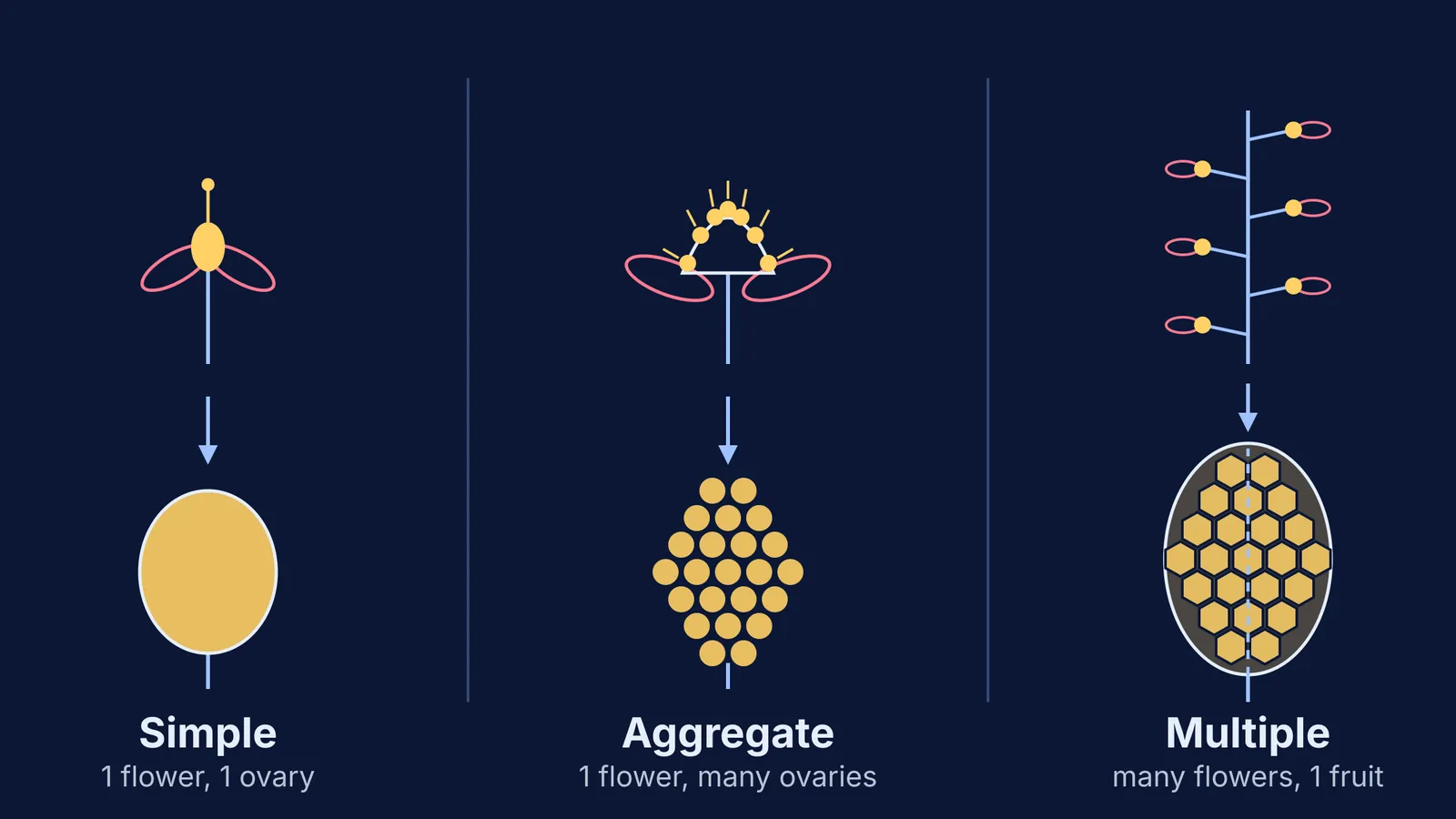
Botany sorts fruits by counting two things: flowers and ovaries. A fruit morphology teaching note from SIES College sets out the three main groups:
Simple fruit: develops from the ovary of a single pistil in one flower, as in pea or mango.
Aggregate fruit (etaerio): a cluster of simple fruitlets from the separate ovaries of one flower, as in raspberry (an etaerio of drupes) or custard apple (an etaerio of berries).
Multiple (composite) fruit: a whole inflorescence, meaning many flowers on one axis, ripens into one fruit-like mass.
The pineapple shows how many flowers can be involved. According to Useful Plants, an economic botany resource from Naturalis Biodiversity Center, the pineapple's compact inflorescence of 100 to 200 flowers develops into an equal number of fused, berry-like fruitlets. So the "one fruit" on your plate is really a hundred or more fruitlets joined together.
Sorosis vs syconus: what is the difference?
Multiple fruits come in two types, and the difference is the shape of the inflorescence they grow from.
Sorosis is a multiple fruit that develops from a spike, spadix or catkin, where the perianth of each flower becomes fleshy and sometimes the peduncle does too, as in pineapple (SIES College note). The flowers sit on the outside of an axis.
Mulberry: the flowers grow in a catkin. Each ovary becomes a drupelet, and the ripened cluster is a multiple fruit, explains botanist W.P. Armstrong on Wayne's Word.
Jackfruit: a 2019 review in the International Journal of Food Science describes it as formed by the fusion of multiple flowers in an inflorescence, with three regions: the fruit axis, the persistent perianth and the true fruit. The fleshy bulb you eat belongs to the perianth, which fits the sorosis pattern. The same review says jackfruit is native to the Western Ghats of India and that flesh makes up about 30% of the fruit's weight.
Syconus (also called a syconium) develops from a hypanthodium inflorescence, where the peduncle becomes fleshy and hollow, as in fig, banyan and peepal (SIES College note). Here the flowers sit on the inside. A University of Queensland explainer describes the fig as an inside-out inflorescence holding anywhere from tens to thousands of tiny flowers, depending on the species. These flowers are never seen from outside. Fig wasps reach them through a small opening called the ostiole. Our post on how fig wasps and figs depend on each other covers that partnership.
How do you tell a multiple fruit from an aggregate fruit?
Use this three-question test on any fruit in a diagram or an assertion-reason question:
How many flowers made it? One flower: go to question 2. Many flowers on one axis: it is a multiple fruit, so go to question 3.
How many free carpels did that flower have? One pistil, even one made of fused carpels: simple fruit. Many separate carpels: aggregate fruit.
Where were the flowers? On the outside of a spike, spadix or catkin: sorosis. Inside a hollow, fleshy receptacle: syconus.
Here is the test run on six fruits, using the sources above:
Pineapple: 100 to 200 flowers on one axis (Useful Plants), so multiple, sorosis.
Jackfruit: many fused flowers with a fleshy perianth, so multiple, sorosis.
Mulberry: drupelets from separate flowers of a catkin, so multiple, sorosis.
Blackberry: looks like a mulberry, but Armstrong notes all its drupelets come from a single flower, so aggregate.
Custard apple (sitaphal): many berries from one flower, so aggregate (etaerio of berries).
Fig: flowers hidden inside a hollow receptacle, so multiple, syconus.
If spike, spadix, catkin and hypanthodium still blur together, revise racemose and cymose inflorescence types first. Question 3 depends on them. The Fermi Concept Library gives every biology concept its own lesson and its place in the map, which helps when one topic depends on another.
Which mistakes cost marks on fruit questions?
Calling mulberry aggregate. It looks like a blackberry, but its drupelets come from many flowers.
Calling fig a sorosis. The flowers are inside, so it is a syconus.
Equating "many seeds" with "multiple fruit". A tomato is a many-seeded berry, and a berry is a simple fruit.
Forgetting the non-ovary parts. In a sorosis, the perianth, and sometimes the peduncle, become fleshy, so much of what you eat is not the ovary wall. Our guide to false fruits and parthenocarpy explains why that matters.
Try the three-question test on the next fruit you eat, and say the answer out loud.