

On this page
Two flowering shoots can look almost the same in a textbook diagram, and a one-line question can turn on a single detail. That detail is the growing tip of the main axis. Check it first and most inflorescence questions sort themselves out, including the special types that seem to break the rules.
What is the difference between racemose and cymose inflorescence?
An inflorescence is a cluster of flowers arranged on a stem made of a main branch or a system of branches, as the Wikipedia overview of inflorescence puts it.
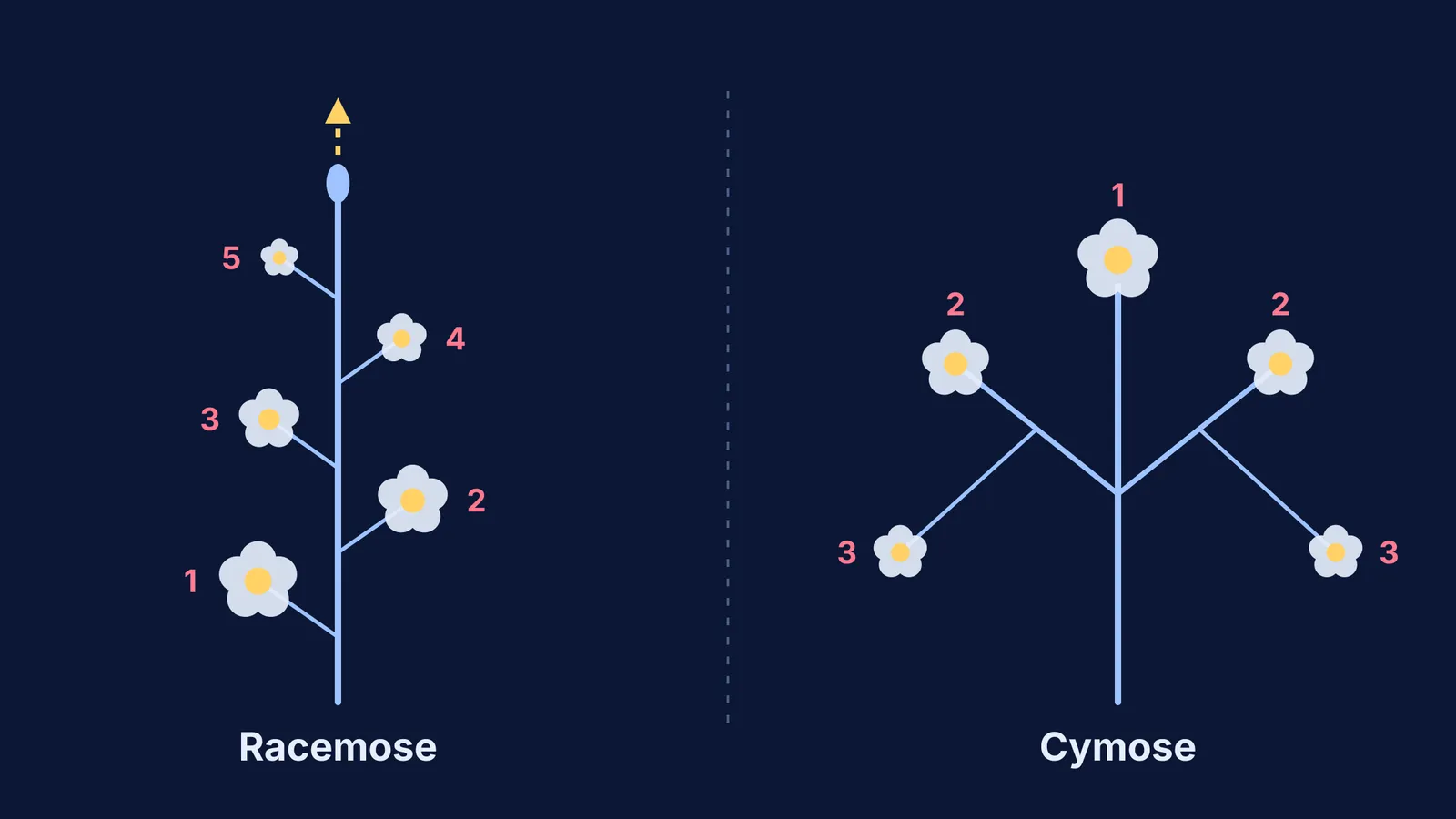
In a racemose (indeterminate) inflorescence, the terminal bud keeps growing and forming lateral flowers, and a terminal flower is never formed (Inflorescence).
In a cymose (determinate) inflorescence, the terminal bud forms a flower and then stops, and the other flowers grow from lateral buds (Inflorescence).
Everything else follows from that one difference. If the tip keeps growing, new flowers appear above the old ones, so the oldest sit at the bottom. This is acropetal order. Mustard and radish carry racemes, with the oldest flowers near the base and new ones opening as the shoot grows upward (Raceme).
If the tip is used up by a flower, that flower is usually the first to mature (Inflorescence), and younger flowers come from side buds below it. School textbooks call this basipetal order, though in some cymes the remaining flowers open from the base upward. Jasmine flowers are borne in cymose clusters, typically of at least three flowers (Jasmine).
How do you identify the type from a diagram?
Work through these steps in order; step 2 settles most questions.
Trace the main axis to its very top.
Look at what is there: a bud or growing point means racemose; an open flower means cymose.
Check the ages. Bigger or more open flowers are older. Racemose: oldest at the base. Cymose: oldest at the top.
If the head is flat or crowded, read position instead of height. Squash a racemose axis flat and its base becomes the rim, so the oldest flowers are on the outside and the youngest in the centre (centripetal). In a cyme the centre flower is the oldest (centrifugal).
In a cyme, count side branches at each node. One branch gives a monochasium; two give a dichasium (Inflorescence).
Worked example. A diagram shows a stalk ending in a fully open flower, with two smaller flowers on short side branches just below it. Step 2: the tip ends in a flower, so it is cymose. Step 5: two side branches at the node, so it is a dichasial cyme. The flower at the top opened first.
What are capitulum, cyathium and the other special types?
These look like single flowers, which is why they confuse students. Apply the same tip test to each.
Capitulum (head). A capitulum is a very contracted raceme whose stalkless flowers are borne on an enlarged stem (Inflorescence). So it is racemose. In the sunflower, what looks like one flower is a flower head 7.5–12.5 cm wide made of many small florets (common sunflower). The outer ray florets look like petals and are sterile, while the spirally arranged disc florets in the centre mature into the "seeds".
Cyathium. The cyathium of *Euphorbia* closely resembles a single bisexual flower. It is traditionally interpreted as an inflorescence of highly reduced male flowers surrounding a single terminal female flower, according to a 2007 study of its development in the American Journal of Botany by Prenner and Rudall. The flowers sit in a cup-shaped structure of bracts, often rimmed with nectaries, and each male flower is a single stamen (Pseudanthium). Run the tip test: the axis ends in a flower, so the cyathium sorts with the cymose types.
Hypanthodium. In figs (*Ficus*), numerous flowers are borne on the inside of an inward-folded receptacle (Inflorescence). This fleshy, hollow structure holds between 50 and 7,000 tiny flowers depending on the species, closed off by a small opening called the ostiole (Syconium).
Verticillaster. A verticillaster is a cluster built like a dichasium and is common in the mint family, Lamiaceae (Inflorescence).
Which examples should you remember for NEET-UG?
Keep one example per type and tie each to its tip-test answer:
Raceme (racemose): mustard, radish
Capitulum (racemose, condensed): sunflower
Cymose cluster: jasmine
Cyathium (cymose, special): *Euphorbia*
Hypanthodium (special): fig
Verticillaster (special, dichasium-like): the mint family
A five-minute drill helps: cover the type names, read each example, say its type and the reason ("tip ends in a flower, so cymose"), then check. The reason is what you will need for a diagram you have not seen before.
If a term in the chain is shaky, such as bract, pedicel or receptacle, the Fermi Concept Library has a lesson for each concept in biology and shows where it sits in the map. For practice questions, the Fermi Problem Library works through problems step by step and explains the reasoning rather than printing an answer.
Inflorescence is one part of a bigger chapter. Next, see how to read a floral formula, then aestivation types: valvate, twisted and imbricate and placentation types in flowers.


