

On this page
You might expect leaves to send glucose to roots, fruits and growing tips. They mostly don't. What moves through phloem is mainly sucrose, a disaccharide of glucose and fructose; some plants also send related non-reducing sugars. Two properties explain the choice: sucrose is chemically quiet, and it packs two sugar units into each dissolved particle.
Why is sucrose transported in phloem instead of glucose?
The textbook rule has been tested. In a 2012 study in the Journal of Experimental Botany, David Liu, Wesley Chao and Robert Turgeon fed radiolabelled carbon dioxide to leaves of four plant species and found almost all the label in the leaf stalks was in sucrose, with little in glucose or fructose. The paper restates the long-held view that non-reducing sugars were selected as transport compounds because they are less reactive than reducing sugars.
Concentration is what makes reactivity matter. During long-distance transport, sugar in companion cells and sieve tubes reaches several hundred millimolar up to 1 M, according to a 2020 review of plant glucose transporters by Dietmar Geiger. The same review explains that at high concentrations, reducing sugars can react with amino-acid residues without any enzyme (non-enzymatic glycosylation), damaging proteins the cell needs. So plants prefer to move sucrose. (Storage follows similar logic: see why plants store starch instead of glucose.)
What makes sucrose a non-reducing sugar?
A reducing sugar has a free anomeric carbon (C1 in glucose), so its ring can open into an aldehyde or ketone form that reduces Fehling's reagent and reacts with proteins.
In sucrose, the glycosidic bond is an ether link between C1 of the glucose unit and C2 of the fructose unit. Both anomeric carbons are used up, so neither ring can open, and sucrose is classified as a non-reducing sugar.
There is a cost: as a relatively large polar molecule, sucrose needs membrane proteins to cross membranes, and Brian Ayre's 2011 review notes that only symport with protons is well established at the molecular level.
How does sucrose's osmotic effect drive pressure flow?
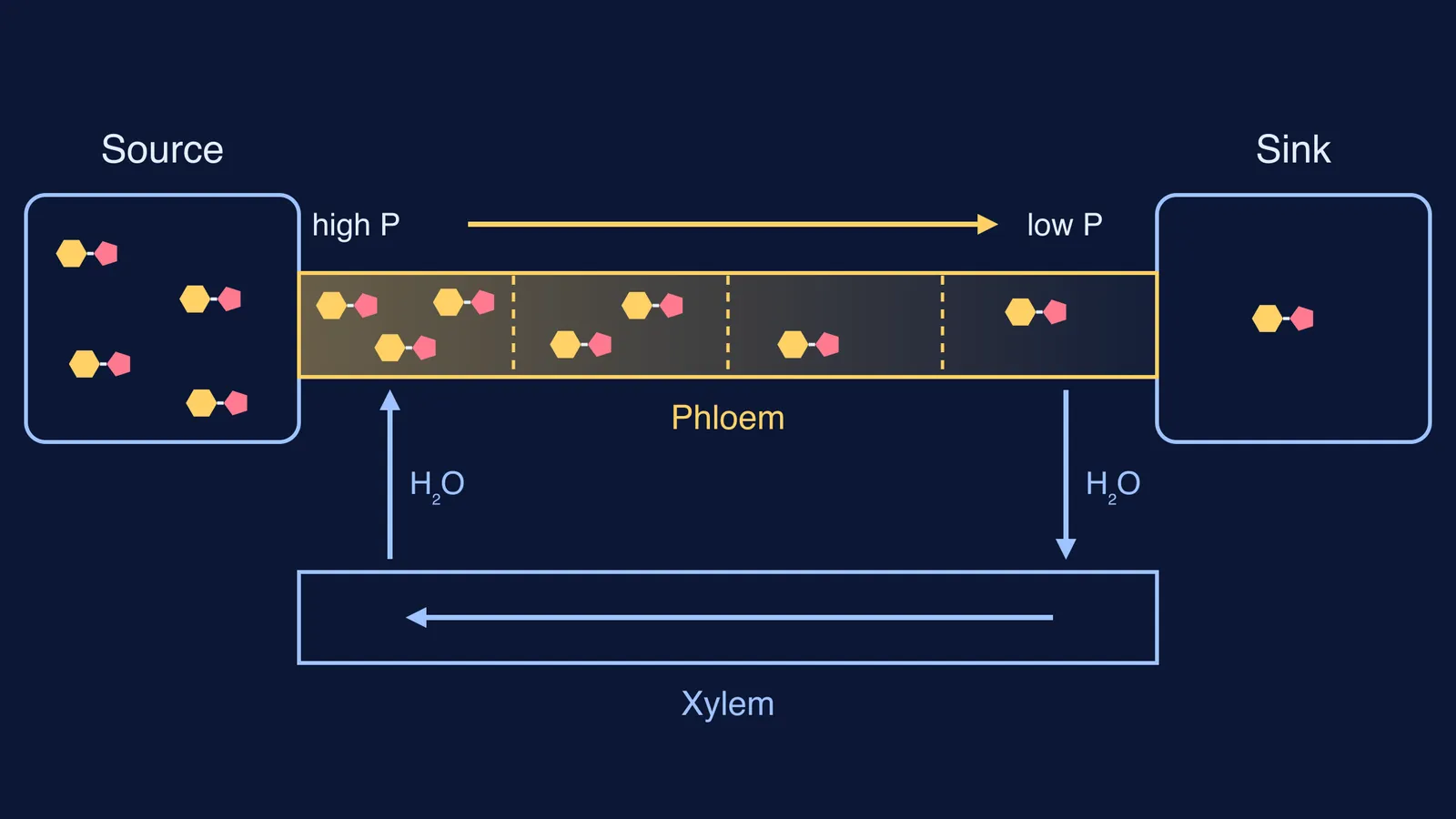
Ernst Münch proposed the pressure flow model in 1930; a 2016 eLife study by Michael Knoblauch and colleagues tested it in Ipomoea nil and found that sieve tube conductivity and turgor rise with source-to-sink distance, supporting it. The steps, from this UC Davis botany text on translocation):
Sucrose is actively loaded from leaf cells into companion cells and sieve tubes.
The dissolved sugar lowers the water potential, so water enters the phloem from the nearby xylem.
Turgor pressure builds at the source, and sap flows towards the sink, where pressure is lower.
At the sink, sucrose is unloaded and used or stored, and water returns to the xylem.
For more detail, see pressure flow hypothesis: how phloem moves sugar and how the girdling experiment proves phloem carries food.
How much osmotic pressure does sucrose save?
Osmotic pressure depends on the number of dissolved particles, not their size: the van 't Hoff equation/Physical_Properties_of_Matter/Solutions_and_Mixtures/Colligative_Properties/Osmotic_Pressure) gives Π = iMRT, with i = 1 for sugars because they do not ionise. Suppose a sieve tube must carry 1 mol of hexose units per litre at 25 °C (298 K), using R = 0.0821 L atm/mol K.
As glucose: M = 1.0 mol/L, so Π = 1.0 × 0.0821 × 298 ≈ 24.5 atm, about 2.5 MPa.
As sucrose: the same hexose units pair up into 0.5 mol/L, so Π ≈ 12.2 atm, about 1.2 MPa.
This is an ideal-solution estimate, but the direction holds: sucrose carries 12 carbons per particle, glucose 6, so the plant moves the same sugar with half the osmotic load. There is an upper limit: a 2013 analysis by Kaare Jensen, Jessica Savage and Michele Holbrook notes that if sugar is too concentrated, sap viscosity impedes flow. Literature data from 41 species gave average phloem sugar concentrations of 18.2% (all species) to 21.1% (active loaders).
How do you answer this in an exam?
A complete answer has four points:
Structure: C1 of glucose and C2 of fructose form the glycosidic bond, so there is no free anomeric carbon and sucrose is non-reducing.
Stability: unlike reducing sugars, it does not glycate proteins, even at sieve-tube concentrations.
Osmotic effect: one particle carries two hexose units, so more sugar moves per unit of osmotic pressure.
Link to pressure flow: loading sucrose lowers water potential at the source, water enters from the xylem, and turgor pushes sap to the sink.
If water potential or reducing sugars still feel shaky, the Fermi Concept Library gives each concept its own lesson and its place in the map. To practise the numbers, the Fermi Problem Library has worked problems with a step-by-step solver that explains the reasoning.
Next time you revise translocation, write the four points from memory, then check them here.


