On this page
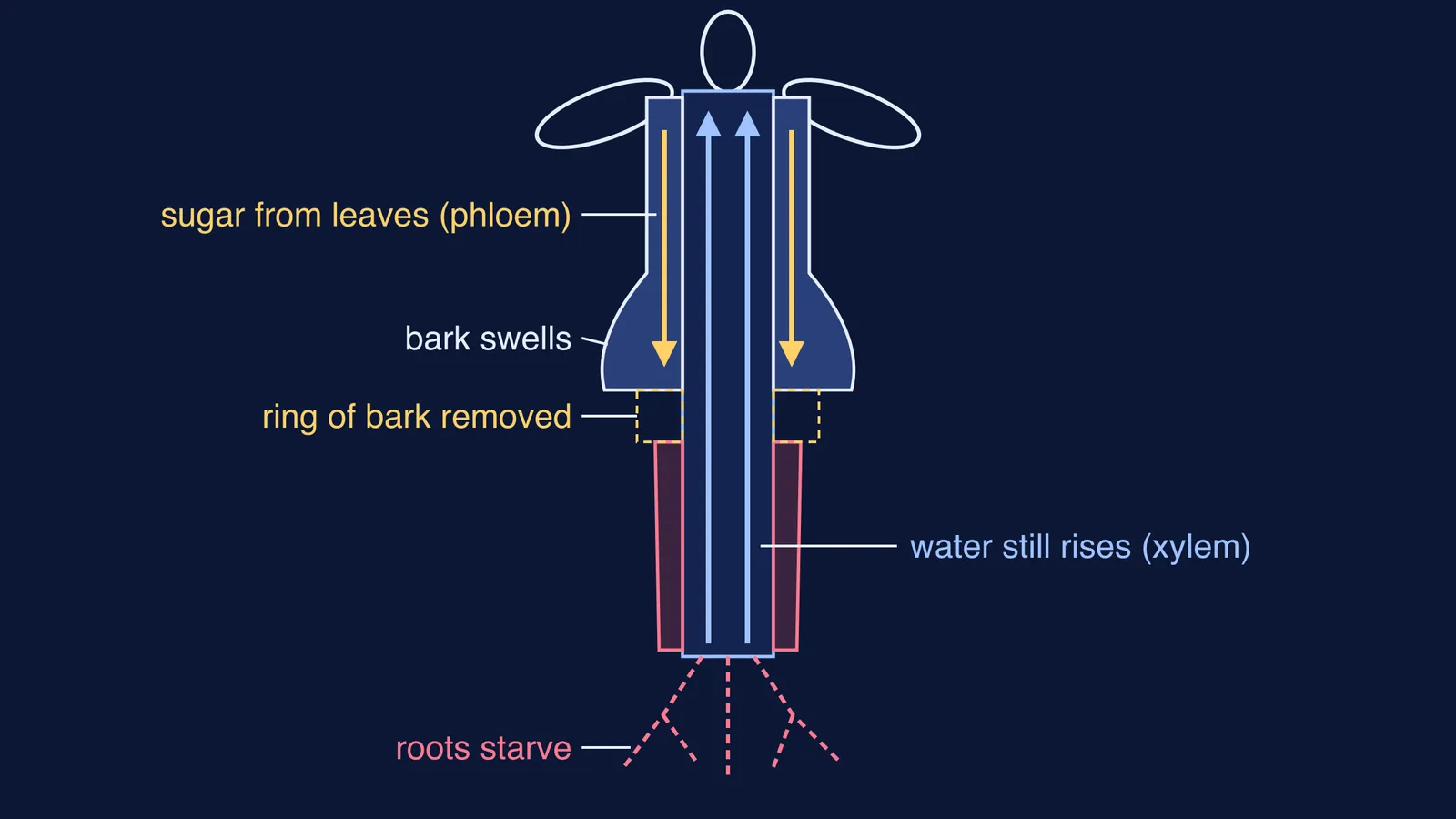
Cut a complete ring of bark from a woody stem and wait. The bark above the cut swells and the roots slowly run out of food, yet water keeps reaching the leaves. That result is the standard evidence that phloem carries sugar down from the leaves, and examiners build predictable MCQs on it.
What is the girdling experiment?
Girdling is the complete removal of a strip of bark around a stem's outer circumference, as defined by Veerle De Schepper and Kathy Steppe in a 2011 Annals of Botany paper. Growers use it to promote flowering and improve fruit production.
The trick is anatomy. In a woody stem, bark is everything from the vascular cambium outward (OpenStax Biology 2e, Stems), so the phloem goes with it, while the wood (xylem) stays inside. In a 2015 girdling study on three-year-old Canary Island pine seedlings, the strip removed was periderm, cortex and phloem, and girdling did not affect xylem embolism (López and colleagues, Frontiers in Plant Science). One cut separates the two transport systems: phloem gone, xylem untouched.
The classic version is credited to Marcello Malpighi in 1686, according to student resources for Taiz's Plant Physiology and Development.
Why does the bark swell above the ring and the roots starve?
Start with what phloem does. Translocation is the delivery of sugars from sources such as leaves to sinks such as roots, young shoots and developing seeds through the phloem (OpenStax Biology 2e, Transport).
Above the ring, sugar coming down from the leaves reaches the cut and cannot cross it. The Taiz web topic says sugars accumulate above the girdle and are depleted below it, and that eventually the bark below dies while the bark above swells and stays healthy. The swelling is real growth: De Schepper and Steppe report stem growth speeding up above the girdle and stopping below (Annals of Botany).
Below the ring, the roots are a sink with no supply. The pine study reports that roots are gradually depleted of their carbohydrate reserves and can suffer starvation, and its seedlings survived more than 140 days without carbohydrate supply to the roots (Frontiers in Plant Science). So the damage builds slowly, starting below the ring.
Meanwhile, the leaves do not wilt straight away. Describing Mason and Maskell's 1928 work, the Taiz web topic states that girdling has no immediate effect on transpiration, because water moves in the xylem, inside the bark.
How does girdling prove phloem transports food?
Read it as an experiment with one tissue removed:
The cut removes phloem but leaves xylem.
Water still reaches the leaves, so water transport does not need phloem.
Sugar piles up just above the cut and is missing below, so sugar travels down through the tissue that was removed.
The only conducting tissue removed is phloem, so phloem carries food.
The Taiz web topic concludes that sugar moves in the bark, with sieve elements as its channels. For what happens inside them, see the pressure-flow hypothesis of phloem transport and how sieve tubes and companion cells work together.
What MCQ traps are built on the girdling experiment?
The plant wilts at once. Wrong: transpiration is not immediately affected, because the xylem is intact.
The bark swells below the ring. Wrong: it swells above, on the side toward the leaves.
The roots die because water cannot reach them. Wrong: they starve of sugar, not water.
Phloem only moves food downward. Wrong: the trunk experiment shows downward flow, but intermediate leaves send products in both directions, unlike xylem flow, which is always one-way (OpenStax).
It works on any stem, such as maize. Wrong: in monocot stems the vascular bundles are randomly scattered (OpenStax), so no ring of outer tissue removes the phloem while leaving the xylem.
Worked example: a ring of bark is removed from a mango tree's main stem. What is most likely after some weeks? (a) The leaves wilt within a day. (b) The bark below the ring swells. (c) The bark above the ring swells and the roots slowly starve. (d) Water stops reaching the leaves.
The answer is (c). Options (a) and (d) assume the cut reached the xylem. Option (b) puts the sugar on the wrong side: it comes down from the leaves, so it collects above.
How should you revise the girdling experiment?
Draw a stem with a ring cut out, a yellow arrow coming down and stopping at the ring, and a blue arrow going straight up through it. Say the four-step chain aloud. Then cover the trap list and explain why each statement is wrong. If you can say why water still reaches the leaves but the roots starve, you understand it rather than having memorised it.
If a step in the chain feels shaky, the Fermi Concept Library has a lesson for every concept in biology, each with its place in the map. To practise, the Fermi Problem Library has worked problems with a step-by-step solver that explains the reasoning rather than printing an answer.
Next, read how Ernst Münch explained pressure flow in the phloem.