

On this page
While the amount of sugar a plant produces can be limited by factors such as photorespiration, where RuBisCO wastes energy in C3 plants, the sugars that are successfully made must be transported to the rest of the plant. They achieve this using a specialised vascular tissue called the phloem 1. Just as overall growth is directed by specific regions like apical, intercalary and lateral meristems, this transport system relies on highly specialised cell partnerships. The main conduits within the phloem are sieve tube elements—but to become effective pipes, these cells must sacrifice a crucial part of themselves.
Why do sieve tube elements lack a nucleus?
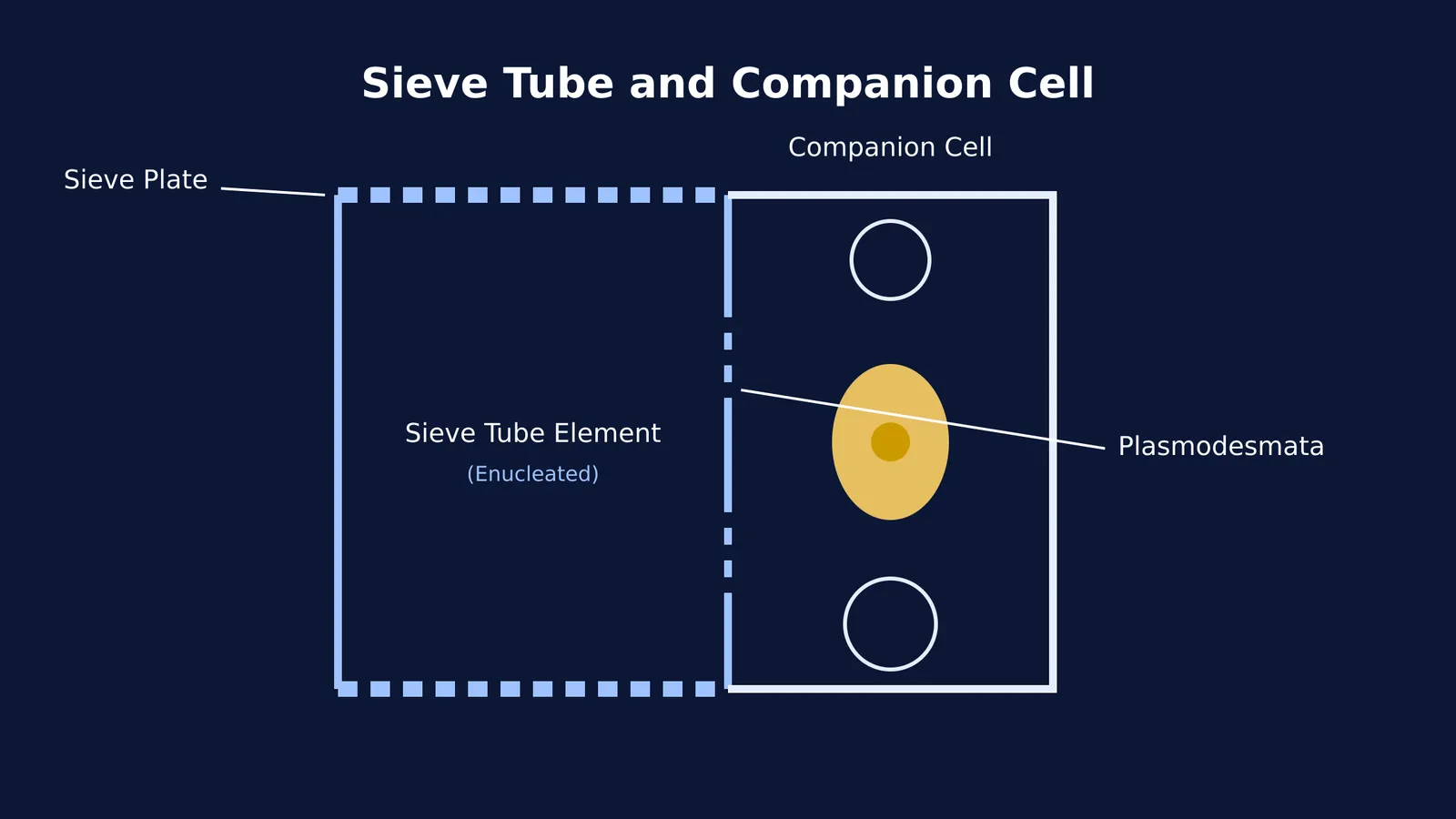
In angiosperms (flowering plants), the primary cells responsible for transporting organic nutrients are the sieve tube elements 1. At maturity, these cells undergo a drastic transformation: they lose their nucleus, their ribosomes, and many other organelles. One of the few organelles they retain is the rough endoplasmic reticulum, which is typically found near the plasma membrane, often close to the plasmodesmata 1.
This structural reduction creates a clear, unobstructed channel that allows sap to flow freely through the sieve tube. However, a cell without a nucleus or ribosomes cannot synthesize proteins or manage its own basic metabolic functions. Left alone, an enucleated cell would die. To survive and function, it forms a lifelong partnership with a sister cell.
What is the relationship between sieve tube and companion cell?
Because mature sieve tube elements lack the machinery to run themselves, they rely entirely on adjacent companion cells 1. A companion cell is a specialised parenchyma cell that retains its nucleus, alongside a high density of ribosomes and mitochondria.
The two cells act as a single functional unit. All the cellular and metabolic functions required by the sieve tube element are carried out by its dedicated companion cell 1.
How do companion cells control sieve tubes?
The connection between the two cells is direct and intense. They share a common sidewall, which has large numbers of microscopic channels known as plasmodesmata 1.
Through these plasmodesmata, the companion cell sends proteins, ATP, and signalling molecules to keep the sieve tube element alive. These channels also facilitate the active loading and unloading of sugars (such as sucrose) from the surrounding tissues into the sieve tube for long-distance transport 1. Specialized companion cells actively pump solutes and sugars into their cytoplasm using energy in the form of ATP 1. This active phloem loading creates the positive hydrostatic pressures required to move the sap throughout the plant 1.
What are albuminous cells in gymnosperms?
The specific partnership of a sieve tube element and a companion cell is unique to flowering plants. Gymnosperms (such as pine trees) and seedless vascular plants use a slightly different anatomical system.
Instead of sieve tube elements, gymnosperms rely on narrower conducting cells called sieve cells, which lack highly specialized sieve plates 1. Because they do not have companion cells, the metabolic support for these sieve cells is provided by albuminous cells (also known as Strasburger cells). Like companion cells, albuminous cells supply the enucleated sieve cells with necessary metabolites 1.
Mastering plant anatomy
When studying plant anatomy for exams, it is crucial to remember the differences between the angiosperm and gymnosperm vascular systems. A common mistake is confusing the angiosperm pair (sieve tube elements and companion cells) with the gymnosperm pair (sieve cells and albuminous cells).
It helps to build a conceptual map of how these tissues relate rather than relying on rote memorisation. If you are struggling to picture these cellular relationships, the Fermi Concept Library maps out every biological concept with its own lesson, showing how structures like plasmodesmata fit into the larger picture of plant transport. When you encounter a challenging question on these structures, the Fermi Problem Library breaks down the reasoning step by step rather than just printing the final answer.
Summary Checklist for Phloem Transport
Sieve tube element: Found in angiosperms; lacks a nucleus at maturity; conducts sap.
Companion cell: Found in angiosperms; nucleated; controls the sieve tube; connected via plasmodesmata on shared sidewalls.
Sieve cell: Found in gymnosperms; narrower conducting cell.
Albuminous cell: Found in gymnosperms; supports the sieve cell.


