On this page
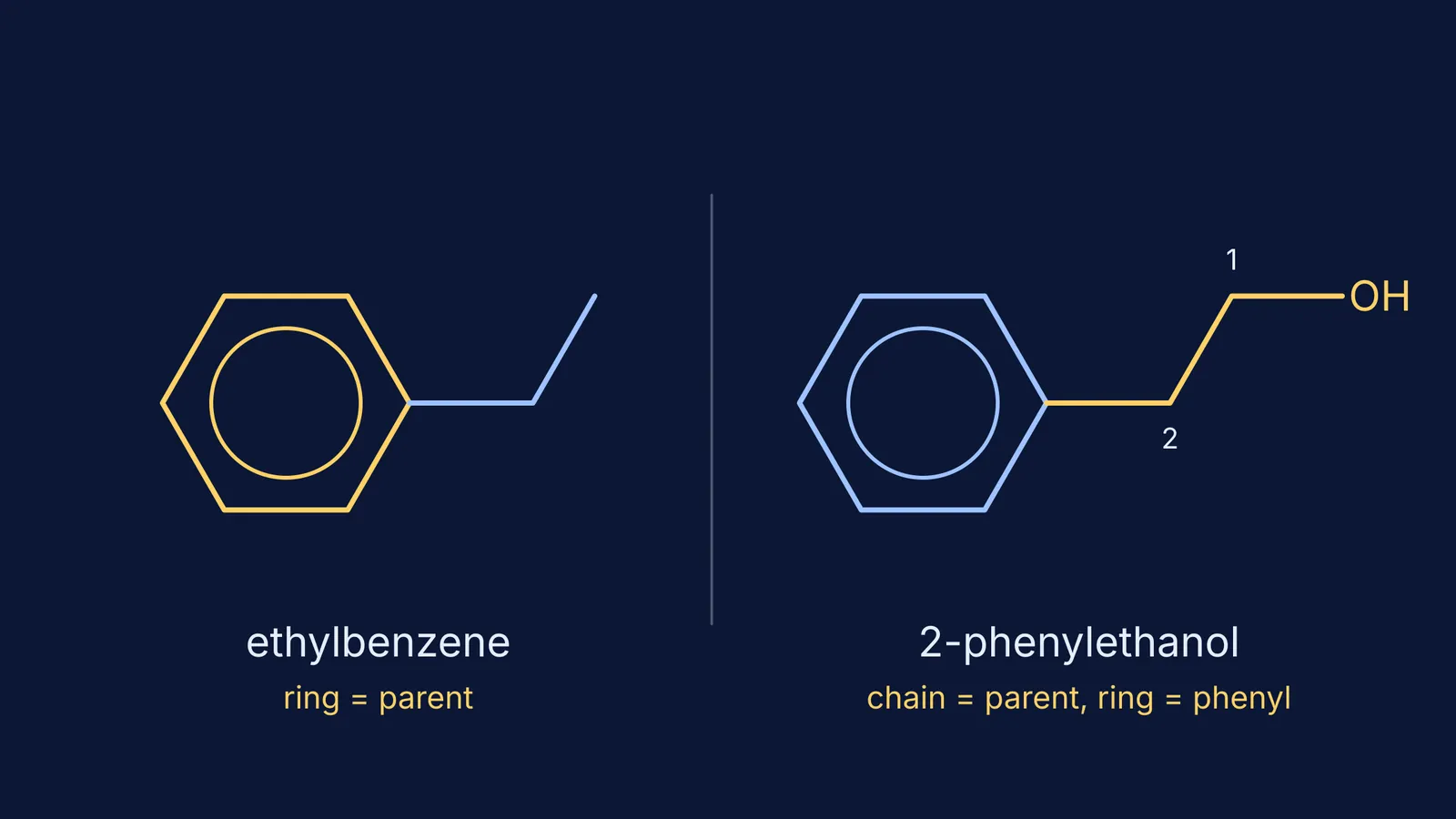
You see a C6H5 ring on a structure and two names compete: something-benzene, or phenyl-something. One question settles it: which part of the molecule is the parent? Benzene is the parent when it carries the main functional group or wins the tie. Otherwise it is a substituent called phenyl.
What does phenyl mean in IUPAC naming?
Phenyl is the prefix for C6H5–, a benzene ring that has lost one hydrogen so it can attach to something else. The IUPAC 2013 recommendations keep 'phenyl' as a retained prefix that can be fully substituted, so a name like 4-methylphenyl is correct (IUPAC Blue Book, P-29.6.1). The same section treats benzyl (C6H5CH2–) as a separate retained prefix, so do not mix the two up. Benzene itself is the retained name for C6H6 (IUPAC Blue Book, P-22.1.2).
When is benzene named as phenyl in IUPAC?
Run two checks, in this order.
Find the principal characteristic group. This is the highest-ranking group that can be written as a suffix. IUPAC's first rule for choosing the parent is that it has the most of these groups (IUPAC Blue Book, P-44.1.1). The class order in the same chapter (P-41) puts acids first, then, among the common classes, anhydrides, esters, acid halides, amides, nitriles, aldehydes, ketones, hydroxy compounds (alcohols and phenols) and amines. If that group sits on the chain, the chain is the parent and the ring becomes phenyl.
If there is no suffix group, compare ring and chain. The 2013 rule is: "Within the same class, a ring or ring system has seniority over a chain" (IUPAC Blue Book, P-44.1.2.2). That is why the preferred IUPAC name is heptylbenzene, not 1-phenylheptane.
Halogens and nitro groups never decide check 1. IUPAC says halogens are always written as prefixes in substitutive names, and –NO2 is named with the prefix 'nitro' (IUPAC Blue Book, P-61.3 and P-61.5). So chlorobenzene and nitrobenzene keep benzene as the parent.
If the suffix ranking itself is shaky, our post on the IUPAC functional group priority order goes through it in full.
Worked examples: benzene or phenyl?
Each name below is the computed IUPAC name listed on PubChem; open the link to see the structure.
Benzoic acid: COOH sits on the ring, so benzene is the parent.
2-phenylacetic acid: COOH sits on the CH2 carbon, so the two-carbon acid is the parent and the ring is phenyl.
1-phenylethanone (acetophenone): the ketone carbon belongs to the two-carbon chain, so ethanone is the parent.
2-phenylethanol: OH is on the end of the chain, and the ring hangs on carbon 2.
Phenylmethanol (benzyl alcohol): OH is on the CH2, so methanol is the parent.
3-(4-hydroxyphenyl)propanoic acid: the ring has OH, the chain has COOH. Acids outrank hydroxy compounds, so the chain wins and the ring's OH goes inside the brackets as 'hydroxy'.
Ethylbenzene: no suffix group anywhere, so the ring is senior and benzene is the parent.
That bracketed name, (4-hydroxyphenyl), is a substituted substituent. Our guide to naming complex substituents like 1-methylethyl shows how those brackets and locants work.
Why do some books write 1-phenylheptane?
IUPAC describes a second method alongside the preferred one. Here the context can favour the ring or the chain, for example "the one chosen has the greater number of skeletal atoms", which gives 1-phenylheptane (IUPAC Blue Book, P-44.1.2.2). Both name the same compound; heptylbenzene is the preferred IUPAC name. Databases differ too: PubChem lists diphenylmethane as benzylbenzene, while the Blue Book prefers 1,1′-methylenedibenzene.
For school and entrance exams, use your textbook's convention. In a multiple-choice question, check whether only one of the two forms appears among the options.
A 60-second check before you write the name
Circle the highest-ranking group that can be written as a suffix.
Ask where it sits: on the ring or on the chain?
On the ring: benzene, or a retained name such as benzoic acid, phenol or benzaldehyde, is the parent.
On the chain: the chain is the parent, the ring is phenyl, and you give the locant of the carbon it hangs from.
No suffix group: the ring is senior under the 2013 rules; know the longer-chain name too.
If the ring carries its own groups, put them inside the phenyl prefix: (4-hydroxyphenyl), (4-methylphenyl).
Once the parent is fixed, numbering a ring with two groups is the next step; see how to name disubstituted benzene compounds.
If you keep picking the wrong parent, practise on the Fermi Problem Library, where the step-by-step solver explains the reasoning rather than printing an answer. To revise priority from scratch, the Fermi Concept Library gives each chemistry concept its own lesson.