

On this page
A complex substituent is a branch that has branches of its own. In Class 11 organic chemistry and JEE practice, it shows up as a small knot of carbons hanging off a long chain, and the name has to say exactly how that knot is built. Three rules from the IUPAC Blue Book do almost all the work.
What is a complex substituent in IUPAC naming?
The current IUPAC recommendations (Blue Book P-29.1) sort substituent groups into three kinds. A simple substituent is one unit with a free valence, such as methyl or propyl. A compound substituent is a simple substituent carrying other simple substituents, such as chloromethyl. A complex substituent is a parent substituent that carries at least one compound substituent.
By these strict definitions, a propyl group carrying two methyls is a compound substituent, and "complex" is kept for branches that carry compound groups. Many textbooks use "complex substituent" more loosely for any branched alkyl group you cannot name in one word. Either way, the naming method is the same.
How do you number a branched substituent from the point of attachment?
The carbon bonded to the main chain is carbon 1 of the substituent. For alkyl-type groups, IUPAC says "the atom with the free valence terminates a chain and always has the locant '1'" (Blue Book P-29.2).
Name the main chain first and find which carbon holds the branch.
Start at the branch carbon touching the main chain. Call it 1.
Walk outwards along the longest chain inside the branch. That gives the stem: eth-, prop-, but-.
Name anything hanging off that chain with its own locant: 1-methyl, 1,2-dimethyl.
Put the whole substituent name in parentheses; IUPAC uses parentheses around compound and complex prefixes (Blue Book P-16.5.1.1).
So (CH3)2CH– is 1-methylethyl: a two-carbon chain counted from the attachment point, with a methyl on carbon 1. The Blue Book lists propan-2-yl as the preferred prefix and 1-methylethyl as an alternative for the same group (Blue Book P-29.2). The propan-2-yl style numbers the whole propane and puts the free valence on carbon 2.
Worked example: a branch inside a branch
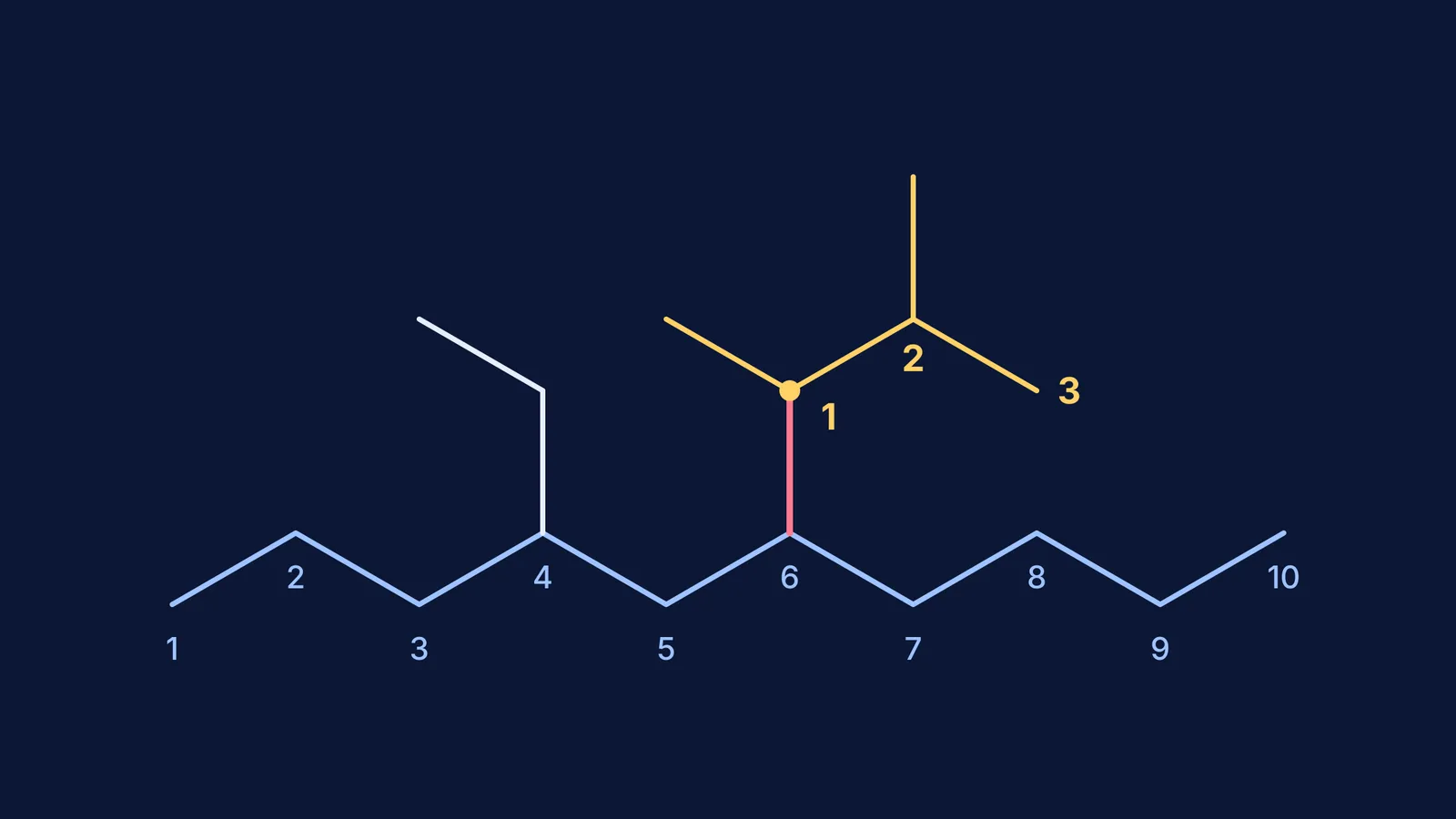
Take a ten-carbon chain with an ethyl group on carbon 4 and –CH(CH3)–CH(CH3)–CH3 on carbon 6, as in the diagram above.
Main chain: ten carbons, so decane. Numbering from the left gives the branches 4 and 6; from the right, 5 and 7. Keep 4,6.
The branch on carbon 6: the attached carbon is 1. Carbons 1, 2 and 3 make a propyl stem, with one methyl on carbon 1 and one on carbon 2. That is 1,2-dimethylpropyl.
Alphabetical order: a compound substituent's name starts with the first letter of its complete name (Blue Book P-14.5.2). "Dimethylpropyl" files under d, before e for ethyl. You ignore "di" in a simple prefix like dimethyl, but here it is part of the branch's own name.
Name: 6-(1,2-dimethylpropyl)-4-ethyldecane.
The preferred-name style calls the same branch 3-methylbutan-2-yl, which files under m, giving 4-ethyl-6-(3-methylbutan-2-yl)decane. Both describe the same molecule, so check which style your board or exam expects.
To check names like this against a full solution, the Fermi Problem Library has worked problems with a step-by-step solver that explains the reasoning rather than printing an answer. To go the other way, see our guide on drawing a structure from an IUPAC name.
When can you use isopropyl, isobutyl or tert-butyl?
This is where older books and the 2013 rules part ways.
tert-butyl is still a preferred prefix, but it "has never been recommended for further substitution" (Blue Book P-29.6.1).
isopropyl is kept for general use, but "no substitution of any kind is allowed" (Blue Book P-29.6.2.2). Put a chlorine on it and you must switch to the systematic name.
isobutyl, sec-butyl, isopentyl, tert-pentyl and neopentyl were in the 1993 recommendations but are no longer recommended; use 2-methylpropyl, butan-2-yl, 3-methylbutyl, 2-methylbutan-2-yl and 2,2-dimethylpropyl (Blue Book P-29.6.3).
Past papers may still use the older names, so recognise both. When unsure, write the systematic name.
One alphabetising detail: italic letters count only when the Roman letters cannot decide, so tert-butyl files under b (Blue Book P-14.5.3).
Where do the brackets go when substituents nest?
Use parentheses first. When a bracketed name sits inside another, the outer pair becomes square brackets, then braces, in the nesting order {[({[( )]})]} (Blue Book P-16.5.4). The Blue Book's own example is 2-[(4-bromophenyl)methyl]pyridine (Blue Book P-29.6.1).
Rings follow the same logic; see naming substituted cycloalkanes, and read functional group priority order for what changes once a suffix like -ol appears. If free valence itself feels shaky, the Fermi Concept Library has a lesson for every chemistry concept.


