On this page
Paths to Modernisation is Theme 7 of NCERT's Class 11 book Themes in World History. The 2026-27 reprint of the chapter compares how Japan and China answered the challenge of Western power, and also tells the stories of Taiwan and Korea. This guide covers the core: Meiji Japan, and China from the Opium Wars to 1949.
How did Japan modernise after the Meiji Restoration?
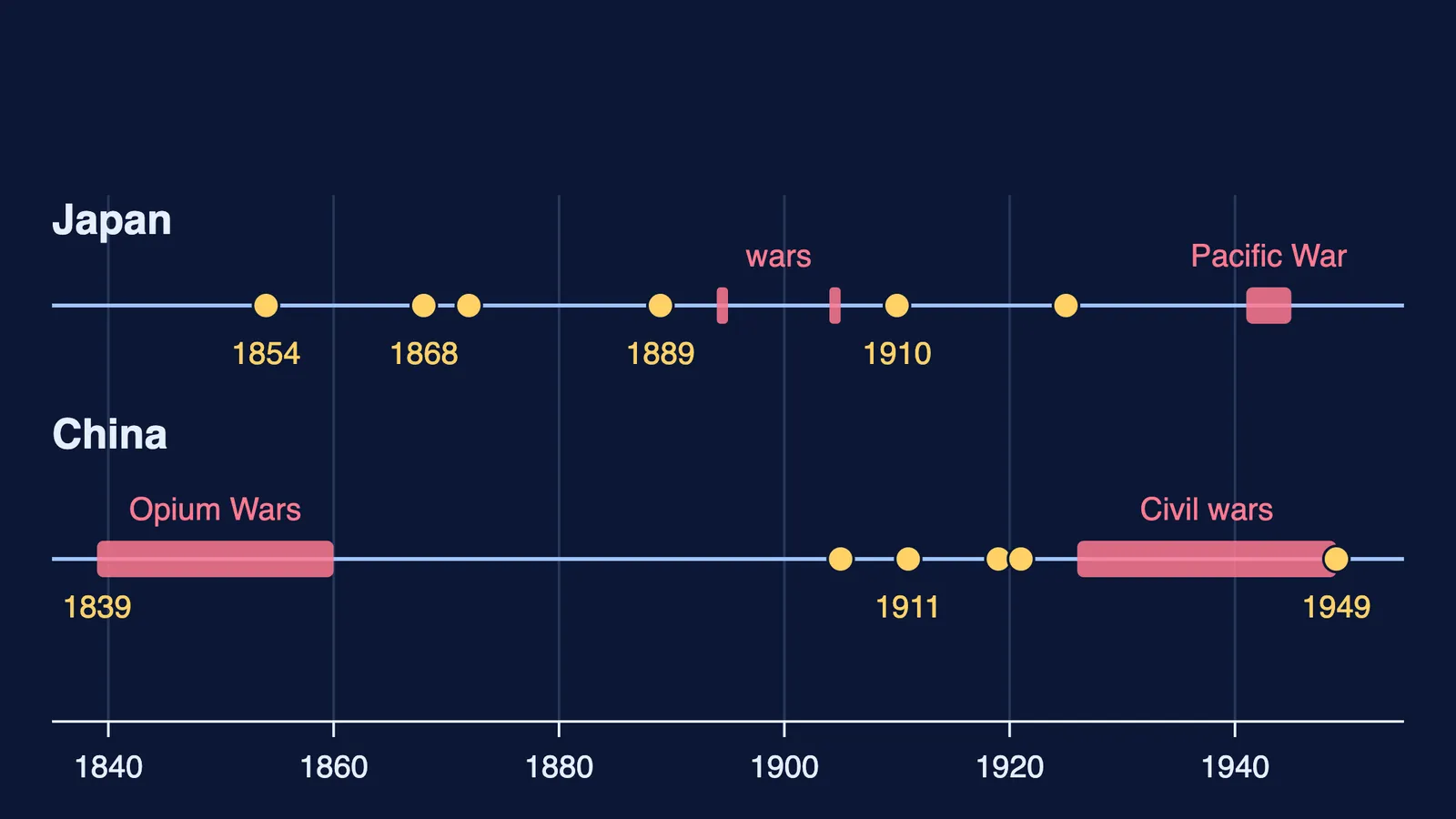
According to the NCERT chapter, the Tokugawa family held the post of shogun from 1603 to 1867. In 1853 the USA sent Commodore Matthew Perry to demand a treaty for trade and diplomatic relations, which Japan signed the following year. In 1868 a movement removed the shogun and brought the emperor to Edo, which was renamed Tokyo.
The new government's slogan was fukoku kyohei, “rich country, strong army”. In the chapter's account, it built:
Schools from the 1870s, compulsory for boys and girls and almost universal by 1910.
A modern army, with military service for all young men over twenty.
The first railway, Tokyo to Yokohama, in 1870-72, and modern banks from 1872.
The Meiji Constitution of 1889, with a restricted franchise and a Diet with limited powers.
Japan's population grew from 35 million in 1872 to 55 million in 1920, and the number of people in manufacturing rose from 700,000 in 1870 to 4 million in 1913, according to NCERT. Japan defeated China in 1894 and Russia in 1905, and took Taiwan (1895) and Korea (1910) as colonies.
How was China's path different from 1839 to 1949?
Britain used force to expand its opium trade, leading to the first Opium War (1839-42), which undermined the Qing dynasty, says the NCERT chapter; its timeline lists two Opium Wars between 1839 and 1860. Reformers such as Kang Youwei and Liang Qichao pushed for a modern administration, army and schools, and the old examination system was abolished in 1905.
Then events moved quickly:
1911: the Manchu empire was overthrown and a republic set up under Sun Yat-sen, whose Three Principles were nationalism, democracy and socialism.
4 May 1919: a Beijing protest against the post-war peace conference grew into the May Fourth Movement.
1921: the Communist Party of China (CCP) was founded.
1934-35: the Long March took the Communists to a new base in Yanan.
1949: after civil war, the People's Republic of China was established.
Prices rose 30 per cent per month between 1945 and 1949, the chapter notes, which “utterly destroyed the lives of ordinary people”.
Japan vs China: what are the key differences?
Use these five lenses for any comparison question; each comes from the NCERT chapter.
Trigger: Japan, Perry's arrival in 1853; China, the Opium War from 1839.
Who drove change: Japan, the Meiji state; China, reformers, then republicans, then the CCP.
Tradition: Japan presented the emperor as both a descendant of the Sun Goddess and the leader of westernisation; in China, Confucianism came to be seen as a major barrier to new ideas.
Economy: Japan, state-backed industry and zaibatsu (large business organisations controlled by families); China, slow and limited industrial growth.
After 1945: Japan, defeated and placed under a US-led occupation; China, a new People's Republic from 1949.
To turn these lenses into a revision chart, follow our guide on making a cause-and-effect chart for a history chapter.
How do you answer the NCERT questions on this chapter?
One short-essay question in the NCERT exercises asks: “Did Japan's policy of rapid industrialisation lead to wars with its neighbours and destruction of the environment?” Here is a worked plan:
Thesis: largely yes. Industry fed an army that pressed for territory, and growth ignored health and the environment.
Wars: victories over China (1894) and Russia (1905), colonies in Taiwan and Korea, and the invasion of China in 1931.
Environment: in 1897 Tanaka Shozo led 800 villagers in the first agitation against industrial pollution; mercury poisoning at Minamata followed in the 1960s.
Balance: popular demand for democracy often opposed the government's aggressive policies, and new laws later improved conditions.
Close: tie it back to “rich country, strong army”.
Mixed-up years cost the most marks in this chapter, so learn its timeline on page 170 first. If an AI app gives you a date, check it against the NCERT text before you write it down.
If history revision is eating into time you need for physics or maths, Fermi's AI tutor can work out what you already know and build a plan for the session, so you sit down to a clear next step.
Start tonight: write the five lenses from memory, then check them against the chapter.