

On this page
At Billing, above Bir in Himachal Pradesh, a pilot runs a few steps and a sheet of fabric becomes a wing, with no engine and no rigid frame. Here is the physics, with numbers you can check.
How does a paraglider wing make lift?
A paraglider canopy is a ram-air aerofoil: most of its cells are open only near the leading edge, so incoming air keeps the wing inflated and holds its shape (Wikipedia: Paragliding). Without moving air it is just fabric, which is why pilots fill the wing by running, being pulled, or letting an existing wind inflate it before take-off (same source).
Then it works like any wing. Lift is an aerodynamic force produced by the motion of a fluid past an object, defined to be perpendicular to the flow direction (NASA Glenn Research Center). It appears when a flow of gas is turned by a solid object: the curved, slightly tilted wing deflects air downward, and the air pushes the wing up. How much lift you get depends on the speed of the air and how the wing is inclined to the flow (NASA: factors that affect lift).
For the theory, see the Kutta–Joukowski lift theorem; how a frisbee makes lift from its curve is the same idea in your hand.
What is a glide ratio, and why is the glide so flat?
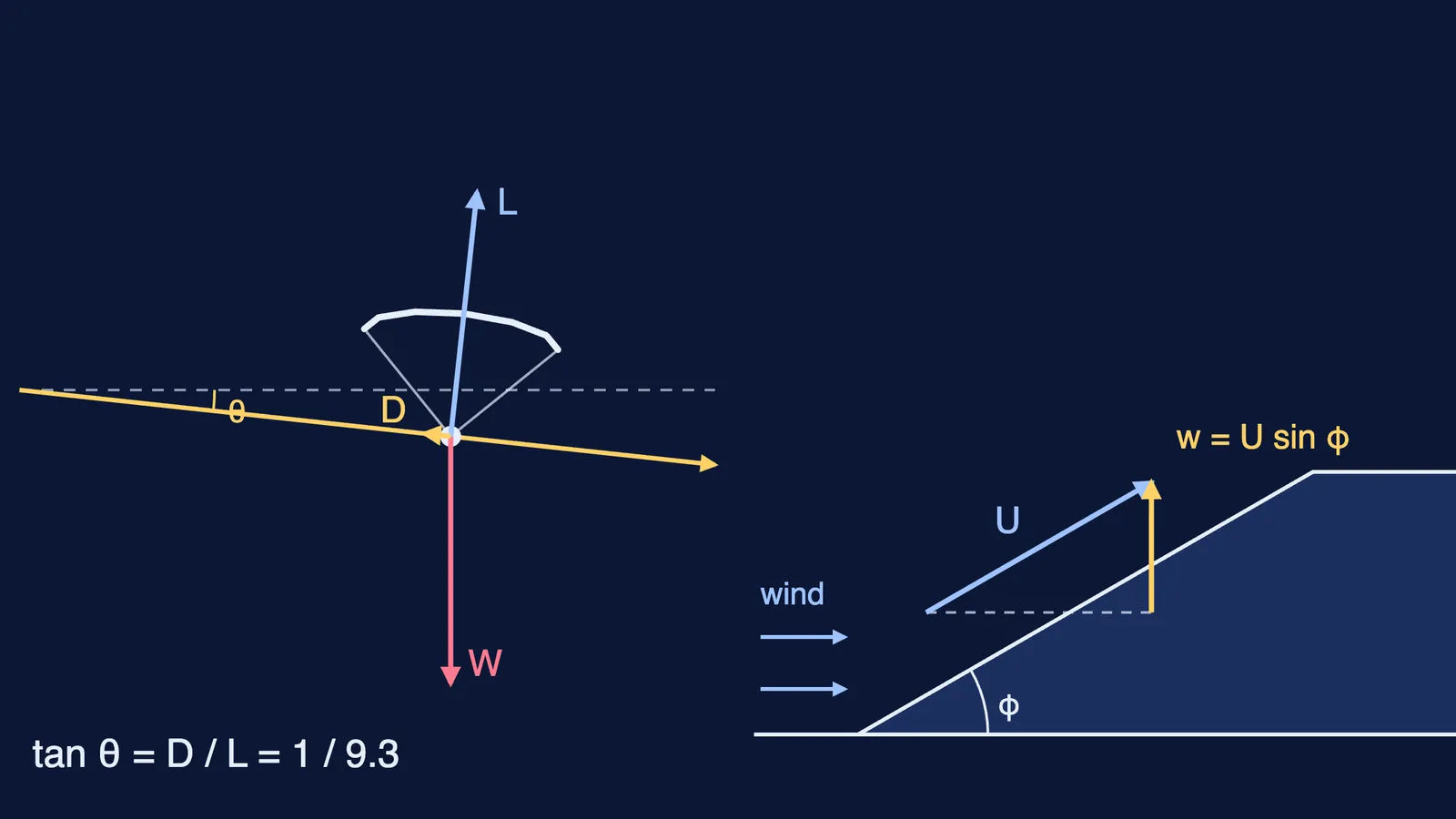
A paraglider is always sinking through the air. Weight pulls down, lift acts across its path and drag along it. In a steady glide they balance, and the lift divided by the drag equals the cosine of the glide angle divided by its sine (NASA: force balance for a glider). In short, tan θ = D/L: the higher the lift-to-drag ratio, the flatter the glide.
The glide ratio of paragliders ranges from about 9.3 for recreational wings to about 11.3 for modern competition wings (Wikipedia: Paragliding). Put 9.3 into tan θ = 1/9.3 and the glide angle is only about 6.1 degrees; at 11.3 it is about 5.1 degrees. The same source gives a typical trim speed of 32–40 km/h.
That gives you the sink rate. At 36 km/h (10 m/s) and a glide ratio of 9.3, the wing drops about 10 ÷ 9.3 ≈ 1.1 metres every second. It is a rough estimate.
How does ridge lift keep a paraglider up?
Ridge lift, or slope lift, is created when wind strikes an obstacle such as a mountain ridge or cliff and is deflected upward (Wikipedia: Ridge lift). The rule that matters is short: an unpowered aircraft climbs if the surrounding air is rising faster than its sink rate (same source).
The diagram at the top uses a simple model. If wind of speed U follows a slope at angle φ, its upward part is w = U sin φ. On a 30 degree slope sin φ = 0.5, so a 15 km/h wind (about 4.2 m/s) rises at about 2.1 m/s, well above the 1.1 m/s sink we just worked out. Real air is messier, but this is why pilots need a steady wind.
There is a window. With too little wind, pilots end up 'scratching' along the slope; with too much, they risk being blown back over it (Wikipedia: Paragliding).
Worked example: how far can a paraglider glide from Billing?
Bir lies in the Dhauladhar foothills, and its paragliding launch is the meadow at Billing, north of Bir, at an elevation of 2,400 m; the landing site is on the southern edge of Bir, which stands at 1,525 m (Wikipedia: Bir, Himachal Pradesh). The same page gives the flying season as September and October, with some flying in November. A Paragliding World Cup competition finished in Bir-Billing on 31 October 2015 (XC Mag).
Height to lose, taking Bir's 1,525 m as the landing height: 2,400 − 1,525 = 875 m.
Still-air glide: 875 × 9.3 ≈ 8.1 km for a recreational wing, 875 × 11.3 ≈ 9.9 km for a competition wing.
Time in the air with no rising air: 875 m ÷ 1.1 m/s ≈ 800 seconds, roughly 13 minutes.
Add wind. Distance over the ground scales with ground speed. Into a 10 km/h headwind at 36 km/h airspeed, ground speed is 26 km/h, so the ground glide ratio is 9.3 × 26/36 ≈ 6.7 and 875 m buys about 5.9 km. With a 10 km/h tailwind it becomes about 11.9, or about 10.4 km.
On a still day, then, a wing glides a few kilometres and lands; staying up means finding air rising faster than about 1.1 m/s. Step 4 is the same idea behind why planes take off and land into the wind.
How can you practise this kind of estimate?
Resolving lift, drag and weight along a sloping path is the same skill as an inclined-plane problem. Try it:
Find the glide angle from tan θ = 1/(L/D).
Divide airspeed by the glide ratio to get the sink rate.
Compare it with the updraft U sin φ, then redo step 4 with your own headwind.
If force triangles are hard to picture, the Fermi Simulation Lab has interactive simulations for ideas that are easier to see than read. Fermi's AI tutor can draw the figure with you and check your understanding as you work through an estimate like this one.


