On this page
Students learn early that alkyl groups are ortho/para directors. Then the exam asks which product is major, and the answer seems to change from one molecule to the next. Two things decide it: how many sites of each kind the ring has, and how crowded those sites are. Toluene and tert-butylbenzene show each of these effects clearly.
Why is the para product major over ortho in electrophilic substitution?
An alkyl group pushes electron density into the ring. That stabilises the positively charged intermediate (the arenium ion) when the electrophile attacks ortho or para to it, so meta attack is slow. That explains why you get ortho and para products. It does not tell you how they split between the two.
Two effects decide the split, and they pull in opposite directions:
Statistics favour ortho. A monosubstituted benzene has 2 ortho positions, 2 meta positions and 1 para position, as the Wikipedia summary of directing groups sets out. If every activated site were equally reactive, you would expect about twice as much ortho as para.
Sterics favour para. The ortho carbons sit right next to the substituent, while the para carbon is on the far side of the ring. A bulky group blocks the incoming electrophile at ortho, and the same source notes that steric hindrance at ortho "but not the para position" leads to more para product.
Which effect wins depends on how big the group is.
What do toluene and tert-butylbenzene actually give on nitration?
William Reusch's textbook chapter on the effect of substituents on orientation gives the measured product mixtures:
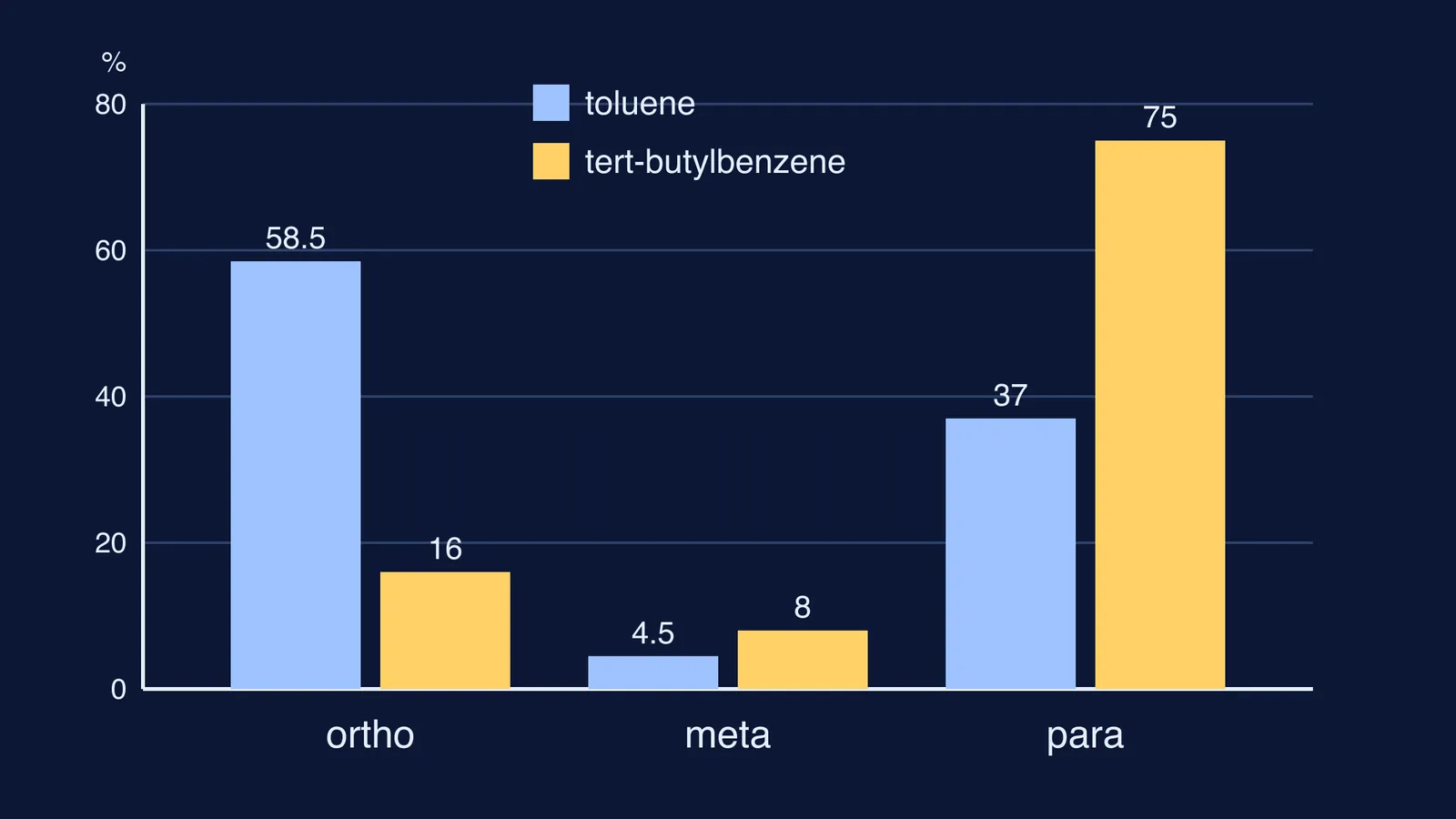
Toluene (methyl group) gives 58.5% ortho-nitrotoluene, 37% para and 4.5% meta.
tert-Butylbenzene gives 16% ortho, 8% meta and 75% para.
The chapter explains the change directly: the extra bulk of the tert-butyl group hinders attack at the ortho sites. A methyl group is one carbon with three hydrogens. A tert-butyl group is a central carbon carrying three methyl groups, so it fills much more space on both sides of the ring carbon it is attached to.
The table of nitration data on Wikipedia puts isopropylbenzene (cumene) in between, at 30% ortho and 62% para. Its tert-butylbenzene figures (16% ortho, 73% para) are close to Reusch's; different measurements of the same reaction differ slightly.
How do you compare ortho and para fairly, site by site?
Total percentages hide the fact that you are comparing two sites with one. Here is a worked example using the figures from Reusch's chapter. It is quick enough to do in the margin of an exam paper.
Split the ortho total between its two sites. Toluene: 58.5 / 2 = about 29 per ortho site. tert-Butylbenzene: 16 / 2 = 8 per ortho site.
Put each para total beside it. Toluene: 37 at the single para site. tert-Butylbenzene: 75.
Compare per site. In toluene, the para site reacts only about 1.3 times as often as each ortho site (37 / 29). With tert-butylbenzene it is about 9.4 times (75 / 8).
So even in toluene, the para carbon is slightly more reactive than each ortho carbon; ortho wins the total only because it has two sites. Make the group bulkier and the per-site gap grows until two sites can no longer make up for it.
How should you write this in a JEE or board exam answer?
A clear short answer covers four points:
Name the group as an activating ortho/para director, and say why (it donates electrons and stabilises the arenium ion).
Say that statistically you would expect ortho:para of about 2:1, because there are two ortho sites and one para site.
Say that the bulk of the group hinders ortho attack, so para increases as the group gets bigger.
Name the major product: ortho-nitrotoluene for toluene, para-nitro-tert-butylbenzene for tert-butylbenzene.
A common slip is to write "para is always major for ortho/para directors". Toluene breaks that rule. Another trap is to treat halogens the same way: chlorine directs ortho/para for a different reason, which we explain in why chlorine is deactivating yet ortho/para directing. If the methyl group's electron donation itself is shaky, our post on counting alpha hydrogens for hyperconjugation covers it. Questions with two groups on the ring are the next step up, covered in directing effects with two substituents.
If you can follow the reasoning but still pick the wrong major product under time pressure, practise on worked problems. The Fermi Problem Library has a step-by-step solver that explains the reasoning rather than printing an answer, so you can check each step of your own working. To go back to arenium ions and directing groups from the start, each concept has its own lesson in the Fermi Concept Library.
Next time a question asks for the major product, check two things before you answer: how many sites of each kind there are, and how big the group is.