

On this page
Your heart already has a pacemaker: a small clump of cells called the sinoatrial (SA) node. An implanted pacemaker is its backup. Most pacemakers listen to every beat and fire only when the heart's own signal comes too late.
What does the heart's own pacemaker do?
The SA node sits in the upper back wall of the right atrium, close to where the superior vena cava enters, according to OpenStax Anatomy and Physiology. Its cells slowly let sodium ions in until they reach threshold, then fire, with no nerve telling them to. This is why heart muscle is called myogenic, a difference we explain in myogenic vs neurogenic hearts.
Left to itself, with no nervous or hormonal control, the SA node would set off about 80 to 100 beats a minute (OpenStax). Other parts of the conduction system can fire too, but more slowly: without the SA node, the AV node would give 40 to 60 beats a minute, according to the same chapter. For most people, a resting rate below 50 beats a minute is called bradycardia. Your nerves then speed this rhythm up or slow it down, which is why your heart races when you are scared.
How does a pacemaker work?
A traditional pacemaker has three main parts, according to the US National Heart, Lung, and Blood Institute (NHLBI): a pulse generator that makes the pulses, wires (leads) that run through veins into the heart, and electrodes. The generator sits in the chest or abdomen, and its electrodes reach one to three heart chambers.
The key idea is sensing. "Electrodes sense your natural heartbeat," the NHLBI says, and when the heartbeat is slower than normal they deliver electrical impulses to make it beat normally. The British Heart Foundation puts it simply: most pacemakers work just when they are needed, while others send out impulses all the time at a fixed rate. A pacemaker's job, it adds, is to take over the role of the sinus (SA) node when that node is not working properly.
Newer leadless pacemakers are about the size of a large pill capsule and sit inside a chamber of the heart, with the generator and electrodes in one device (NHLBI).
Worked example: a pacemaker's one-second rule
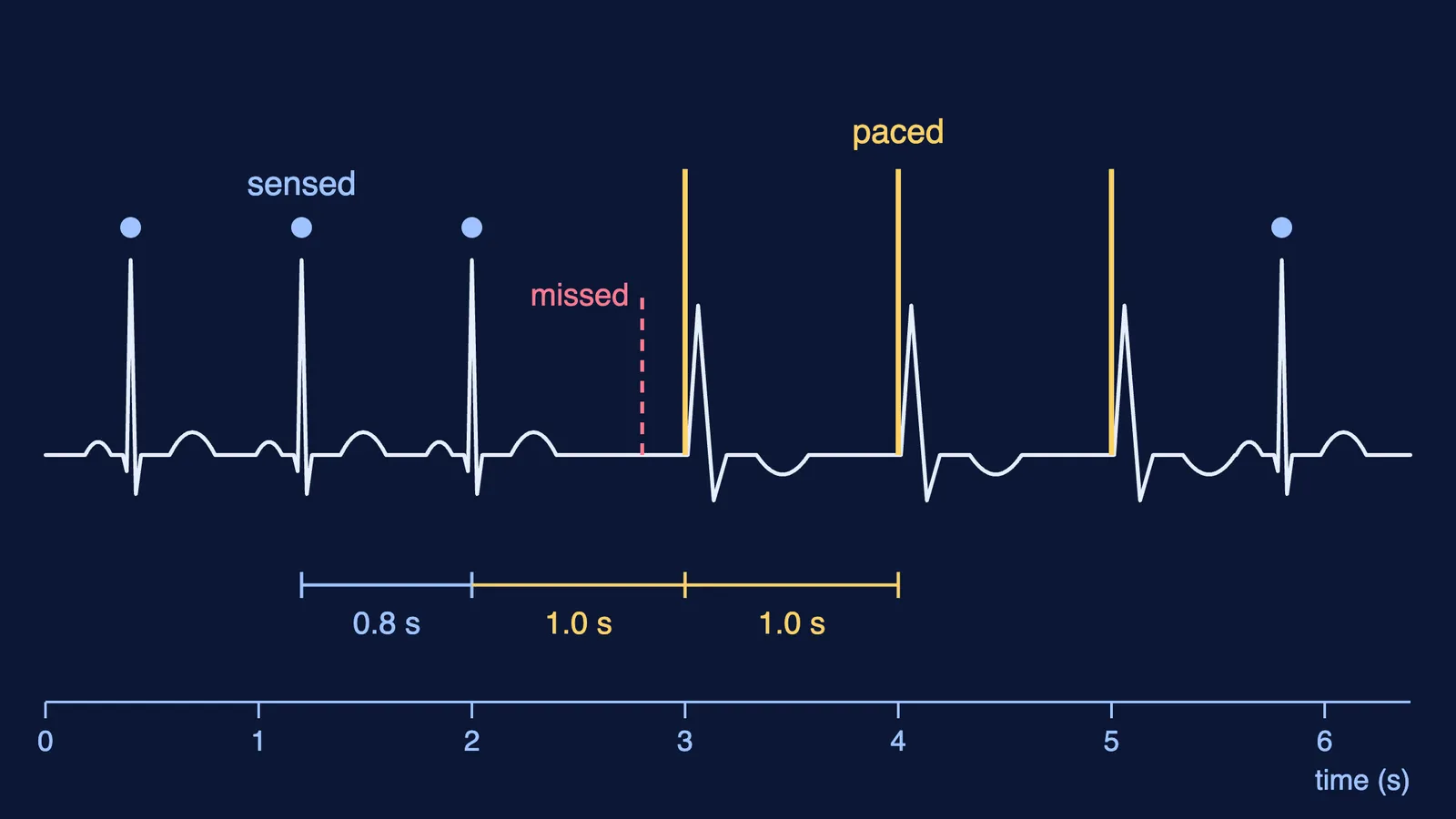
Suppose a doctor programmes a lower rate of 60 beats a minute. That means at most 1.0 second between beats. Follow the strip in the picture above:
A natural beat arrives. The device senses it and starts a 1.0-second timer.
The next natural beat comes after 0.8 seconds, before the timer runs out. The device does nothing and restarts the timer.
The SA node misses a beat. After 1.0 second of silence, the device fires a pulse and the ventricles contract.
It keeps pacing every 1.0 second until a natural beat arrives first, then goes quiet again.
If the P, QRS and T labels are new to you, read what the ECG waves mean. If the conduction pathway itself is the gap, the Fermi Concept Library gives each biology concept its own lesson and its place in the map.
How long does a pacemaker battery last?
A pacemaker battery usually lasts 6 to 7 years, says the NHS, with more frequent checks when it is nearly time to change it. The NHS schedule is a check about 6 weeks after the procedure, another at 3 to 6 months, then at least every 12 months.
Battery life depends partly on how often the device has to fire, since each pulse uses energy. A 2025 modelling study in Future Cardiology (Leal and colleagues) used real-world pacing data from a clinical study and the manufacturer Medtronic's databases to project the battery life of one family of leadless pacemakers. Based on 644 patients, the median projected longevity was 12.3 years for the Micra VR and 16.7 years for the newer Micra VR2. These are projections, not measured lifetimes.
What should a family know when someone gets a pacemaker?
If a grandparent or parent at home has a new pacemaker, the NHLBI's living-with guidance and the NHS give simple everyday rules:
Use the speaker setting or hold the mobile phone to the ear on the opposite side, and do not keep it in a shirt pocket.
Keep devices that can interfere at least 6 inches (about 15 cm) from the pacemaker, or use them only briefly.
At airport security, show the pacemaker ID card. Staff must not use a handheld metal detector over the device; you can ask for a hand search instead.
Household appliances such as microwave ovens are usually safe if they work properly.
Keep every pacemaker clinic appointment, including the battery checks.
Next time you study the cardiac cycle, start at the SA node and trace the one-second rule yourself.


