

On this page
Predict the dipole moment of p-nitroaniline the textbook way, by lining up the group moments along the ring axis and adding, and the answer comes out too small. The gap is chemistry the simple vector model leaves out, and it is what JEE-style "compare the dipole moments" questions test.
What is the dipole moment of p-nitroaniline?
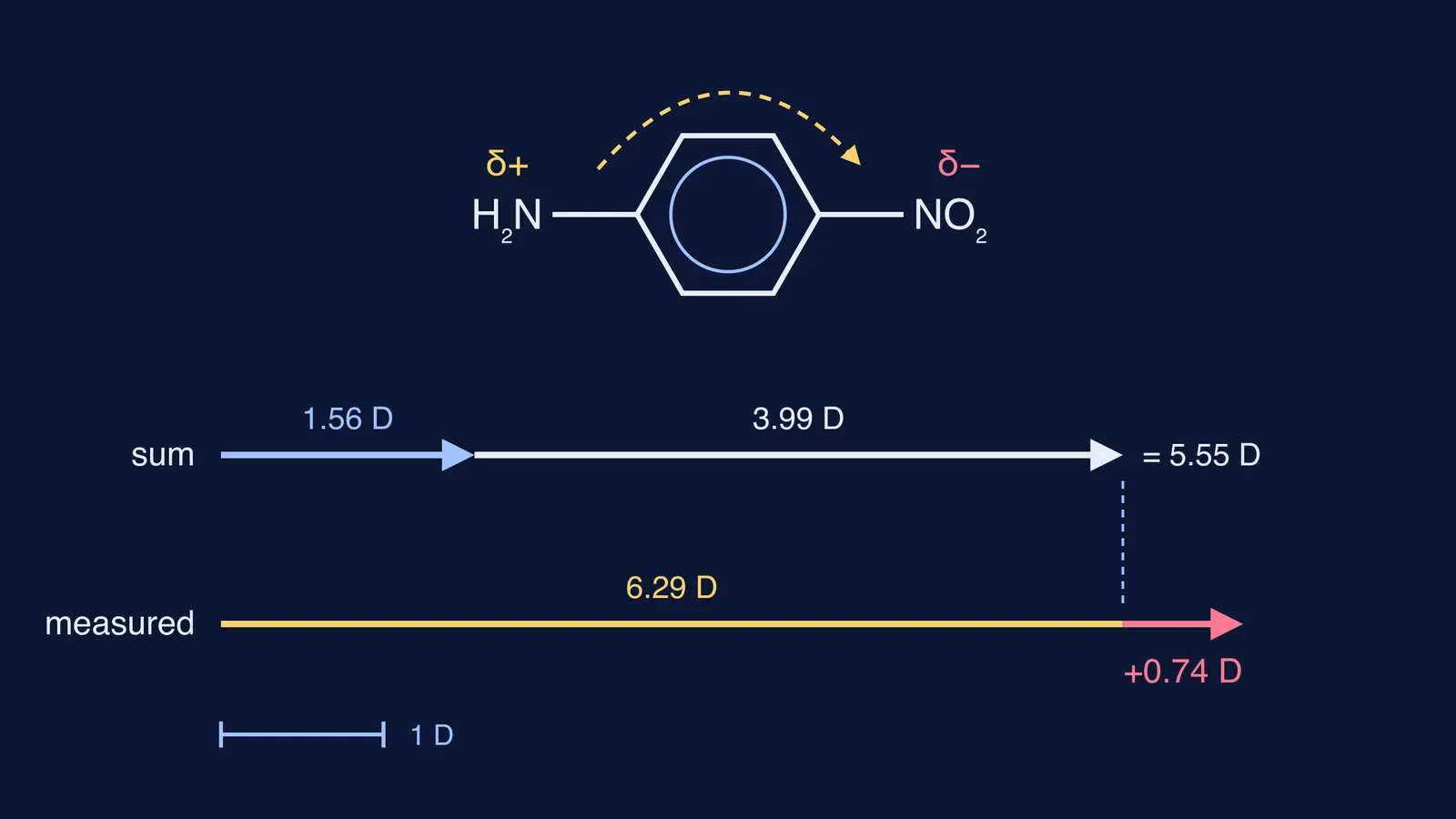
The experimental ground-state dipole moment of p-nitroaniline is 6.29 D in benzene solution, the value tabulated by A. L. McClellan and reported in a 1977 study of nitroanilines by Millefiori and co-workers in Spectrochimica Acta80143-8).
For the parent molecules, a reference table built on Kaye and Laby gives nitrobenzene 13.3 × 10⁻³⁰ C m and aniline 5.2 × 10⁻³⁰ C m, both measured in benzene solution (LibreTexts dipole moment table). Since 1 D is 3.336 × 10⁻³⁰ C m, those are about 3.99 D and 1.56 D.
Why is it more than the vector sum of the group moments?
Start with the directions. The -NO2 group pulls electron density out of the ring, so the negative end of nitrobenzene's dipole sits on the nitro group. The -NH2 group pushes its lone pair into the ring, so in aniline the nitrogen end is relatively positive and the ring is the negative end. Put the two groups para to each other and both arrows point the same way, from the amino end to the nitro end. With the benzene-solution values from Kaye and Laby, they add: 1.56 + 3.99 = 5.55 D.
The vector sum assumes each group behaves exactly as it did on its own. In p-nitroaniline it does not. The donor and the acceptor sit at opposite ends of one conjugated system, so a resonance form becomes possible that neither parent molecule has: a C=N double bond with N+ at one end, and a negative charge on the nitro oxygens at the other, with a quinoid ring in between. This is push-pull, or through-conjugation. That form separates a whole unit of charge across the length of the molecule, so even a small contribution adds noticeably to the dipole moment.
In the same Spectrochimica Acta paper, the authors' calculation gave a mesomeric (resonance) moment of 1.69 D for ground-state p-nitroaniline (Millefiori et al., 197780143-8)). That figure comes from a theoretical model, not a measurement, but it points the same way as the experiment: charge transfer adds to the simple sum.
The effect is even stronger after light is absorbed. From the temperature shift of absorption spectra, Kawski and colleagues estimated first excited-state dipole moments of 13.35 D for p-nitroaniline and 6.59 D for nitrobenzene, and confirmed strong intramolecular charge transfer in p-nitroaniline (Chemical Physics, 2006).
How does p-nitroaniline compare with p-dichlorobenzene and nitrobenzene?
Each of the other two lacks one ingredient of push-pull.
p-Dichlorobenzene: the two C-Cl moments are equal and point in opposite directions, so they cancel. The listed value is 0.00 D (Stenutz dipole moment table). Chlorobenzene alone is 1.78 D in the gas phase (NIST CCCBDB), so the C-Cl bond is polar; the zero comes from cancellation. With two identical groups there is no donor-acceptor pair.
Nitrobenzene: 3.99 D in benzene solution, from the LibreTexts table. The acceptor is there, but no strong donor sits opposite it to feed electrons in.
p-Nitroaniline: 6.29 D in benzene solution (Millefiori et al., 197780143-8)). Donor and acceptor face each other along one axis and are conjugated, so the moments add and resonance adds more.
The order to remember is p-dichlorobenzene < nitrobenzene < p-nitroaniline.
How do you answer this in an exam?
Use this four-step check for any substituted-benzene comparison.
Draw each group's moment as an arrow pointing to its negative end. Donors such as -NH2 and -CH3 point into the ring; acceptors such as -NO2, -CN and -Cl point out of it.
Use the positions. Para groups lie on one line, so their arrows add or subtract. Ortho and meta need the angle.
Ask whether a donor and an acceptor are conjugated. If they sit para to each other, expect a measured value above the vector sum.
Write the reason in one line: "vector addition plus push-pull resonance".
If the arrow directions are the shaky part, our post on the order of -I and +I effects, checked with pKa data covers induction, and how to check resonance structures shows how to tell a valid charge-separated form from an invalid one.
The same push-pull idea explains reactivity too: a para nitro group stabilises negative charge in the ring, which is why ortho and para nitro groups make chlorobenzene reactive.
To practise, the Fermi Concept Library has a lesson for each concept behind this question, from bond dipoles to resonance, and the Fermi Problem Library has worked problems with a step-by-step solver that explains the reasoning rather than printing an answer.


