On this page
You draw a second structure for ozone or the carbonate ion, paste both into a chatbot and ask, "Is this a valid resonance structure?" It says yes. But a yes doesn't tell you which rules it checked, or whether it checked any.
The fix is to ask for a check, not a verdict. There are three rules, each catches a different mistake, and you can make an AI show its working for every one.
What makes a resonance structure valid?
Resonance forms differ only in where their π electrons and lone pairs sit; neither the position nor the hybridization of any atom changes (Rules for Resonance Forms, OpenStax Organic Chemistry on LibreTexts/02%3A_Polar_Covalent_Bonds_Acids_and_Bases/2.05%3A_Rules_for_Resonance_Forms)). In practice that comes down to three checks:
Same atoms, same skeleton. Every atom stays put and stays joined to the same neighbours. Only π bonds and lone pairs move.
Same electrons. Resonance structures have the same number of electrons, so you never add or remove any (How to Draw Resonance Contributors, UC Davis on LibreTexts/08%3A_Delocalized_Electrons_and_Their_Effect_on_Stability_Reactivity_and_pKa_(Ultraviolet_and_Visible_Spectroscopy)/8.04%3A_How_to_Draw_Resonance_Contributors)). That also keeps the net charge the same.
Valid octets. Resonance forms follow the normal rules of valency, and the octet rule still holds for second-row atoms. The OpenStax text shows an invalid acetate form in which carbon has five bonds and ten valence electrons.
Rule 2's charge check uses formal charges, so revise how to work out formal charges in Lewis structures if they feel shaky.
How do you check a resonance structure step by step?
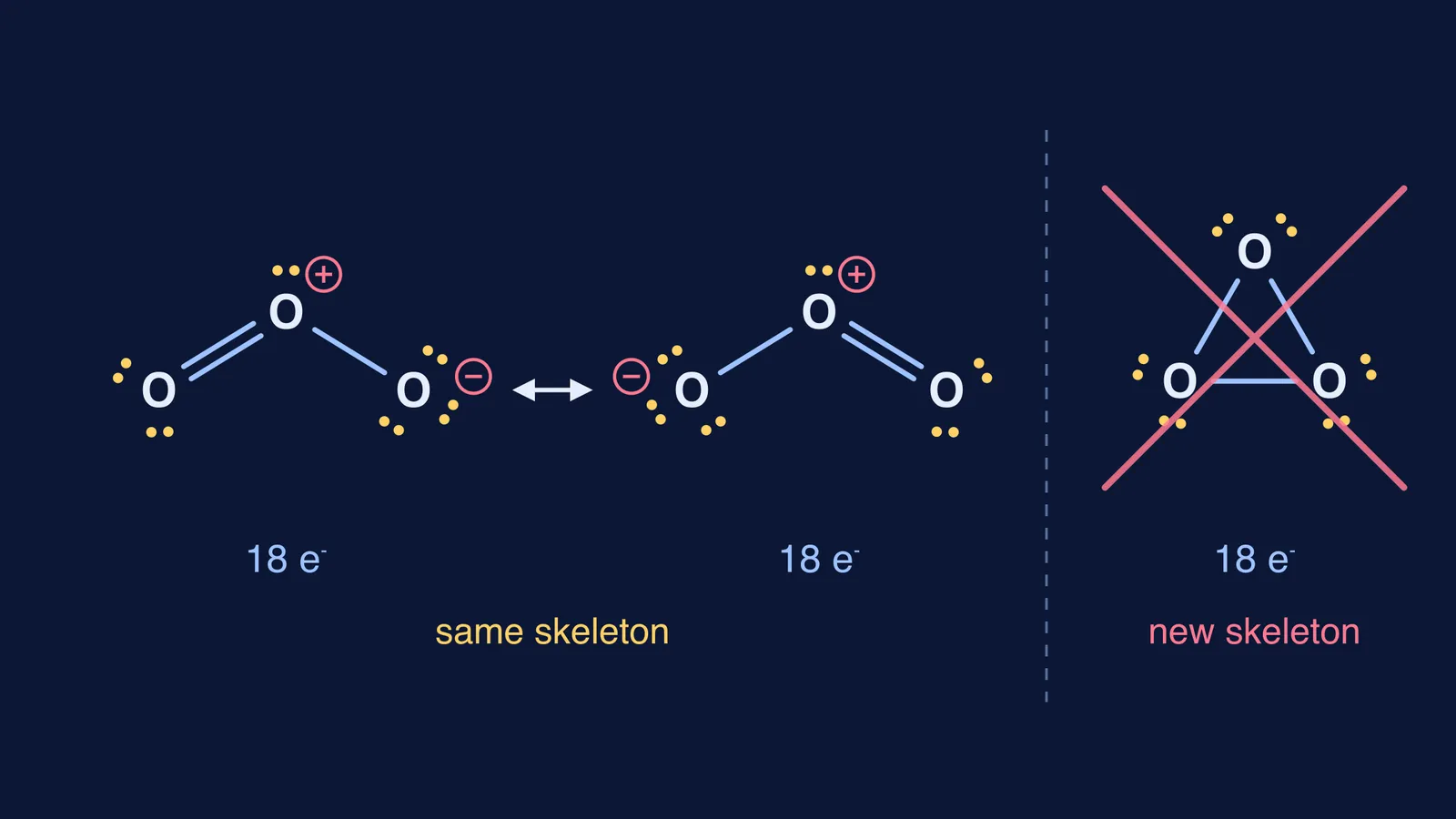
Take ozone, O3. Each oxygen brings 6 valence electrons, so every valid structure must show 3 × 6 = 18.
Structure A: O=O–O. Three bonding pairs (6 electrons) plus six lone pairs (2 on the left O, 1 in the middle, 3 on the right; 12 electrons) makes 18. The middle O is +1, the right O is −1, so the net charge is 0. Every O has eight electrons. It passes.
Structure B: O–O=O. A's mirror image, with the same atoms, 18 electrons and full octets. It passes too. A and B are the pair in the diagram above.
Structure C: a triangle of three O atoms. It has 18 electrons, full octets and no charges, so it looks tidy. But it adds a new bond between the two end oxygens, so it fails rule 1. It is a different molecule, not a resonance form of ozone.
Structure D: O=O=O with one lone pair on the middle O. The ends have two lone pairs each, so the total is again 18 and the skeleton hasn't changed. But the middle O now has two double bonds plus a lone pair: 10 electrons. It fails rule 3.
C and D each pass two rules and fail one. That's why a single "looks fine" is not enough.
Once you have a set of valid structures, our guide to ranking resonance structures by stability covers that second step.
Why does AI get resonance structures wrong?
The ChemBench study tested leading language models on more than 2,700 chemistry question-and-answer pairs. The best models, on average, outperformed the best human chemists in the study, but they struggled with some basic tasks and gave overconfident predictions (Mirza et al., Nature Chemistry, 2025).
Resonance is one place this can happen. You usually describe a drawing in text, and a model can agree with your structure without counting a single electron. A chatbot can also simply go along with what you proposed. Our post on what to do when AI agrees with a wrong answer explains how to push back.
What prompt makes AI check each rule?
Write each structure as atoms, bonds, lone pairs and charges (for example, "O1=O2, O2–O3, O1 two lone pairs, O2 one lone pair +1, O3 three lone pairs −1"). Then paste this:
"Do not tell me yet whether these are valid resonance structures."
"Rule 1: list each atom's neighbours in both structures and tell me if any atom or sigma bond has changed."
"Rule 2: count the total valence electrons and the net charge in each structure, atom by atom."
"Rule 3: give the electron count around every second-row atom and flag any above eight."
"Only now give a verdict, naming the rule that fails if one does."
Then check its counts against your own. If the AI says 18 and you get 20, don't pick one. Ask it to redo that count one atom at a time until the two of you agree.
If you keep failing the same rule, the gap is usually in Lewis structures or formal charge, not resonance. The Fermi Concept Library has a lesson for every chemistry concept, each with its place in the map, so you can go back to the idea underneath. Fermi's AI tutor holds a line of reasoning across a whole session and notices where you're stuck.
Next time you draw a resonance structure, do your electron count before you ask anyone, human or AI.