

On this page
The three dichlorobenzenes have the same formula, C6H4Cl2, and the same atoms joined in almost the same way. Yet at room temperature one is a white solid and the other two are liquids. That contrast is a common comparison question in school and JEE Main chemistry.
What are the melting and boiling points of the three dichlorobenzenes?
These are the values from the NIST Chemistry WebBook, which lists measured data for each isomer in kelvin. We have converted them to °C.
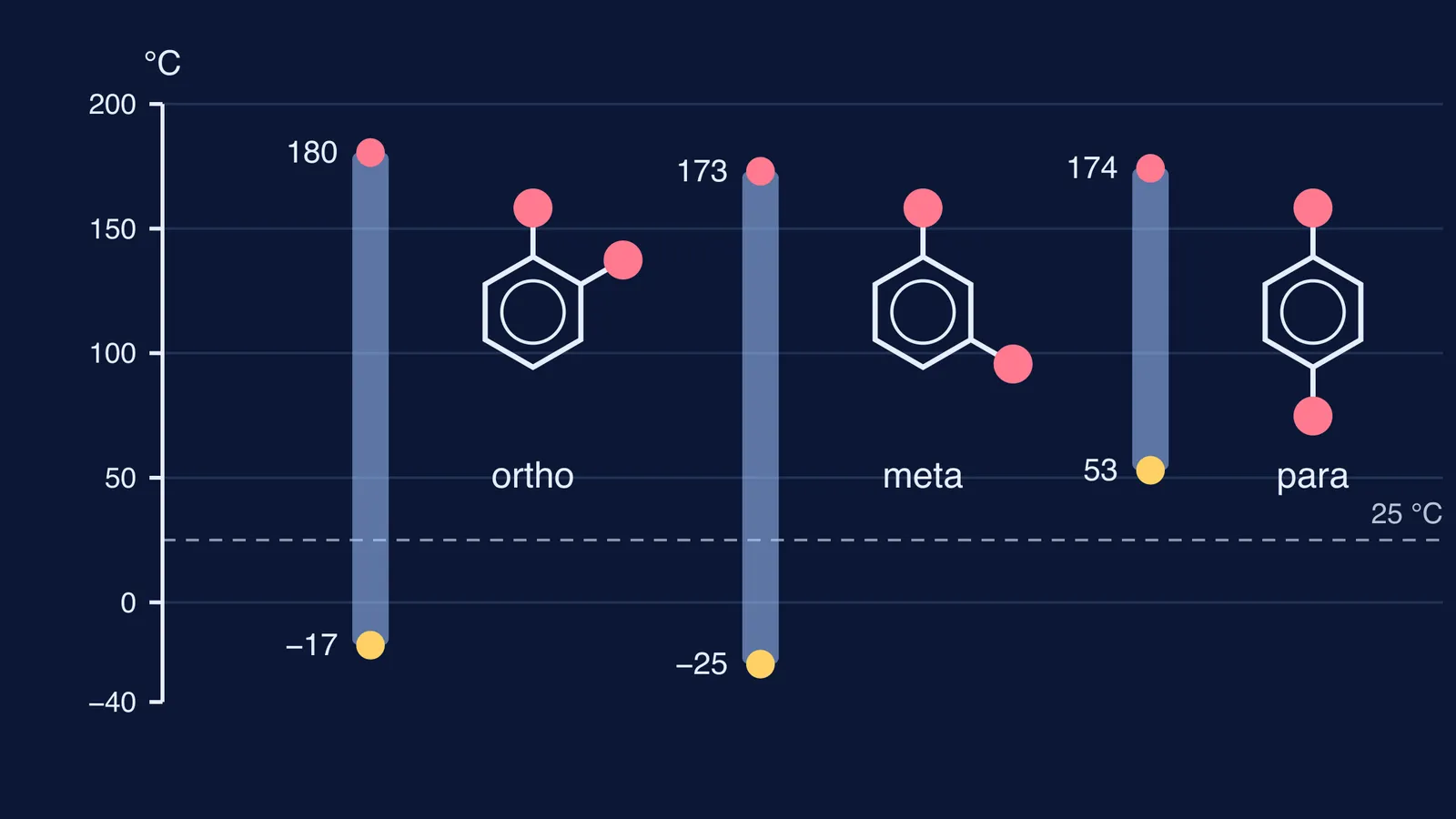
ortho (1,2-dichlorobenzene): melts at 256.0 K (about −17 °C) and boils at 453.6 K (about 180 °C), per NIST's page for 1,2-dichlorobenzene.
meta (1,3-dichlorobenzene): melts at 248.4 K (about −25 °C) and boils at 446.2 K (about 173 °C), per NIST's page for 1,3-dichlorobenzene.
para (1,4-dichlorobenzene): melts at 326.1 K (about 53 °C) and boils at 447.3 K (about 174 °C), per NIST's page for 1,4-dichlorobenzene.
The para isomer melts 70 to 78 °C higher than the other two. The boiling points, though, are all within about 7 °C, and the order changes: ortho boils highest.
Why does p-dichlorobenzene have a higher melting point?
Melting means pulling molecules out of an ordered crystal. The better they fit together in that crystal, the more energy it takes to pull them apart.
In para-dichlorobenzene the two chlorine atoms sit directly opposite each other across the ring. The molecule is flat and looks the same if you turn it half a turn. Molecules shaped like that can line up in a regular, tightly packed lattice, with each one touching its neighbours closely. Ortho and meta are lopsided: both chlorines sit on one side. They tend to pack less efficiently, so the contacts are weaker and the crystal comes apart at a lower temperature.
In 1882 Thomas Carnelley proposed that, among isomers, those whose atoms are arranged more symmetrically and compactly melt higher than asymmetrical ones, in his paper "Chemical symmetry" in the Philosophical Magazine. Today this is known as Carnelley's rule.
There is a second, quieter reason. The melting point is Tm = ΔH(fusion) ÷ ΔS(fusion). Good packing raises ΔH, which raises Tm. Symmetry also affects ΔS, but less tidily. A 2004 paper by Rodolfo Pinal of Purdue University notes that, "as a general rule", symmetrical molecules have higher melting temperatures and lower solubilities than similar, less symmetrical ones. His analysis shows that symmetry directly reduces the entropy gained on melting but also has indirect effects, so a more symmetric crystal often, though not always, gains more entropy when it melts (Organic & Biomolecular Chemistry, via Europe PMC).
Why doesn't boiling point follow the same order?
By the time a substance boils there is no crystal left. The molecules tumble freely, so how neatly they could have stacked no longer counts. What holds them together now is attraction between moving molecules.
All three isomers have the same atoms and almost the same size, so their London dispersion forces are very similar. That is why the boiling points sit so close together. The small differences come from polarity. In ortho, the two C–Cl bond dipoles point partly the same way and add up, giving the most polar molecule. In para, they point in exactly opposite directions and cancel, so the molecule has no net dipole. Our post on the dipole moments of ortho, meta and para dichlorobenzene works through that vector sum.
So ortho, the most polar, boils highest. Notice that para still boils about 1 °C above meta, by the NIST figures for 1,4-dichlorobenzene and for 1,3-dichlorobenzene, even with no dipole. The gap is tiny: when dipoles are small, dispersion forces do most of the work.
How do you answer this in an exam?
Use this four-step check whenever a question asks you to compare isomers:
Name the change. Is it melting (solid to liquid) or boiling (liquid to gas)?
For melting, ask: which molecule is most symmetric and packs best? That one usually melts highest.
For boiling, ask: which has hydrogen bonding, the larger dipole, or the larger surface area? That one usually boils highest.
Write the order, then give one reason for each end of it.
A model two-mark answer: "p-Dichlorobenzene has the highest melting point because its symmetric structure fits more closely into the crystal lattice, so stronger intermolecular forces must be overcome on melting. Its boiling point is not the highest, because boiling depends on forces in the liquid, and the more polar o-isomer has stronger dipole-dipole attraction."
The same split shows up elsewhere. Our post on why neopentane and n-pentane split on melting and boiling points is the alkane version. To see how much space tight packing really saves, read packing efficiency of fcc, bcc and simple cubic, derived.
If intermolecular forces still feel fuzzy, the Fermi Concept Library gives each concept in chemistry its own lesson and shows its place in the map. When you want to test the four-step check on real questions, the Fermi Problem Library has worked problems with a step-by-step solver that explains the reasoning rather than printing an answer.


