On this page
Neopentane and n-pentane are both C5H12, with the same mass and the same kind of attraction between molecules. So why does one boil higher while the other melts higher? The answer comes down to two different things. Boiling depends on how strongly molecules hold each other in the liquid. Melting depends on how much order is lost when a crystal falls apart.
All the numbers here come from the NIST Chemistry WebBook phase-change pages for n-pentane, isopentane and neopentane.
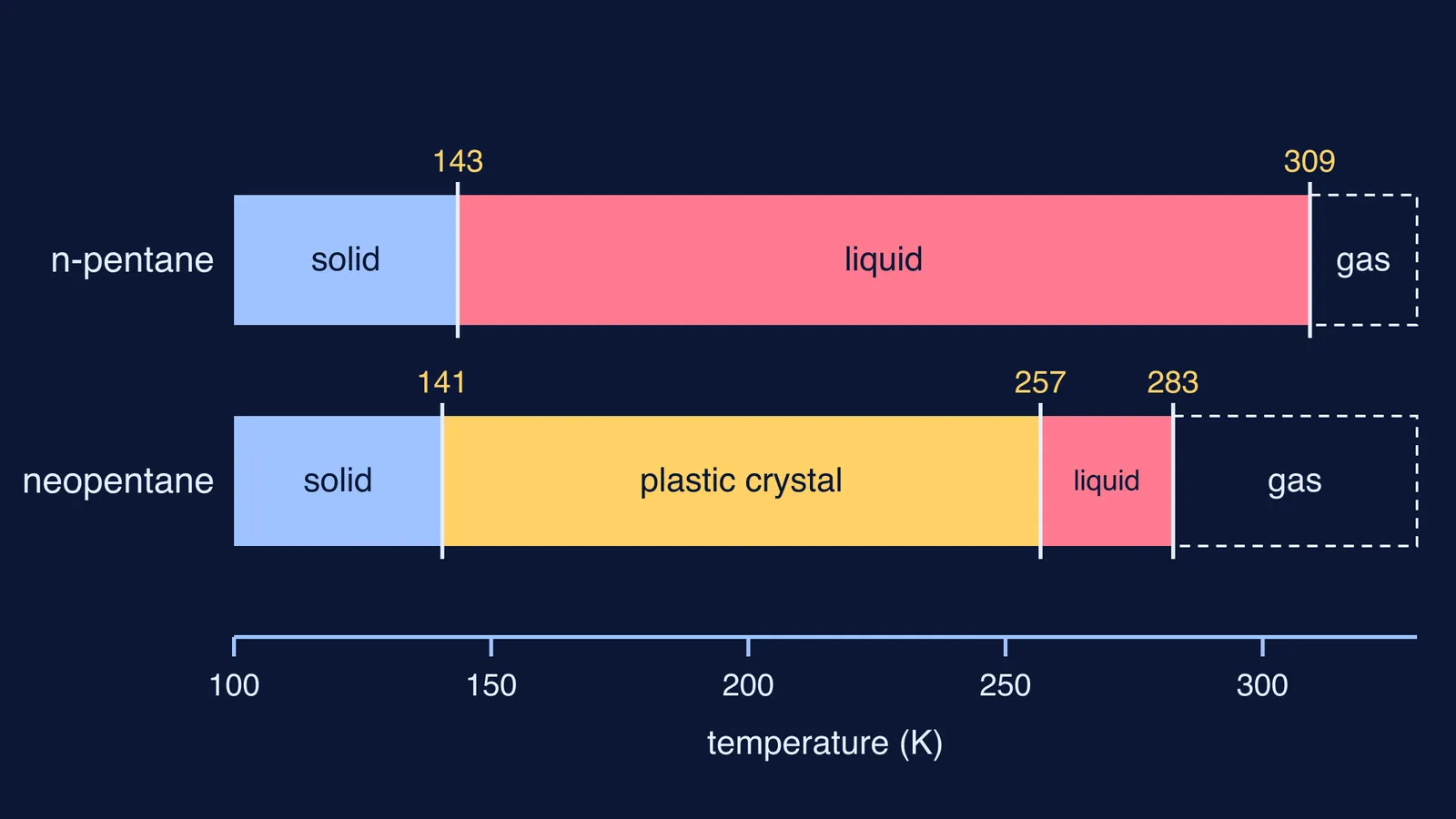
n-Pentane boils at 309.2 K (about 36 °C) and melts at 143.4 K (about −130 °C).
Isopentane (2-methylbutane) boils at 301.1 K and melts at 113 K.
Neopentane (2,2-dimethylpropane) boils at 282.6 K (about 9.5 °C), and its triple point, where solid, liquid and gas coexist, is 256.76 K (about −16 °C).
On a Delhi afternoon, neopentane is a gas, while n-pentane stays liquid up to about 36 °C.
Why does n-pentane boil higher than neopentane?
Alkane molecules attract each other through London dispersion forces, and these grow with the area over which two molecules can touch. The LibreTexts organic chemistry text/03:_Organic_Compounds-_Alkanes_and_Their_Stereochemistry/3.05:_Properties_of_Alkanes) puts it this way: for isomers, the more branched the chain, the lower the boiling point tends to be, because short, fat molecules cannot lie as close together as long, thin ones.
Two pencils side by side touch along their whole length; two tennis balls touch at a single point. n-Pentane's zigzag chain behaves like the pencils. Neopentane, a carbon with four methyl groups, is nearly a ball. Less contact means weaker attraction in the liquid, so less heat is needed to boil it. That is why the boiling order (n-pentane > isopentane > neopentane) follows branching. For the physics behind these forces, see Fritz London and dispersion forces between nonpolar molecules.
Why does neopentane melt higher than n-pentane?
Melting is a contest between enthalpy and entropy. A solid melts at the temperature where the energy needed to break up the crystal (the enthalpy of fusion) is balanced by the disorder gained (the entropy of fusion). In symbols, Tm = ΔfusH / ΔfusS.
Solid neopentane even has a disordered "plastic" phase between 140 K and 257 K, in which the near-spherical molecules can turn in their lattice sites. A crystallography conference abstract by Buhrmester and Fuess describes this phase. Because the molecules are already turning in the solid, melting adds little new disorder. A floppy chain like n-pentane gains a great deal of disorder when it melts: it can tumble and twist into many shapes.
How do you calculate the melting points? A worked example
Use the measured fusion data listed by NIST for neopentane (Chang and Westrum, 1970) and n-pentane (Messerly and co-workers, 1967).
n-Pentane: ΔfusH = 8.401 kJ/mol and ΔfusS = 58.56 J/(mol·K). Tm = 8401 / 58.56 = 143.5 K.
Neopentane: ΔfusH = 3.096 kJ/mol and ΔfusS = 12.05 J/(mol·K). Tm = 3096 / 12.05 = 256.9 K.
Compare. Neopentane needs less than half the energy to melt, which on its own would point to a lower melting point. But its entropy gain is nearly five times smaller (58.56 / 12.05 = 4.9), and that wins.
NIST also lists a solid-to-solid transition for neopentane at 140.5 K, with ΔS = 18.70 J/(mol·K). That is larger than its entropy of fusion. Much of the disorder that n-pentane gains only on melting, neopentane has already gained inside the solid.
Does more branching always raise the melting point?
No, and exam questions test this. Isopentane is branched but lopsided, and it melts lowest of the three, at 113 K, according to NIST. The melting point jumps only when branching makes the molecule highly symmetric. For more on how packing shapes melting points, see why even-carbon alkanes have higher melting points, and for all three structures with their names, our guide to the isomers of pentane, C5H12.
How should you write this in an exam?
A three-line answer covers both trends and avoids the usual mix-up:
Boiling point: n-pentane > isopentane > neopentane. Branching reduces surface contact, which weakens dispersion forces in the liquid.
Melting point: neopentane > n-pentane > isopentane. Neopentane's near-spherical, symmetric molecules pack well and gain little entropy on melting, so Tm = ΔfusH / ΔfusS is high.
Name the force (London dispersion) and the shape argument (surface contact for boiling, symmetry and packing for melting) separately.
If the link between molecular shape, entropy and phase changes still feels shaky, the Fermi Concept Library covers every concept in chemistry, each with its own lesson and its place in the map. To practise comparison questions like this one, the Fermi Problem Library has worked problems with a step-by-step solver that explains the reasoning rather than printing an answer.