

On this page
Pentane has three structural isomers. They all share the same molecular formula, C₅H₁₂, but their five carbon atoms and twelve hydrogen atoms are connected differently. This difference in structure changes their physical properties, especially their boiling points, making them behave as completely distinct substances.
Alkanes with fewer than four carbon atoms (methane, ethane and propane) have only one possible arrangement. Butane (C₄H₁₀) introduces branching and has two isomers. Pentane is the first alkane to offer three structural possibilities, demonstrating how quickly the number of isomers grows as the carbon chain lengthens.
What are the isomers of pentane C5H12?
1. n-Pentane (Pentane)
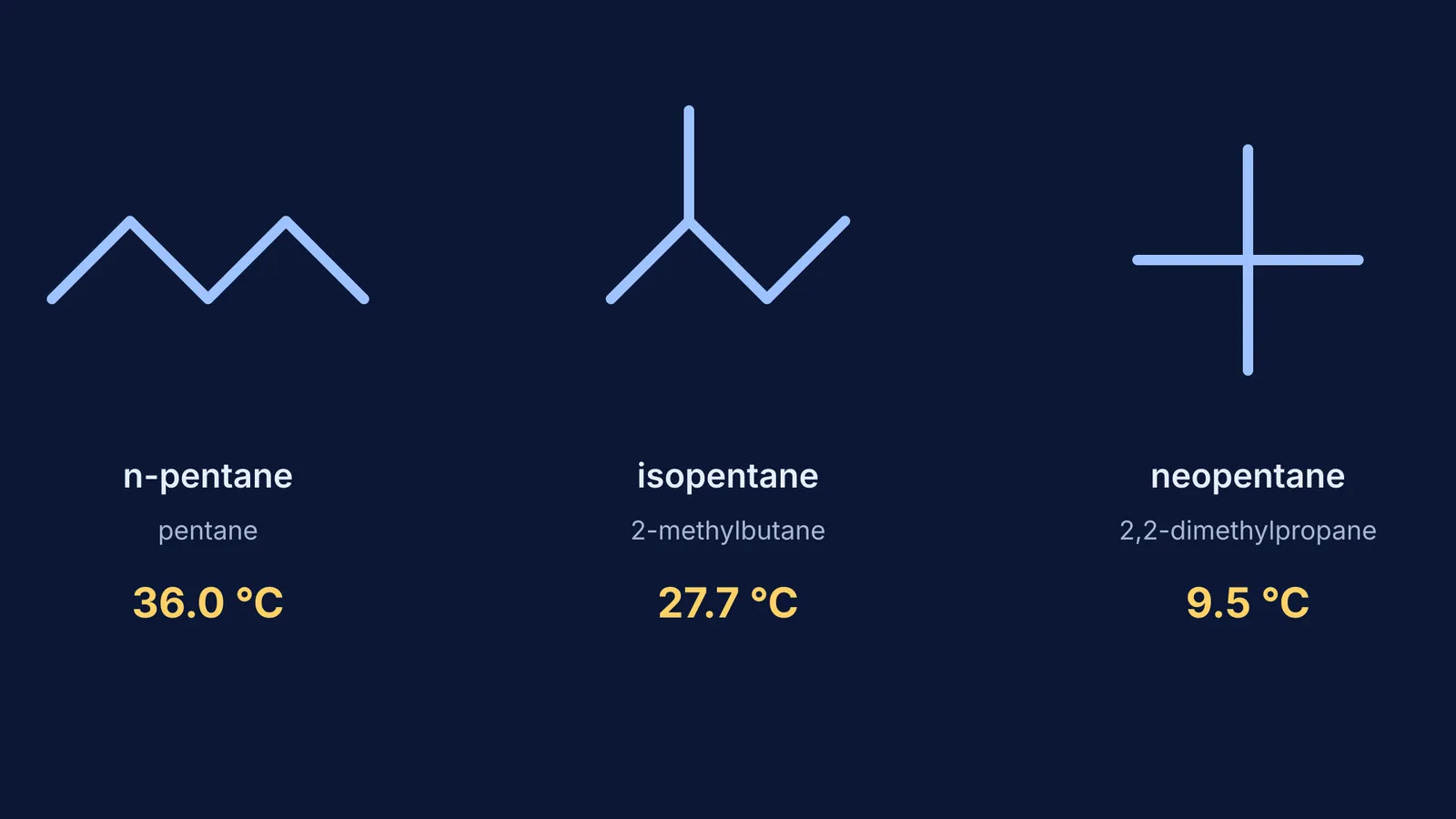
The straight-chain isomer is called n-pentane (normal pentane). Its IUPAC name is simply pentane. All five carbon atoms are joined in a continuous, unbranched row. Because of its long, cylindrical shape, the molecules can pack closely together. It has the highest boiling point of the three isomers at 36.0 °C. This means n-pentane is a volatile liquid at room temperature, easily evaporating on a warm day.
2. Isopentane (2-Methylbutane)
If you take a four-carbon chain and add a methyl group (−CH₃) to the second carbon, you get the first branched isomer, commonly known as isopentane. According to IUPAC nomenclature rules, you must number the longest continuous carbon chain from the end closest to the branch to give the substituent the lowest possible number. This gives the systematic name 2-methylbutane. This single branch makes the molecule slightly more compact than its straight-chain counterpart, dropping its boiling point to 27.7 °C.
3. Neopentane (2,2-Dimethylpropane)
The most highly branched isomer features a three-carbon main chain with two methyl groups attached to the central carbon atom. Its common name is neopentane. To find its IUPAC name, identify the longest chain (three carbons, meaning propane) and number it. Since both methyl groups sit on the second carbon, the name becomes 2,2-dimethylpropane.
Its structure is almost perfectly spherical. The central carbon atom is a quaternary carbon, meaning it is bonded directly to four other carbon atoms. This compact shape gives it a boiling point of just 9.5 °C. Since this is well below room temperature (around 25 °C), neopentane exists as a colourless gas under standard conditions, while the other two isomers are liquids.
Why do boiling points drop as branching increases?
The boiling point of an alkane depends entirely on the strength of the intermolecular forces holding its molecules together in the liquid state. For non-polar molecules like the pentane isomers, these attractive forces are solely London dispersion forces.
London dispersion forces rely on temporary fluctuations in the electron clouds, which create weak, temporary dipoles. These forces are strongest when molecules have a large surface area for contact. n-Pentane is long and cylindrical, so its molecules can lie close to one another, tangling along their entire length. This large contact area creates strong attractions, which take more heat energy to break apart when turning the liquid into a gas.
As branching increases (from n-pentane to isopentane to neopentane), the molecule becomes increasingly compact and spherical. A perfect sphere has a smaller surface area than a cylinder of the exact same volume. With significantly less surface area for the molecules to touch each other, the London dispersion forces become much weaker. Consequently, less thermal energy is needed to separate the molecules, and the liquid boils at a lower temperature.
If you are struggling with molecular shapes, the Fermi Concept Library has every concept in physics, chemistry, biology, mathematics and computing, each with its own lesson and its place in the map.
How do you draw the structures in exams?
When asked to draw the structural isomers of butane or pentane in exams like JEE or NEET, guessing randomly will often lead to drawing the exact same molecule twice in different orientations. Instead, follow a systematic plan to ensure you find every isomer:
Start with the straight chain: Draw the longest possible unbranched chain (five carbons for n-pentane).
Shorten by one: Reduce the main chain to four carbons. Take the remaining carbon and place it on an inner position. If you put it on either end, you have simply drawn a bent five-carbon chain. Placing it on carbon-2 gives 2-methylbutane. (Note that placing it on carbon-3 is the exact same molecule flipped over, so it is still 2-methylbutane).
Shorten by two: Reduce the main chain to three carbons. You now have two carbons left to place. Put them both on the middle carbon to get 2,2-dimethylpropane.
If you find yourself stuck on naming carbon compounds or spotting identical structures drawn differently, Fermi's AI tutor works out what you already know and builds a plan for the session, teaching through it step-by-step until you can reliably name any alkane.


