On this page
Ovule, ovary and ovum sound so alike that students swap them in otherwise correct answers. The fix is to ask what each word names: an organ, a structure inside that organ, or a single cell.
What is the difference between ovule, ovary and ovum?
These definitions follow the NCERT Class 12 Biology chapter on sexual reproduction in flowering plants and the NCERT chapter on human reproduction.
Ovary (plant): the swollen basal part of the pistil; ovules arise inside it from the placenta.
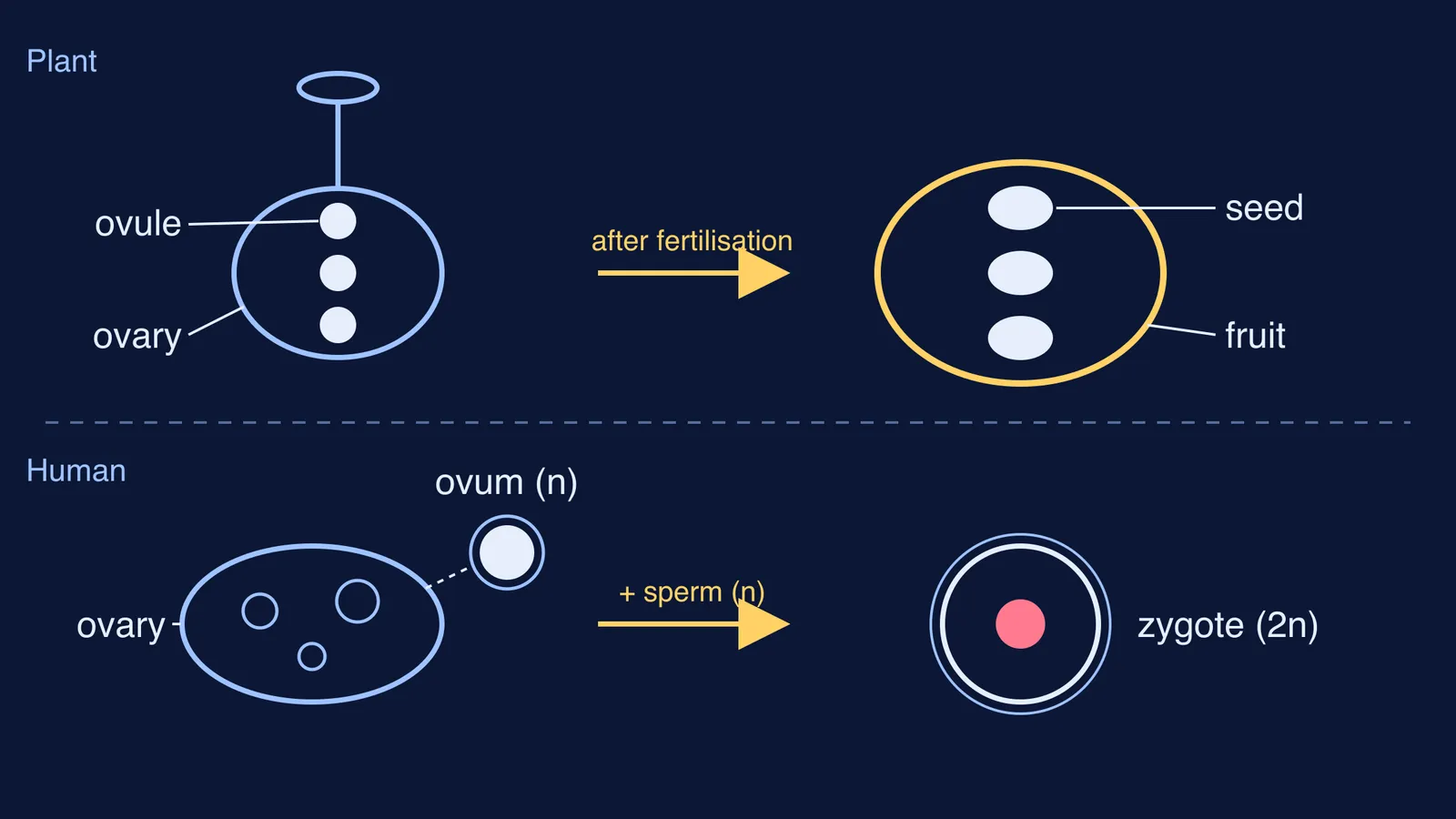
Ovule (plants only): the megasporangium, a small structure attached to the placenta by a stalk called the funicle and wrapped in one or two integuments, with a small opening called the micropyle.
Ovary (human): the primary female sex organ, which produces the female gamete (ovum) and several steroid hormones.
Ovum: the female gamete, a single haploid cell.
The trap is that a flowering plant has both an ovary and ovules, but its egg is neither of them. According to NCERT Chapter 1, the ovule holds the embryo sac, and at its micropylar end sits the egg apparatus of two synergids and one egg cell. A typical angiosperm embryo sac is 8-nucleate but 7-celled. So the plant egg is nested three deep: egg cell inside embryo sac, embryo sac inside ovule, ovule inside ovary. One ovary may hold one ovule (wheat, paddy, mango) or many (papaya, watermelon, orchids).
Humans have no ovules. Each human ovary is about 2 to 4 cm long and holds follicles, and only 60,000 to 80,000 primary follicles are left in each ovary at puberty, according to NCERT Chapter 2. At ovulation the mature Graafian follicle ruptures and releases the secondary oocyte (ovum). It completes its second meiotic division only after a sperm enters it.
What does each become after fertilisation?
In flowering plants
Flowering plants show double fertilisation: one male gamete fuses with the egg to form a diploid zygote, and the other fuses with the two polar nuclei to form a triploid primary endosperm nucleus (NCERT Chapter 1). After that:
Ovary becomes the fruit.
Ovary wall becomes the pericarp, the wall of the fruit.
Ovule becomes the seed.
Integuments harden into the seed coat; the micropyle stays as a small pore that lets in oxygen and water at germination.
Zygote becomes the embryo.
Primary endosperm cell becomes the endosperm, the food store for the embryo.
In humans
Fertilisation happens in the ampullary region of the fallopian tube, where the haploid nuclei of the sperm and the ovum fuse to form a diploid zygote (NCERT Chapter 2). After that:
Ovum plus sperm becomes the zygote.
The zygote divides by cleavage into a morula, then a blastocyst, which implants in the uterus lining.
The corpus luteum, formed from what was left of the Graafian follicle after ovulation, keeps secreting progesterone, which maintains the uterus lining.
The ovary itself stays an ovary.
How do you avoid mixing them up in an exam?
Ask three questions, in this order:
Is it the organ that holds ovules (plant) or makes eggs (human)? Then it is an ovary.
Is it inside a plant ovary, and does it hold an embryo sac? Then it is an ovule.
Is it one haploid cell that fuses with a male gamete? Then it is the egg: the ovum in humans, the egg cell in plants.
Now try these checks. Cover the answer and say yours out loud first.
"The ovule is the female gamete of a flowering plant." False. The gamete is the egg cell inside the embryo sac; the ovule is the structure that holds it.
"A mango has one seed. How many ovules were in its ovary?" One. Mango is NCERT's own example of a one-ovule ovary, and each seed is a fertilised ovule.
"What is a groundnut shell?" The pericarp. Groundnut is a dry fruit, and the fruit wall develops from the ovary wall.
"What forms the seed coat?" The integuments of the ovule, not the ovary wall.
"Where is the human ovum fertilised?" In the ampullary region of the fallopian tube, not in the ovary or the uterus.
If you got two or more wrong, the gap is usually the chain, not the words. The Fermi Concept Library gives every concept in biology its own lesson and its place in the map, so you can see ovary, ovule, embryo sac and seed as one chain rather than four separate flashcards.
What should you read next?
For the n and 2n labels, read haploid vs diploid cells, with plant and animal examples. To compare where fertilisation happens in animals, read internal vs external fertilisation. For why only flowering plants enclose seeds in a fruit, see gymnosperms vs angiosperms: naked seeds, fruits and endosperm.