

On this page
Pines and mango trees both make seeds. So why does NCERT's Class 11 Plant Kingdom chapter ask you to explain why they are classified separately? It comes down to three things: where the ovule sits, how many fusions happen at fertilisation, and the ploidy of the tissue that feeds the embryo.
What does "naked seed" actually mean?
Gymnosperms (gymnos: naked, sperma: seeds) are plants whose ovules are not enclosed by any ovary wall and stay exposed both before and after fertilisation, according to NCERT Biology Class 11, Chapter 3. Their ovules are borne on megasporophylls, which may be clustered into female cones. Examples include *Cycas*, *Pinus* and *Ginkgo*. Pollen is carried by air currents to the opening of the ovule. When the ovule ripens into a seed, nothing wraps it.
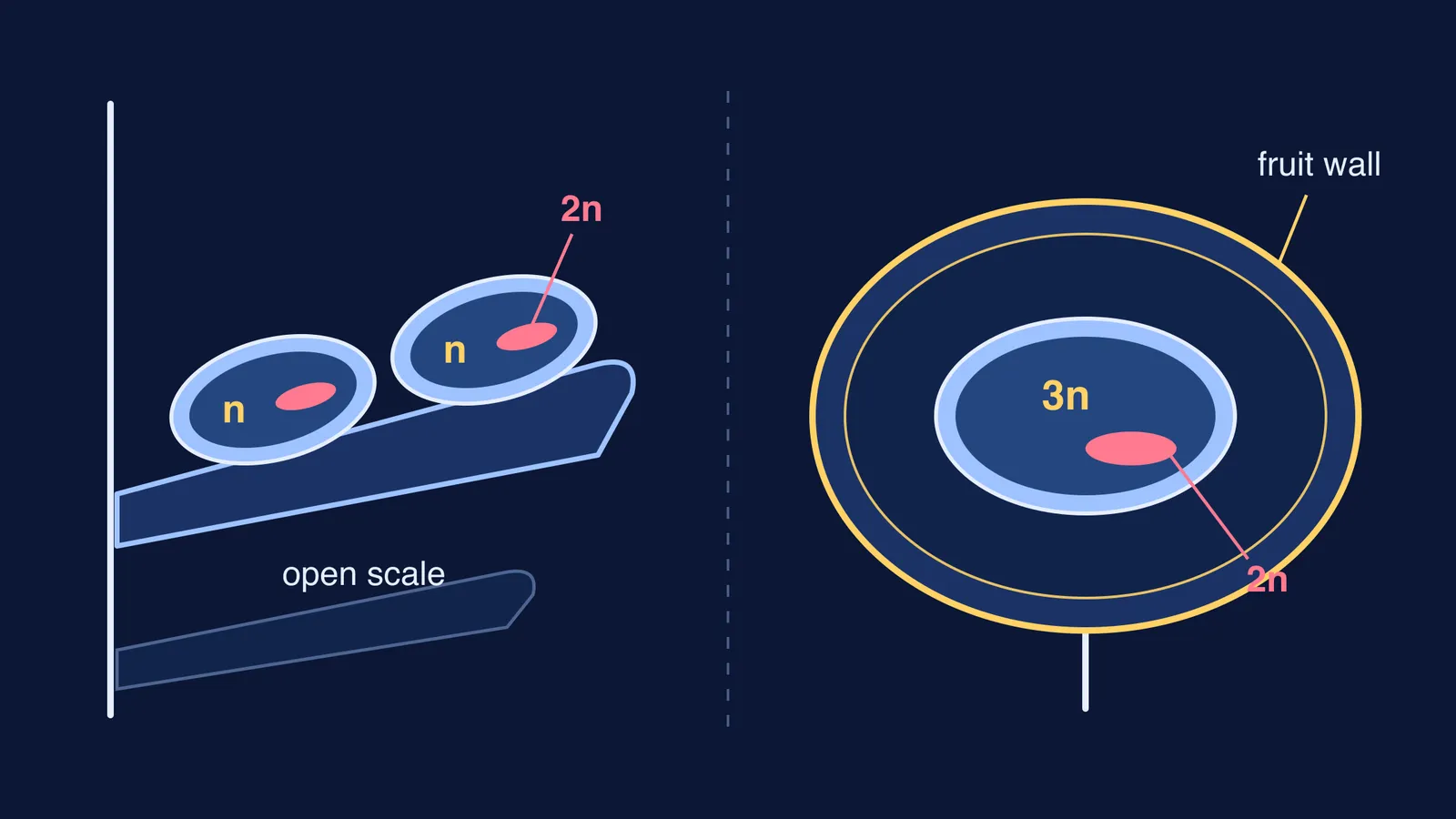
In angiosperms, the pollen grains and ovules develop inside flowers, and the seeds are enclosed in fruits, the same chapter says. NCERT Class 12, Chapter 1 gives the mechanism: as ovules mature into seeds, the ovary becomes the fruit, and the ovary wall becomes the fruit wall, called the pericarp. So "naked" refers to the missing ovary and fruit wall: there is no fruit around a pine seed. If seed and fruit still blur together for you, our explainer on the difference between a seed and a fruit uses mango, pea and wheat.
What is double fertilisation, and why only in angiosperms?
In a flowering plant, the pollen tube releases two male gametes into one of the synergids in the embryo sac. One fuses with the egg (syngamy) to make the diploid zygote. The other fuses with the two polar nuclei to make a triploid primary endosperm nucleus (triple fusion). NCERT calls the pair of fusions double fertilisation, "an event unique to flowering plants" (NCERT Class 12, Chapter 1).
Double fertilisation was discovered by Sergei Nawaschin in 1898 in *Lilium martagon* and *Fritillaria tenella*, according to a review by V. Raghavan in New Phytologist (2003). The review adds that two fusions resembling double fertilisation have been described in some gymnosperms, but the second makes a short-lived extra embryo, not endosperm. For the full story, read our piece on Sergei Nawaschin and the lily.
Why is gymnosperm endosperm haploid but angiosperm endosperm triploid?
Trace each tissue back to the cell it came from. That beats memorising.
Gymnosperm: the megaspore mother cell (2n) divides by meiosis into four megaspores (n). One megaspore develops into a multicellular female gametophyte, which bears the archegonia (NCERT Class 11). All its cells descend from one haploid megaspore, so it is n.
That gametophyte is built before fertilisation, because it carries the egg. Afterwards, the large female gametophyte nourishes the developing embryo, as Baroux, Spillane and Grossniklaus explain in Genome Biology (2002).
Angiosperm: the central cell holds two polar nuclei (n + n). One male gamete (n) joins them, giving 3n. Endosperm forms only after fertilisation.
Embryo in both groups: egg (n) + male gamete (n) = 2n.
To practise the same tracing on the nucellus, embryo sac and other parts, work through our guide to the ploidy of plant reproductive parts.
Gymnosperms vs angiosperms: a quick revision checklist
These points come from NCERT Class 11, Chapter 3 and Class 12, Chapter 1, with the role of the gymnosperm food tissue from the Genome Biology review.
Ovules: exposed on megasporophylls, which may cluster into cones, or enclosed in an ovary inside a flower.
Seeds: naked, or enclosed in a fruit with a pericarp.
Fertilisation: a male gamete fuses with an egg in an archegonium, or double fertilisation with syngamy plus triple fusion.
Food tissue for the embryo: haploid female gametophyte (n), or triploid endosperm (3n).
When the food tissue forms: before fertilisation, or after it.
Examples: *Cycas*, *Pinus*, *Ginkgo*, or everything from tiny *Wolffia* to *Eucalyptus* trees over 100 metres tall.
How do you answer "both bear seeds, so why separate them?"
Use this five-point model answer:
Define the two groups: gymnosperms have naked ovules; angiosperms have ovules inside an ovary.
State the consequence: gymnosperm seeds stay exposed; angiosperm seeds are enclosed in a fruit made from the ovary.
Name the reproductive structure: cones in gymnosperms, flowers in angiosperms.
Contrast fertilisation: single fusion with an archegonial egg, compared with double fertilisation, which NCERT calls unique to flowering plants.
Close with ploidy: food tissue n in gymnosperms, endosperm 3n in angiosperms.
If one step in the ploidy chain keeps slipping, the Fermi Concept Library gives each biology concept its own lesson, so you can revisit an earlier step first. For practice, the Fermi Problem Library has worked problems with a step-by-step solver that explains the reasoning rather than printing an answer.


