On this page
You know 5 is bigger than 2, so it feels as if −5 should beat −2 as well. It doesn't, and the reason is where each number sits on the number line. Once you see that, negative fractions and decimals fall into order too.
Why is −5 less than −2 on the number line?
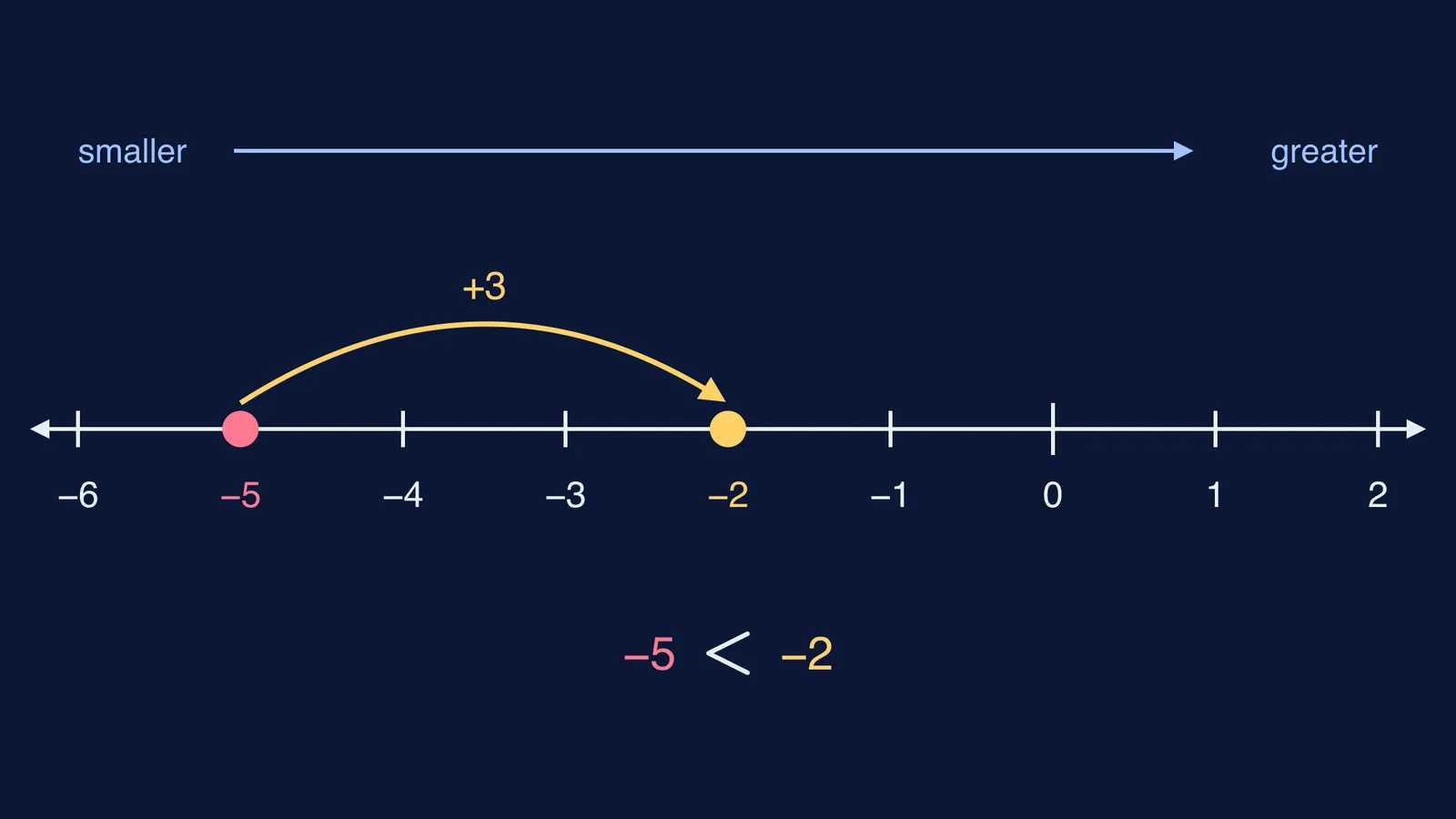
On a number line, every number is smaller than every number to its right. NCERT's Class 6 textbook *Ganita Prakash* says it plainly in its chapter on integers, The Other Side of Zero: smaller numbers lie to the left of bigger numbers, "So, 2 < 5; –3 < 2; and –5 < –3."
Now find −5 and −2. Start at 0 and walk left: −1, then −2, then on to −3, −4 and −5. That puts −5 three steps further left than −2, so −5 < −2.
The muddle comes from mixing up two different questions:
How far from zero? That is the absolute value. |−5| = 5 and |−2| = 2, so −5 is further from zero.
Which number is greater? That depends on position, and −2 is further right.
When both numbers are negative, the one further from zero is the smaller number. We cover this step by step in absolute value and comparing negative integers.
Why does −5 feel bigger than −2?
Because the rules you learned for whole numbers keep firing. Laura Bofferding, then a researcher at Purdue University, interviewed 61 first graders about the values and order of negative numbers. She found that at first they "overrelied on various combinations of whole-number principles", and that a significant number of them went on to develop formal mental models based on their instruction (Journal for Research in Mathematics Education, 2014; ERIC abstract).
So the mistake doesn't mean you're bad at maths. Your whole-number habits just need a new rule on top, and real examples let you check it.
How do temperature and debt make it obvious?
Temperature. The same NCERT chapter has a table of readings taken at different times on a November day in Leh that includes −2°C and −4°C (NCERT, Ganita Prakash Grade 6, Chapter 10). Ask which reading was colder. It was −4°C, and colder means a lower temperature, so −4 < −2. By the same logic, −5°C is colder than −2°C.
Debt. The chapter treats credits as positive numbers and debits as negative ones, and adds them up to get your balance, which "can be positive or negative". If your balance is −₹500, you owe ₹500. If it is −₹200, you owe ₹200. Owing more leaves you worse off, so −500 < −200.
How do you compare negative fractions and decimals?
It's the same rule as for integers, in three steps:
Check the signs. Every negative number is less than 0, and 0 is less than every positive number.
If both are negative, compare their sizes without the minus sign. Use a common denominator for fractions. For decimals, give both the same number of decimal places.
Flip the result. The larger size gives the smaller number, because it sits further left.
Worked example 1: compare −2/3 and −3/4. Their sizes are 2/3 = 8/12 and 3/4 = 9/12. 3/4 is the larger size, so it is the smaller number: −3/4 < −2/3. There is a full walkthrough in comparing negative rational numbers.
Worked example 2: compare −0.7 and −0.65. Write −0.7 as −0.70. Then 0.70 > 0.65, so −0.7 < −0.65. A common slip is reading "65" as bigger than "7".
Worked example 3: arrange −0.4, −1/2, −0.45 and −3/8 from smallest to largest. As decimals the sizes are 0.4, 0.5, 0.45 and 0.375. The largest size gives the smallest number, so the order is −1/2 < −0.45 < −0.4 < −3/8.
To picture them, see describing a fraction as a strip and number line.
How can a parent check this in five minutes?
No worksheet needed. Try this at home:
"Which is colder, −3°C or −8°C?" Your child should say −8.
"So which number is smaller?" Again, −8. If they say −3, go back to question 1.
"You owe a friend ₹50 and your sister owes them ₹20. Who is worse off?" Write it down as −50 < −20.
"Now put −0.3 and −1/4 in order." The answer is −0.3 < −1/4, because −1/4 = −0.25. Ask them to explain it by drawing a line.
If your child can explain each answer, rather than just recite it, they understand the idea. If they get stuck on the same step every time, the Fermi Concept Library has a lesson on each concept in mathematics, and you can see where it fits in the map. For practice, the Fermi Problem Library has worked problems with a step-by-step solver that explains the reasoning rather than printing an answer.
The next time a minus sign trips you up, draw the line and find out which number is further left.