

On this page
If a Class 6 or Class 7 student tells you that −8 is bigger than −3 "because 8 is bigger than 3", they are using a rule that worked for every number they met before negatives. The fix is to separate two questions that whole numbers let you treat as one: how far is a number from zero, and where does it sit on the line?
What is the absolute value of an integer?
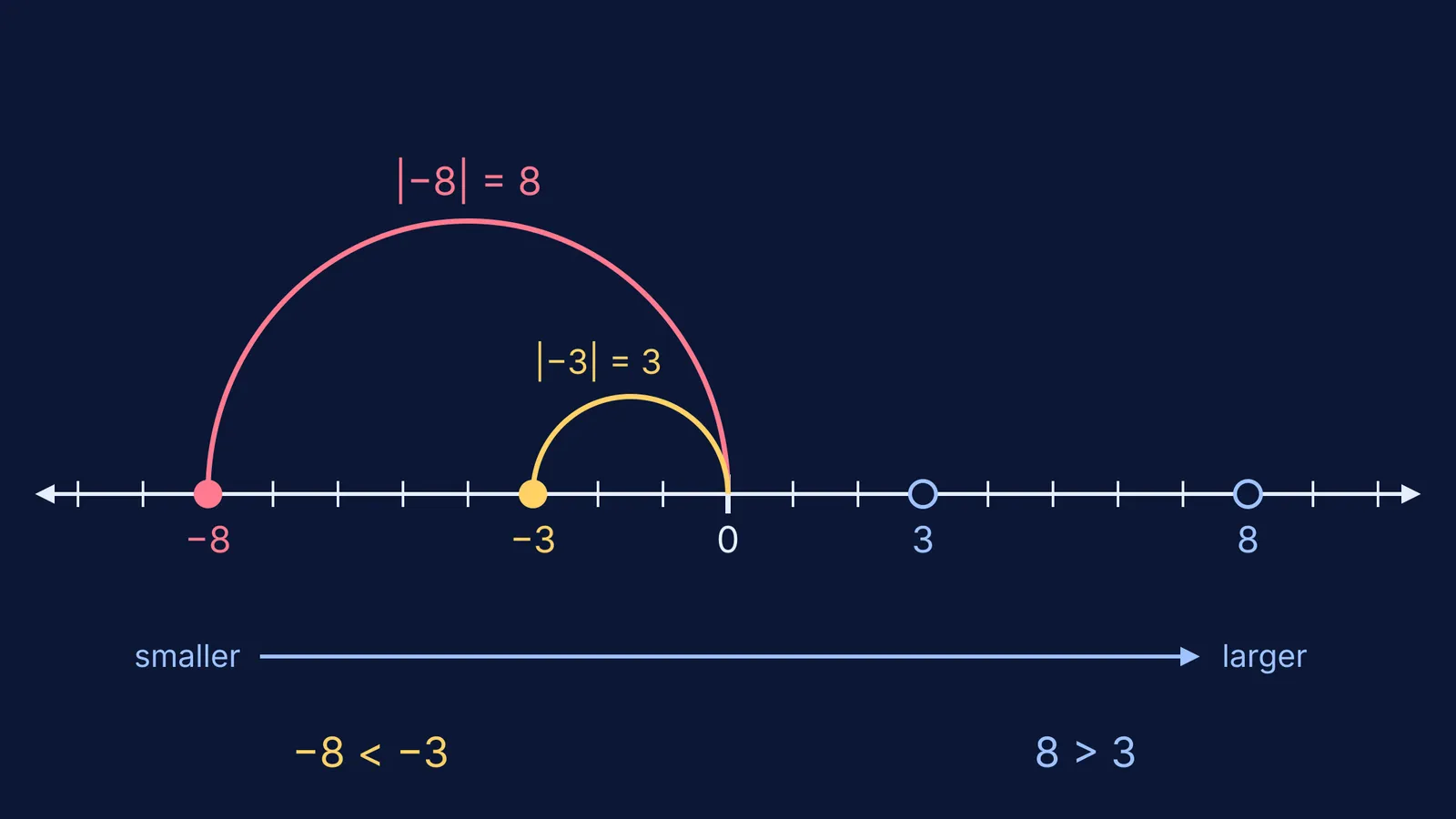
The absolute value of a number is its distance from 0 on the number line, written |n|, according to OpenStax Prealgebra 2e. Because distance cannot be negative, an absolute value is never negative.
So |−8| = 8 and |8| = 8. Both numbers are eight steps from zero; they just sit on opposite sides. Likewise |−3| = 3 and |3| = 3. Absolute value drops the sign and keeps only the size of the gap.
Why is −8 less than −3 if 8 is greater than 3?
Order is about position, not distance. The same OpenStax chapter puts it simply: going from left to right on the number line, numbers increase in value. −8 sits five steps to the left of −3, so −8 < −3.
NCERT's Class 6 textbook Ganita Prakash teaches the same idea with the floors of a building that go below ground. In Chapter 10, "The Other Side of Zero", Floor −4 is lower than Floor −3, "So, −4 < −3", and because every negative floor is below Floor 0, all negative numbers are less than 0.
Here is the twist that confuses people: for negative numbers, a bigger absolute value means a smaller number. −8 is further from zero than −3, and further in the below-zero direction, so it is lower.
How do temperatures make negative numbers easier to compare?
A thermometer is a number line stood on its end. Imagine a winter morning when one hill town reads −3 °C and another reads −8 °C. −8 °C is further below freezing, so it is colder, and colder means a lower number: −8 < −3.
Absolute value still has a job here. It tells you how far below zero each reading is: 8 degrees and 3 degrees. And the gap between the two towns is |−8 − (−3)| = |−5| = 5 degrees. If the temperature drops from −3 °C to −8 °C overnight, it has fallen by 5 degrees. Say it in temperature words first: "minus eight is colder than minus three" becomes −8 < −3.
How do you compare any two integers in three steps?
Check in this order:
Different signs? Any positive number is greater than any negative number, and 0 sits between them. So 2 > −15.
Both positive? The larger absolute value is the larger number: 8 > 3.
Both negative? Flip it: the larger absolute value is the smaller number. Compare |−12| = 12 and |−7| = 7, then write −12 < −7.
Worked examples you can check against the rule:
−1 or −15? |−15| is larger, so −15 is smaller: −1 > −15.
0 or −4? Every negative number is less than 0: 0 > −4.
Order −2, −10, 0, −6, 3 from smallest to largest: −10, −6, −2, 0, 3. Sketch a number line and check that each one sits to the right of the one before.
Which is greater, |−9| or |4|? This compares distances, not positions: 9 > 4, so |−9| is greater, even though −9 < 4.
The last one is the exam trap: check whether the question asks about the numbers or their absolute values.
Why do students mix up negative numbers?
They are reusing whole-number habits. In a study in the Journal for Research in Mathematics Education, Laura Bofferding examined 61 first graders' answers to interview questions about negative integers and found that, at first, they over-relied on combinations of whole-number principles. After instruction on the meanings of the minus sign, a significant number of the children developed formal mental models of negative numbers.
For older students, two habits help. Sketch a number line for any comparison involving a negative. And keep the two questions apart: "how far from zero?" is absolute value; "which is further right?" is order.
If integers as a set still feel shaky, start with the difference between natural numbers, whole numbers and integers, then move on to subtracting negative numbers using the additive inverse. For the history, read about Al-Samaw'al's 12th-century rules for negative numbers.
To see where a wrong comparison slipped, the Fermi Problem Library has worked problems with a step-by-step solver that explains the reasoning rather than printing an answer, and the Fermi Concept Library gives each mathematics concept its own lesson and its place in the map.
Next time you meet a negative sign, ask the two questions separately: how far from zero, and which side of the line.


