

On this page
Your eyes collect light. Your brain turns that light into a best guess about the world: how big things are, what shade they are and whether they are moving. Most of the time the guess is right. An optical illusion is a picture built so that the brain's usual rules give the wrong answer, and that makes it a window onto the rules themselves.
Here are three classic illusions, for size, brightness and motion, and a ten-minute test to try at home.
Why do optical illusions work at all?
The same patch of light on your retina could come from a small object close by or a large one far away, or from a dark surface in bright light or a pale one in shade. The light alone cannot settle it, so the visual system uses context: what surrounds the object, the depth cues in the scene and what you were looking at a moment earlier.
The brain makes predictions about your own body too, which is the trick behind why you cannot tickle yourself. Perception is built on estimates, not raw readings.
Why do two equal circles look different sizes?
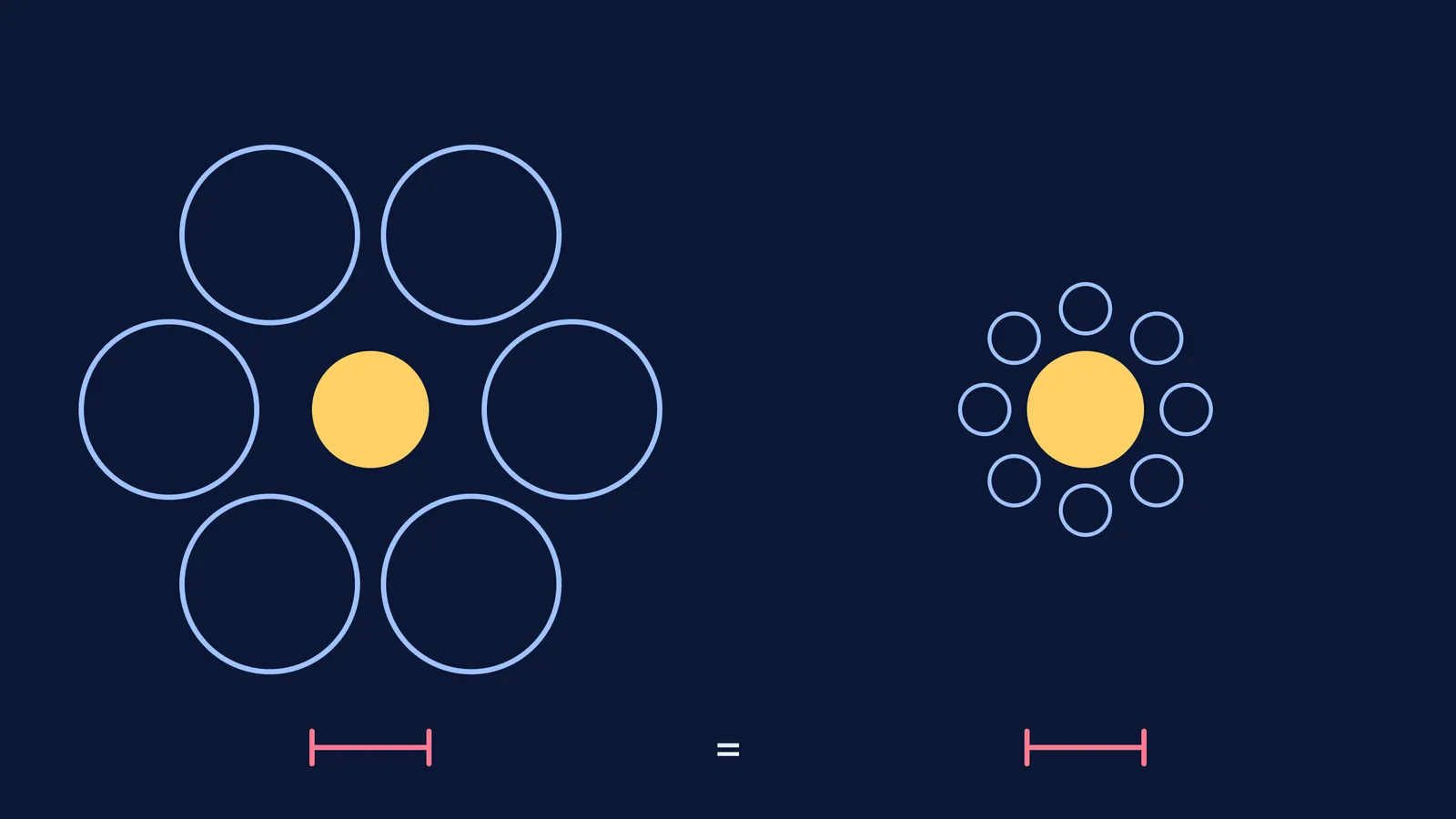
In the Ebbinghaus illusion, two identical circles sit in different company: one ringed by large circles, the other by small ones. The one among large circles looks smaller. Your brain judges size partly by comparison with neighbours.
In a 2011 study in Nature Neuroscience, Samuel Schwarzkopf, Chen Song and Geraint Rees at University College London measured how strongly each person saw the Ebbinghaus illusion and a version of the Ponzo illusion, where equal shapes look different against a background with depth. They also mapped each person's primary visual cortex (V1), the first stage of visual processing in the cortex.
The paper notes that V1 varies between individuals over a threefold range in surface area and volume (full text). People with a smaller V1 surface area tended to see both illusions more strongly, and the link was specific to V1: for the neighbouring areas V2 and V3 it was weak and not significant.
The strengths of the two illusions were not significantly correlated across people, which the authors say suggests different factors may be at work. One possibility they raise: connections within V1 for Ebbinghaus, and feedback from areas that read the 3D layout of the background for Ponzo.
Why does the same grey look lighter or darker?
Put one grey square on a white card and an identical one on a black card. The square on white looks darker. This is called simultaneous brightness contrast.
Edward Adelson of MIT summed it up in a 1993 paper in Science: "a medium-gray patch appears darker when placed on a bright background and brighter when placed on a dark background." He then showed new brightness illusions that simple low-level models cannot explain. Small changes in how a picture is grouped into surfaces greatly changed the strength of the effect, which he suggests points to processing later in the visual system.
Why do still rocks seem to move after you watch a waterfall?
Stare at flowing water, then look at the rocks beside it, and the rocks may seem to drift upwards. A 1998 review in Trends in Cognitive Sciences by Stuart Anstis, Frans Verstraten and George Mather describes this motion aftereffect, which can follow a short period of viewing, perhaps 60 seconds.
The review explains that cells in the visual cortex tuned to the water's direction become less responsive, so when you look at the still rocks, competing detectors produce a false signal of motion the other way. The authors argue this is more likely error correction or efficient coding than simple fatigue.
Motion perception can fool you in other ways too, as when your train seems to move when the other one does.
How can you test these illusions at home?
You need a coin, paper in three shades and a phone. Do each test, then write one line on what you expected and what you saw.
Size: draw two circles round the same coin. Ring one with circles drawn round a jar lid and the other with circles round a pen cap. Ask someone which centre circle is bigger, then let them measure.
Brightness: cut two equal squares from grey paper. Put one on white paper and one on black. Ask which is darker, then put them side by side.
Motion: play a video of flowing water or scrolling credits, fix your eyes on the centre for about a minute, then look at a textured wall or a book cover.
Compare: did everyone see all three equally? The UCL study found the strength of the size illusions varies between people.
For colour, try the card test in can you see colour at the edge of vision.
There is a study lesson here too. In geometry and ray diagrams, lines that look equal are a hint, not a proof: work from the lengths and angles you are given. If an idea is hard to picture from one still figure, the Fermi Simulation Lab has interactive simulations for ideas that are easier to see than to read, so you can change a value and watch what happens.
Run the three tests with a friend this week and compare notes.


