

On this page
Look straight at one word on this screen. Everything around it seems coloured, but is your eye really sending colour from out there? You can test it at home with a friend, some coloured cards and a piece of string. Write down your prediction first.
Can you see colour at the edge of your vision?
You can, but not as well as you think. In a study published in the Journal of Vision, Hansen, Pracejus and Gegenfurtner showed people coloured patches up to 50 degrees from where they were looking (Hansen et al., 2009). They found that chromatic detection gets worse as you move away from the centre, but is still possible even at large eccentricities. The same paper notes that sensitivity to red-green differences drops off more steeply toward the edge than sensitivity to brightness or to blue-yellow differences.
The feeling of seeing colour all around you is even less reliable. In a 2020 virtual reality experiment, Cohen and colleagues turned the outer part of the scene grey while tracking where people looked, so only the spot they were looking at stayed in colour (Cohen, Botch and Robertson, 2020). In the most extreme case, almost a third of observers failed to notice when less than 5% of the display was in colour.
Why is the edge of your vision weaker at colour?
Colour vision starts with cones, the light-sensitive cells in the retina that come in types tuned to different wavelengths. Rods, the other kind, work in dim light but do not tell colours apart.
The cones are not spread evenly. In a classic study of eight human retinas, Christine Curcio and colleagues counted an average of 4.6 million cones and 92 million rods per eye (Curcio et al., 1990). Peak cone density in the fovea, the tiny pit you aim at whatever you look at, averaged 199,000 cones per square millimetre. Cone density is an order of magnitude lower just 1 mm from the foveal centre, according to the same paper. The very centre of the fovea has no rods at all: a rod-free zone about 1.25 degrees across.
So the edge of your retina samples the world with far fewer, more scattered cones. The cells that carry their signals to the brain also pool input from wider patches as you move out, which the Hansen paper says is thought to explain the steep red-green decline.
How do you test colour at the edge of your vision?
You need a friend, four cards of the same size in red, green, blue and yellow (plus one grey card as a trap), a 50 cm piece of string and a ruler.
Sit still and stare at a dot on the wall straight ahead. Cover one eye. Your eye must not move during a trial.
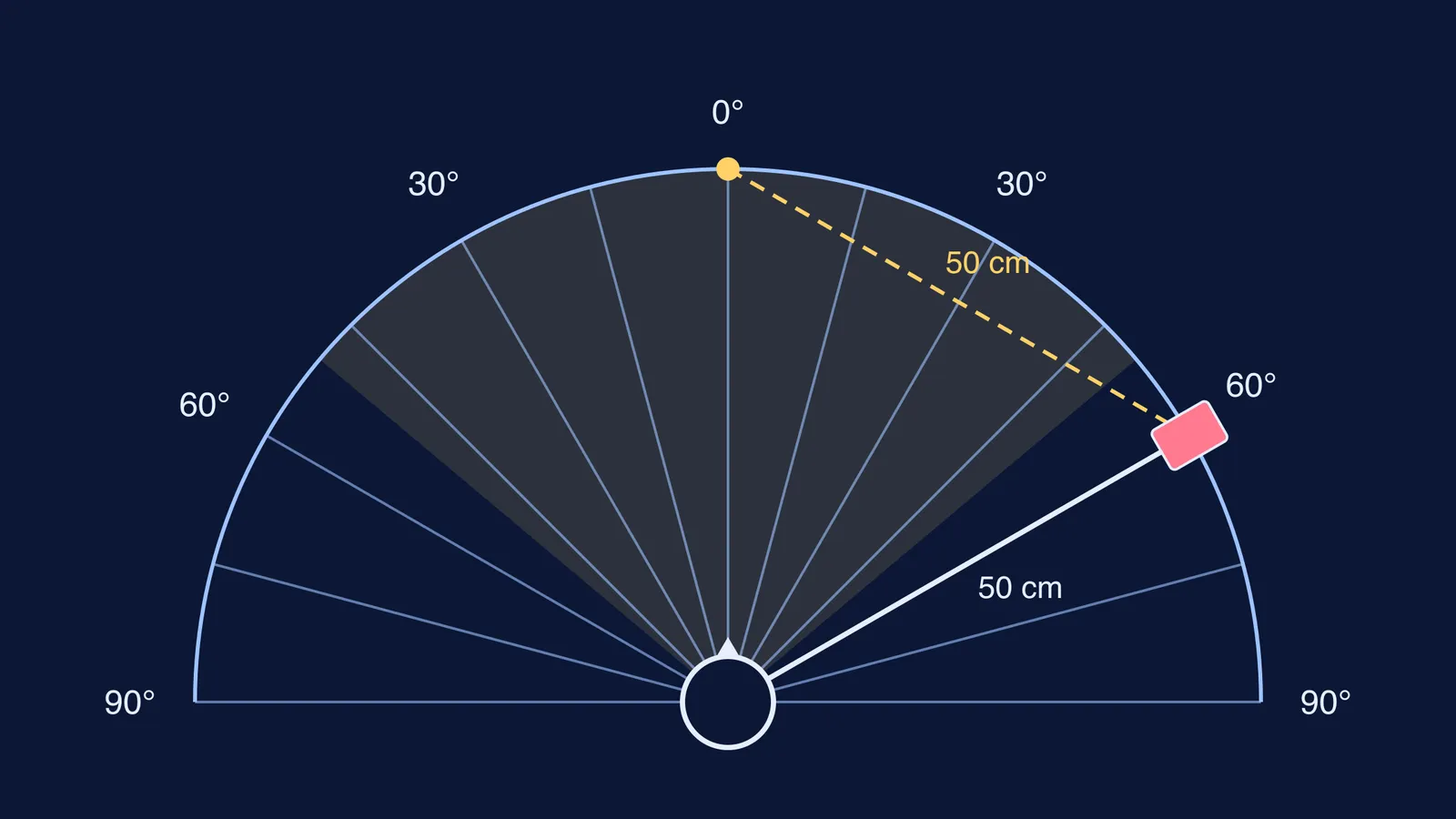
Your friend holds one end of the string at the bridge of your nose and keeps each card at the other end, so it is always 50 cm away. This keeps the card the same size on your retina.
The friend shuffles the cards out of sight, picks one and holds it at a set angle to the side of your open eye.
You name the colour. Your friend records the angle, the true colour and your answer.
Repeat each colour at every angle at least three times, in a random order.
To find each angle, your friend measures a straight line with a ruler from the straight-ahead point (in front of your nose, at the string's end) to the card. On a 50 cm circle, that distance is 2 × 50 × sin(angle ÷ 2):
15 degrees: 13 cm
30 degrees: 26 cm
45 degrees: 38 cm
60 degrees: 50 cm
75 degrees: 61 cm
90 degrees: 71 cm
Worked example: at 60 degrees the ruler distance is 2 × 50 × sin 30° = 50 cm, the same length as the string. Nose, straight-ahead point and card form an equilateral triangle: a quick check.
What should your results show?
If your data match the research, accuracy should fall as the angle grows, and red and green may fail before blue and yellow. Card colours also differ in brightness, which can give you clues. The grey trap card tells you whether you are guessing colour where there is none. Keep your card size fixed so angles are comparable.
This is a home experiment, not an eye test. If you notice a missing patch in your vision, or a big difference between your two eyes, see an ophthalmologist or optometrist.
For ideas that are easier to see than to read, the Fermi Simulation Lab has interactive simulations.
For two more card-and-paper experiments on your own eyes, try finding your blind spot with a card test and why staring at red gives a green afterimage.


