

On this page
A crude oil pipeline sounds simple: oil in at one end, out at the other. The hard part is distance. Over hundreds of kilometres the oil drags against the pipe wall, and every metre costs a little pressure. Three ideas explain how a long line keeps moving: viscosity, pumping stations, and the pig that rides inside.
Why does pressure drop along a pipeline?
Viscosity is a fluid's internal friction, its resistance to layers sliding past each other. The SI unit is the pascal second, as our explainer on units of viscosity and the poise shows.
For smooth, layered (laminar) flow in a long round pipe, the Hagen–Poiseuille equation gives the pressure drop as ΔP = 8μLQ/(πR⁴), where μ is viscosity, L is length, Q is the volume flow rate and R is the pipe radius.
Read it term by term:
ΔP grows with L. Twice the length means twice the pressure drop.
ΔP grows with μ. Twice the viscosity means twice the drop.
ΔP falls as R⁴. That is why flow through a narrow tube depends on the fourth power of the radius.
At high speeds or in wide pipes the flow turns turbulent and the pressure drop is larger than Hagen–Poiseuille predicts, so engineers use the Darcy–Weisbach equation instead. There too, the pressure loss from viscous effects is proportional to the pipe's length. For laminar flow its friction factor is 64/Re, which makes it equivalent to Hagen–Poiseuille.
Why do pipelines need pumping stations?
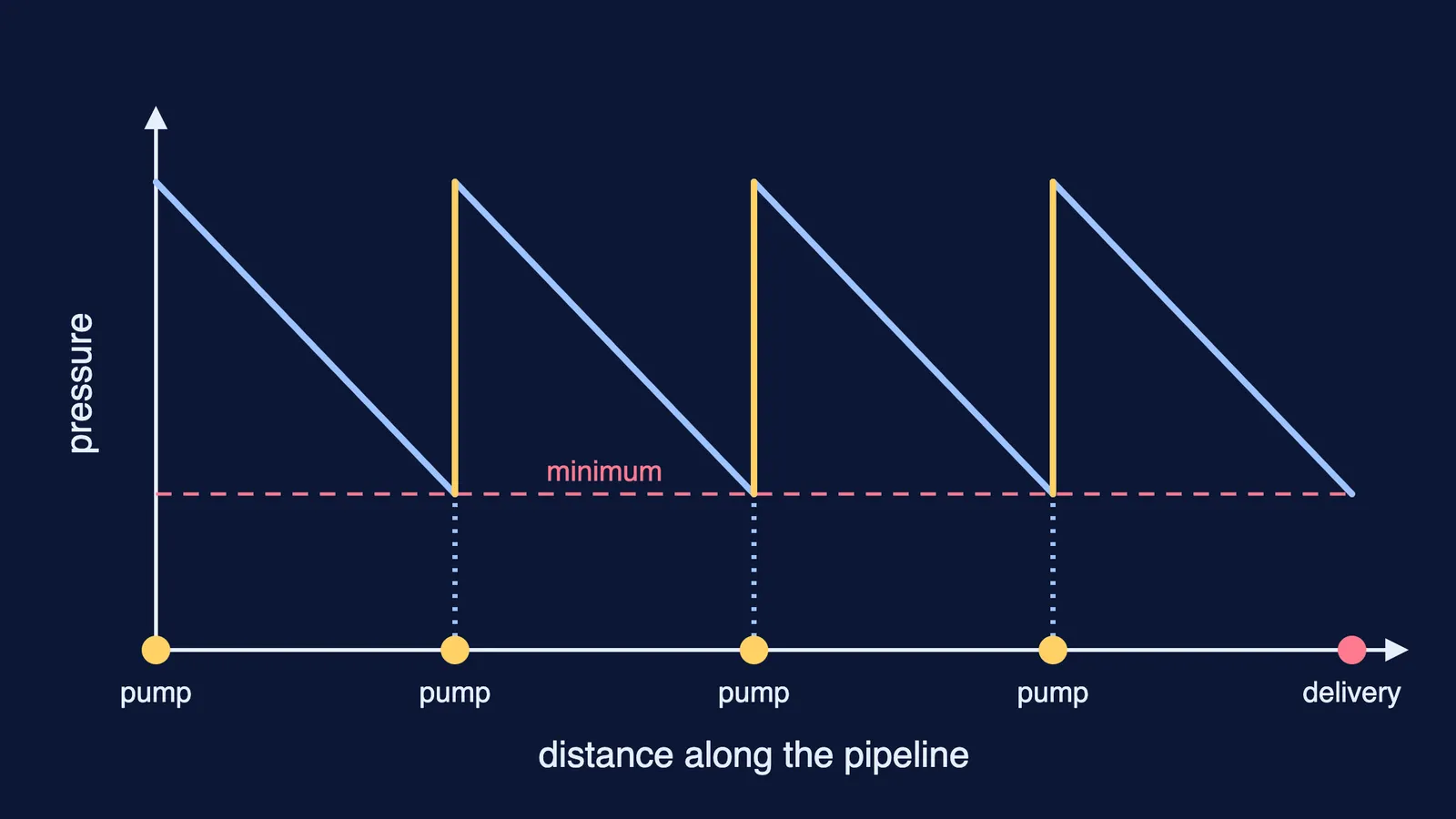
The pressure lost to friction has to be put back. The US Pipeline and Hazardous Materials Safety Administration's fact sheet on pump and compressor stations says that as the oil moves, pressure is reduced by friction losses in the pipe, so pressure must be increased along the pipeline to keep it moving.
Pumps (for liquids) and compressors (for gas) move the product through impellers, which raises the pressure at their outlet. According to the same PHMSA fact sheet, pumps are positioned approximately every 20 to 100 miles, depending on the product and the terrain, and compressors are normally every 40 to 100 miles. Hilly routes need pressure boosts more often than flat ones.
The result is a sawtooth, the pattern in the diagram above. On a level pipe of constant width, pressure falls in a straight line between stations, then jumps back up at each pump, so it stays above the minimum the line needs. Stopping a moving column of liquid suddenly causes a pressure surge, as in why water pipes bang when a tap is shut fast.
Worked example: how many pumping stations does a 1,000 km line need?
Take PHMSA's range of 20 to 100 miles between pumps from its pump station fact sheet. One mile is 1.609 km, so that range is about 32 km to 161 km.
Widest spacing: 1,000 ÷ 161 ≈ 6.2, so you need at least 7 segments, which means 7 pumping stations counting the one at the start.
Tightest spacing: 1,000 ÷ 32 ≈ 31.3, so 32 segments and 32 stations.
Now halve the pipe radius at the same flow. If the flow stays laminar, Hagen–Poiseuille says ΔP rises by 2⁴ = 16 times, so the stations would need to be 16 times closer.
Now let the oil cool and become twice as viscous. In laminar flow ΔP doubles, so the spacing halves.
The Fermi Simulation Lab has interactive simulations for ideas like this that are easier to see than read.
What is a pipeline pig and what does it do?
A pig is a device that travels inside the pipe. PHMSA's fact sheet on in-line inspection says pigs reduce the build-up of waxes and other contaminants along the pipe's interior. Wax narrows the pipe, and you have just seen what a smaller radius does to pressure.
"Smart pigs" are in-line inspection tools that measure and record irregularities such as corrosion, cracks, dents or gouges. Some use magnetic flux leakage to find metal loss; ultrasonic tools measure wall thickness.
A smart pig is loaded at a valve or pump station fitted with special pipes and valves, and the oil's flow launches it into the main line. A similar setup downstream takes it out. PHMSA notes that removing paraffin wax matters for ultrasonic tools, especially in crude oil lines, and recommends a cleaning pig first.
How do you revise pipe flow for JEE and board exams?
When a pipe question appears:
Is the flow laminar? If yes, Hagen–Poiseuille applies.
Write ΔP, then ask which of L, μ, Q and R the question changes.
Use ratios: change one variable and keep the rest fixed.
Check the answer's direction: longer, narrower or more viscous should all need more pressure.
If you get the setup right but still land on the wrong ratio, the Fermi Problem Library has a step-by-step solver that explains the reasoning. And if you don't know where to start with fluids, Fermi's AI tutor can work out what you already know and build a plan for the session.


