On this page
You check the side mirror, see a scooter far behind you, and a second later it is beside you. The mirror didn't move the scooter. It shrank the picture, and your eyes did the rest.
Why does a convex mirror make cars look smaller?
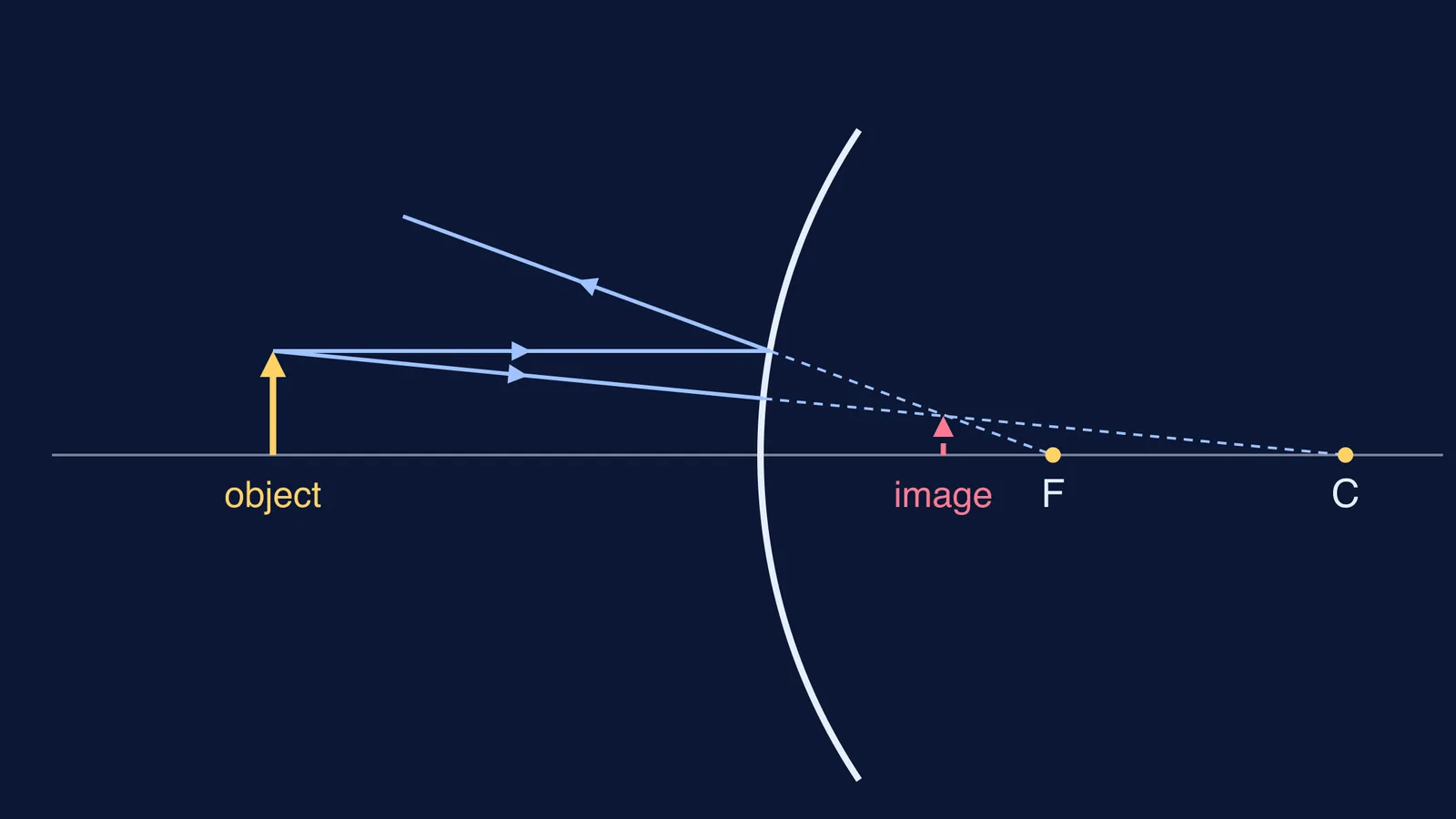
The passenger-side mirror on many cars is convex: it bulges outward. Rays from a car behind you spread apart after they reflect, so traced backwards they seem to come from a point behind the glass.
A convex mirror's image is always "upright with respect to the object, is a virtual image, and is smaller than the object", according to the OpenStax University Physics chapter on spherical mirrors.
The shrinking is the price of a wider view: the bulge fits more of the road into the same small glass. We test that wider view with rays in why convex mirrors are used as rear-view mirrors.
How does the mirror formula prove it?
OpenStax gives the mirror equation as 1/do + 1/di = 1/f and the magnification as m = −di/do (OpenStax, section 2.2). In that convention, f is negative for a convex mirror, di is negative for a virtual image, and a positive m means an upright image.
Now do the sign check, with no numbers:
Rearrange: 1/di = 1/f − 1/do.
A real car has do positive, so 1/do is positive.
A convex mirror has f negative, so 1/f is negative.
Negative minus positive is negative, so di is always negative: the image is virtual, behind the glass.
So m = −di/do is positive (upright), and since the image sits closer to the mirror than the car, m is less than 1 (smaller).
No position of the car can change those signs. If your textbook uses the New Cartesian convention, the signs on u and f are written differently, but the physical answer is the same. For the case-by-case proof, read why a convex mirror always forms a virtual, diminished image.
How far away does the car look? A worked example
The US safety standard FMVSS 111 says a passenger-side convex mirror on a passenger car must have an average radius of curvature between 889 mm and 1,651 mm (49 CFR 571.111, S5.4.3). We take R = 1.2 m, which is inside that range, so f = −R/2 = −0.6 m.
A car 1.5 m tall is 10 m behind the mirror.
Image distance: 1/di = 1/(−0.6) − 1/10 = −1.767, so di ≈ −0.57 m. The image sits about 57 cm behind the glass.
Magnification: m = −di/do ≈ +0.057. The image is upright and about 8.5 cm tall.
Your eye judges the angle the image fills, not its height. Suppose your eye is 1 m from the mirror (an assumed round number). In a flat mirror, the car's image would be 11 m from your eye. In the convex mirror, an 8.5 cm image about 1.57 m from your eye fills only about 40% of that angle, which is how small a car about 27 m away looks in a flat mirror.
With your eye 0.5 m from the mirror, the same car looks about 18 m away. So simple geometry predicts the car looks roughly two to three times farther away than it is, and more so when the mirror is farther from your eye.
Do real drivers misjudge distance this much?
In a 1997 field experiment, Michael Flannagan, Michael Sivak and colleagues at the University of Michigan Transportation Research Institute used flat and convex mirrors on a car, in both the driver-side and passenger-side positions (report UMTRI-97-32, on TRID). A longer eye-to-mirror distance did lead to more overestimation, as the geometry predicts. But in both positions, drivers overestimated distance less than the mathematical model predicted. The authors concluded the concern is weaker for the driver-side mirror, which is near the eyes, than for the passenger-side one.
That is where the famous line comes from. Rule S5.4.2 requires the words "Objects in Mirror Are Closer Than They Appear" on a passenger car's passenger-side convex mirror, in letters 4.8 mm to 6.4 mm high (49 CFR 571.111).
How do you get convex mirror questions right in the exam?
Write the signs before any numbers, and keep one convention all the way through.
Draw two rays: one parallel to the axis that reflects as if from F, one aimed at C that bounces straight back. The image is where their dotted extensions cross behind the mirror.
Check the answer: virtual, upright and smaller, every time.
If a question gives the image size, use magnification to find f, as in finding a convex mirror's focal length from magnification.
If the ray picture won't settle, the Fermi Simulation Lab has interactive simulations for ideas that are easier to see than to read. If your signs keep slipping, the Fermi Problem Library has a step-by-step solver that explains the reasoning, so you can see which step went wrong.
Next time you read that line on a mirror, run the check in your head: f negative, di negative, m between 0 and 1.