

On this page
When solving spherical mirror numericals in Class 10 and entrance exams such as JEE Main and NEET-UG, problems frequently specify image size instead of distance. A question might state that a vehicle's convex mirror produces an image one-third the height of a car behind it. Finding the focal length requires linking linear magnification to the mirror formula while applying the New Cartesian Sign Convention correctly.
Why is magnification always positive for a convex mirror?
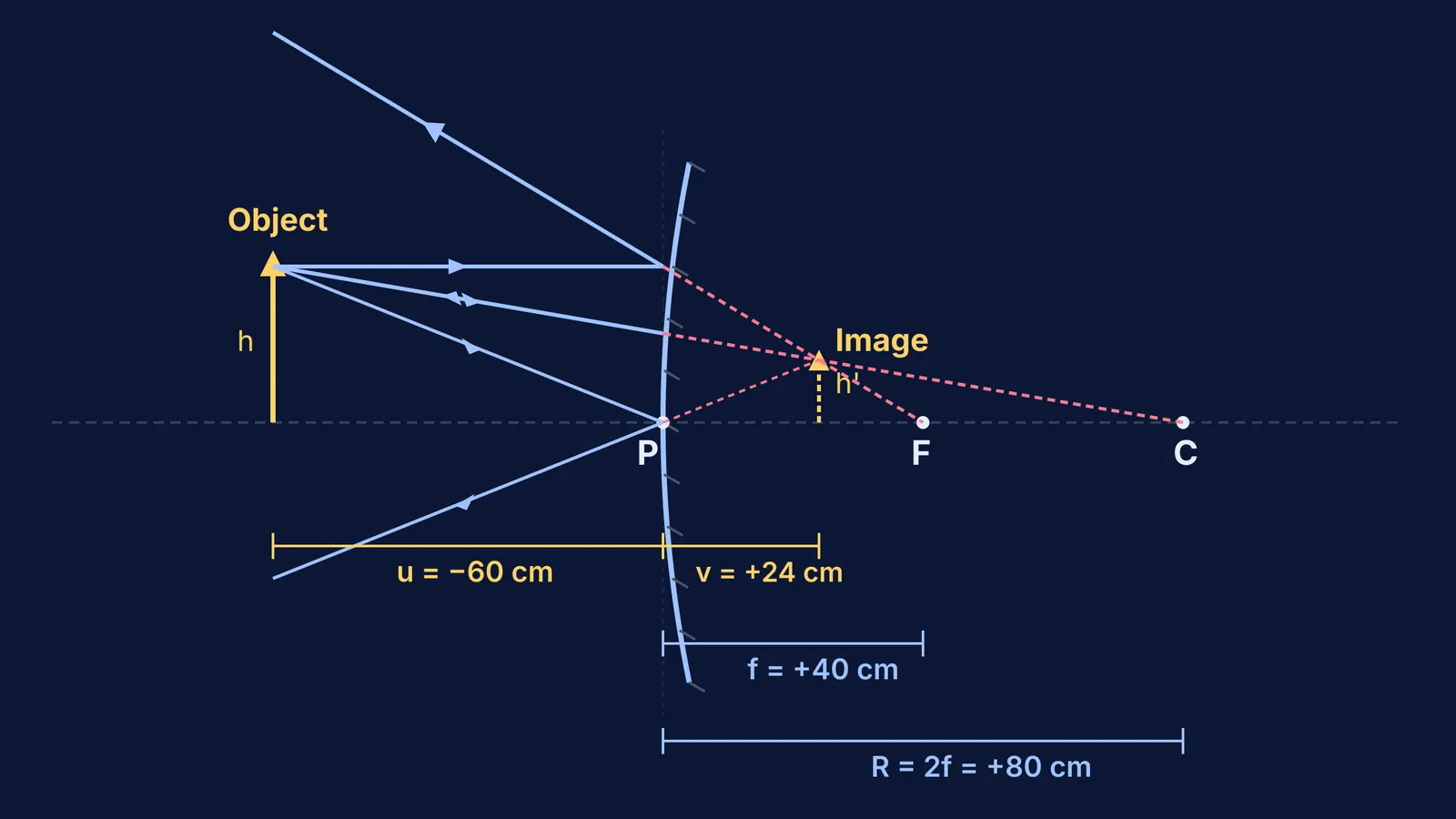
A convex mirror has a reflecting surface curving outward toward the incident light. When rays from a real object strike the mirror, they diverge upon reflection. Tracing these reflected rays backward shows that they intersect behind the mirror surface between the pole and the principal focus. A convex mirror therefore always forms a virtual, erect, and diminished image for any real object.
Under the New Cartesian Sign Convention in Chapter 9 of the NCERT Class 10 Science textbook, upright heights measured above the principal axis are positive. Because virtual images in convex mirrors are erect, object height h and image height h' are positive, making linear magnification m = h'/h strictly positive. Since the image is diminished, m lies between 0 and 1:
0 < m < 1
In physics education research, Fred Goldberg and Lillian McDermott (1987) demonstrated how tenaciously students hold naive conceptions in optics: even after college instruction on concave mirrors, only about 40% of students realized that a real image continues to form in space without a projection screen. Parallel conceptual errors persist when students encounter convex mirrors, where many equate a "diminished" image with a negative magnification. In optics, a negative sign indicates an inverted real image—which a convex mirror never produces for a real object. For comparison, examine how concave mirror image positions switch between real and virtual behavior depending on object distance.
How do you combine the magnification formula and mirror formula?
The standard mirror formula connects focal length f, image distance v, and object distance u:
1/f = 1/v + 1/u
Linear magnification m for any spherical mirror is:
m = −v / u
When a problem specifies magnification m and object distance u, you can eliminate v in three steps:
Express image distance: v = −m × u
Substitute into the mirror formula: 1/f = 1/(−m × u) + 1/u
Factor out 1/u: 1/f = (1/u) × (1 − 1/m) = (1/u) × ((m − 1) / m)
Inverting yields the direct formula for focal length:
f = (m × u) / (m − 1)
Rearranging gives magnification from f and u:
m = f / (f − u)
When image distance v is given instead, rewriting u = −v/m gives:
f = v / (1 − m)
Or in terms of magnification:
m = 1 − v/f
How do you find focal length from magnification step by step?
To solve numerical problems systematically:
Assign Cartesian signs: Object distance u is negative (u < 0) for a real object. Magnification m is positive and less than 1 (0 < m < 1).
Calculate image distance: Use v = −m × u. Because m > 0 and u < 0, v is positive, placing the image behind the mirror.
Solve for focal length: Substitute into 1/f = 1/v + 1/u or use f = (m × u) / (m − 1).
Check physical consistency: Focal length f must be positive, with |v| < f because the image forms between pole and focus. Radius of curvature is R = 2f.
Worked example: An object is placed 30 cm in front of a convex mirror. It forms an erect image one-third the size of the object. Find the mirror's focal length and radius of curvature.
Given: u = −30 cm, m = +1/3
Image distance: v = −(1/3) × (−30 cm) = +10 cm
Focal length: 1/f = 1/(+10) + 1/(−30) = 2/30 = 1/15 cm⁻¹, giving f = +15 cm
Direct check: f = ((1/3) × (−30)) / (1/3 − 1) = (−10) / (−2/3) = +15 cm
Radius of curvature: R = 2f = +30 cm
Because v = +10 cm is less than f = +15 cm, the image lies between the pole and focus.
What common mistakes happen in convex mirror numericals?
Watch out for these frequent pitfalls:
Confusing mirror and lens magnification: Mirrors use m = −v/u, whereas thin lenses use m = +v/u as shown in Class 10 reflection and refraction rules. Dropping the negative sign flips the sign of v.
Making magnification negative: Diminished size means |m| < 1, not m < 0. A negative magnification designates an inverted image.
Dropping the negative sign on u: Real objects in front of the mirror have negative coordinates. Entering a positive u yields a negative focal length, incorrectly describing a concave mirror. See our checklist on avoiding ray optics sign convention mistakes.
Overlooking the boundary condition: Virtual images in convex mirrors cannot form beyond the focal point. Any result where |v| exceeds f signals an error.
When practicing multi-step physics problems, the Fermi Problem Library provides worked problems with a step-by-step solver that explains the reasoning rather than printing an answer. To explore how ray geometry connects across optics topics, visit the Fermi Concept Library, where every concept in physics has its own lesson and clear position in the learning map.


