On this page
When you look into a shiny metal spoon or a car rear-view mirror, your reflection is always upright and diminished. No matter how close or far you stand, the mirror never inverts or magnifies your reflection. While a concave mirror flips your image once you pass its focal point, a convex mirror remains predictable. Both geometric ray tracing and algebraic sign conventions prove why a convex mirror cannot produce any other type of image.
Why do reflected rays always diverge in a convex mirror?
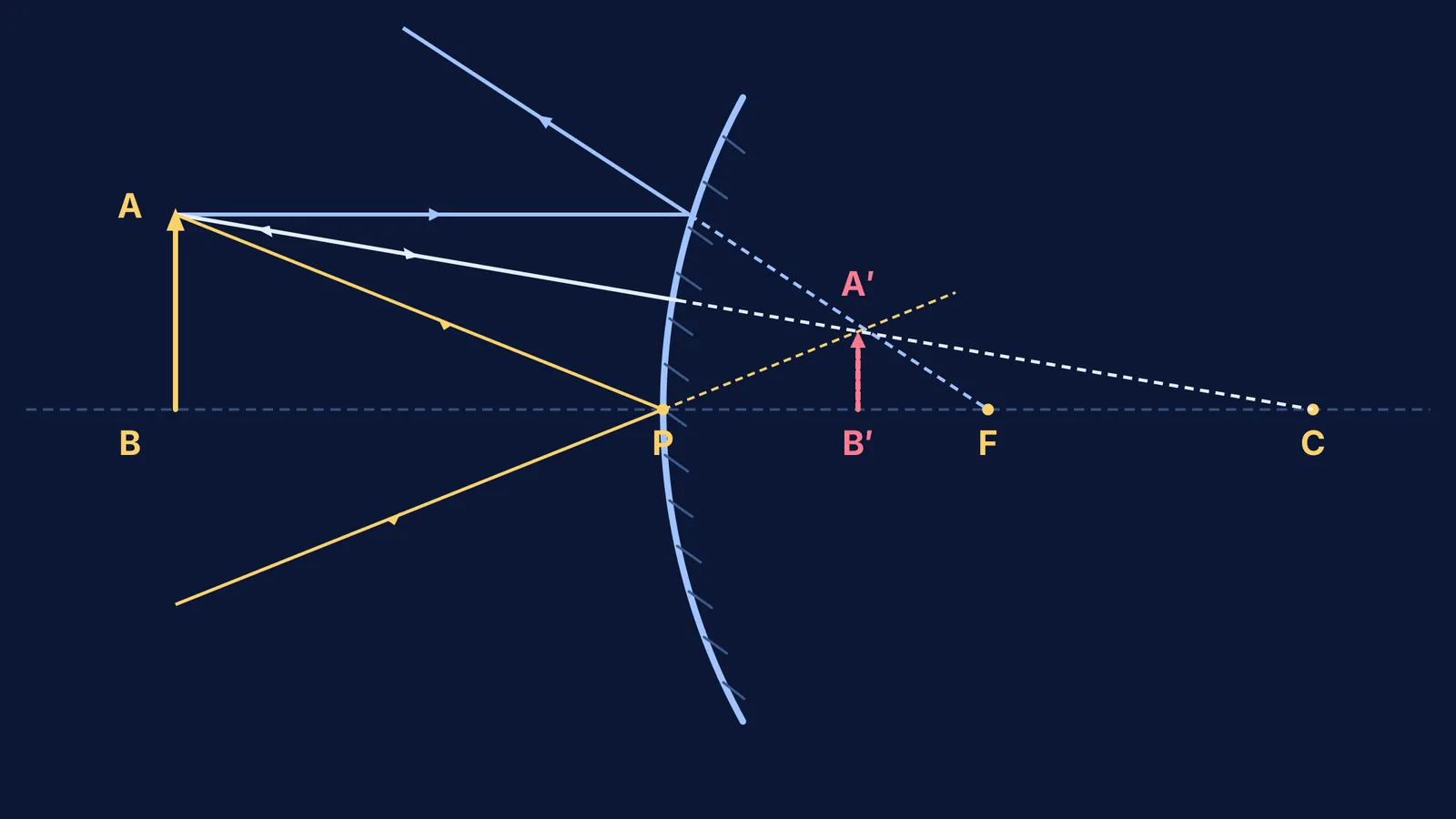
A convex mirror curves outward toward incoming light, placing its center of curvature C and principal focus F behind the reflecting surface. According to OpenStax University Physics Volume 3, a convex mirror is a diverging mirror because incident rays parallel to the principal axis spread apart after reflection.
This divergence stems from surface normals. At any point of incidence, the normal is a radial line drawn from C. Because the surface bulges outward, normal lines tilt progressively farther from the principal axis as you move from pole P toward the rim. By the law of reflection, reflected rays bounce away from these tilted normals, spreading outward into space. Because these rays never intersect in front of the mirror, an observer traces them backward behind the glass, where their extensions meet to form a virtual image. Unlike concave mirror images across six object positions, a convex mirror never focuses light into a real image.
Where does the image form according to the mirror equation?
We can confirm this geometry algebraically using the New Cartesian Sign Convention from the CBSE Class 10 Science curriculum. With pole P as origin, distances in front of the mirror are negative (−) and distances behind are positive (+).
Focal length f is positive (f > 0) because focus F lies behind the mirror. For a real object at distance x in front of the mirror, object distance u = −x (x > 0).
The mirror equation states: 1/v + 1/u = 1/f
Rearranging for v: 1/v = 1/f − 1/(−x) = 1/f + 1/x
Because f > 0 and x > 0, 1/v is strictly positive, proving v > 0 for every object position. A positive image distance confirms the image is always virtual.
Solving explicitly yields v = (f × x) / (x + f). Because x + f > x, v < f: 0 < v < f
The virtual image is always trapped between pole P and principal focus F.
Why is the image always diminished and erect?
Linear magnification m is the ratio of image height h′ to object height h: m = h′ / h = −v / u
Substituting u = −x and v = (f × x) / (x + f): m = −v / (−x) = v / x = f / (x + f)
Because both f and x are positive:
Since f / (x + f) > 0, m is positive, confirming the image is erect (upright).
Since x + f > f, m is strictly less than 1, confirming the image is diminished.
Together, 0 < m < 1 proves a convex mirror cannot produce an inverted or magnified image of a real object. This geometry explains why convex mirrors serve as vehicle side mirrors: diminishing the image expands the field of view while keeping traffic upright.
What mistakes do students make in ray optics problems?
In a 1986 study in *The Physics Teacher*, researchers Fred M. Goldberg and Lillian C. McDermott found that students frequently view an image as an entity on the mirror glass rather than rays intersecting in space. Their 1987 study in the *American Journal of Physics* (Goldberg & McDermott 1987) documented that between 55% and 70% of introductory physics students held persistent misconceptions, such as predicting that removing a screen or covering half an optical component would cut an image in half or make it vanish. In 2000, Igal Galili and Amnon Hazan analysed these alternative frameworks, showing how learners substitute holistic image models for point-to-point ray mapping.
In numerical problems, students frequently stumble over ray optics sign convention traps, such as assigning a negative sign to f. The Fermi Problem Library has worked problems with a step-by-step solver that explains the reasoning rather than printing an answer. When ray diagrams feel abstract, the Fermi Simulation Lab provides interactive simulations for ideas that are easier to see than to read.
How do you calculate image position in a rear-view mirror?
As presented in worked problems from OpenStax University Physics Volume 3, consider an automobile rear-view mirror with radius of curvature R = 2.0 m. A trailing vehicle sits at u = −5.0 m.
Parameters: Focal length f = R / 2 = +1.0 m; object distance u = −5.0 m (x = 5.0 m).
Image distance:
1/v = 1/f − 1/u = 1/(+1.0) − 1/(−5.0) = 1.0 + 0.20 = 1.20 m⁻¹ = 6/5 m⁻¹ So v = +5/6 m ≈ +0.833 m. The positive sign confirms a virtual image 0.83 m behind the mirror, well inside the 1.0 m focal length.
Magnification:
m = −v / u = −(+0.833) / (−5.0) = +0.167 The positive value confirms an erect image, diminished to one-sixth the vehicle's height. This routine reinforces core Class 10 reflection and refraction fundamentals.
If you want to explore how image distance changes as an object approaches, Fermi's AI tutor can work out what you already know and build a plan for the session, drawing the figure and checking understanding as you go.