

On this page
You wake at 5 a.m. from a dream about losing your admit card. Your brother was found in the kitchen at midnight and remembers nothing. Two different sleep stages explain both, and their timing.
What happens in your brain across one night?
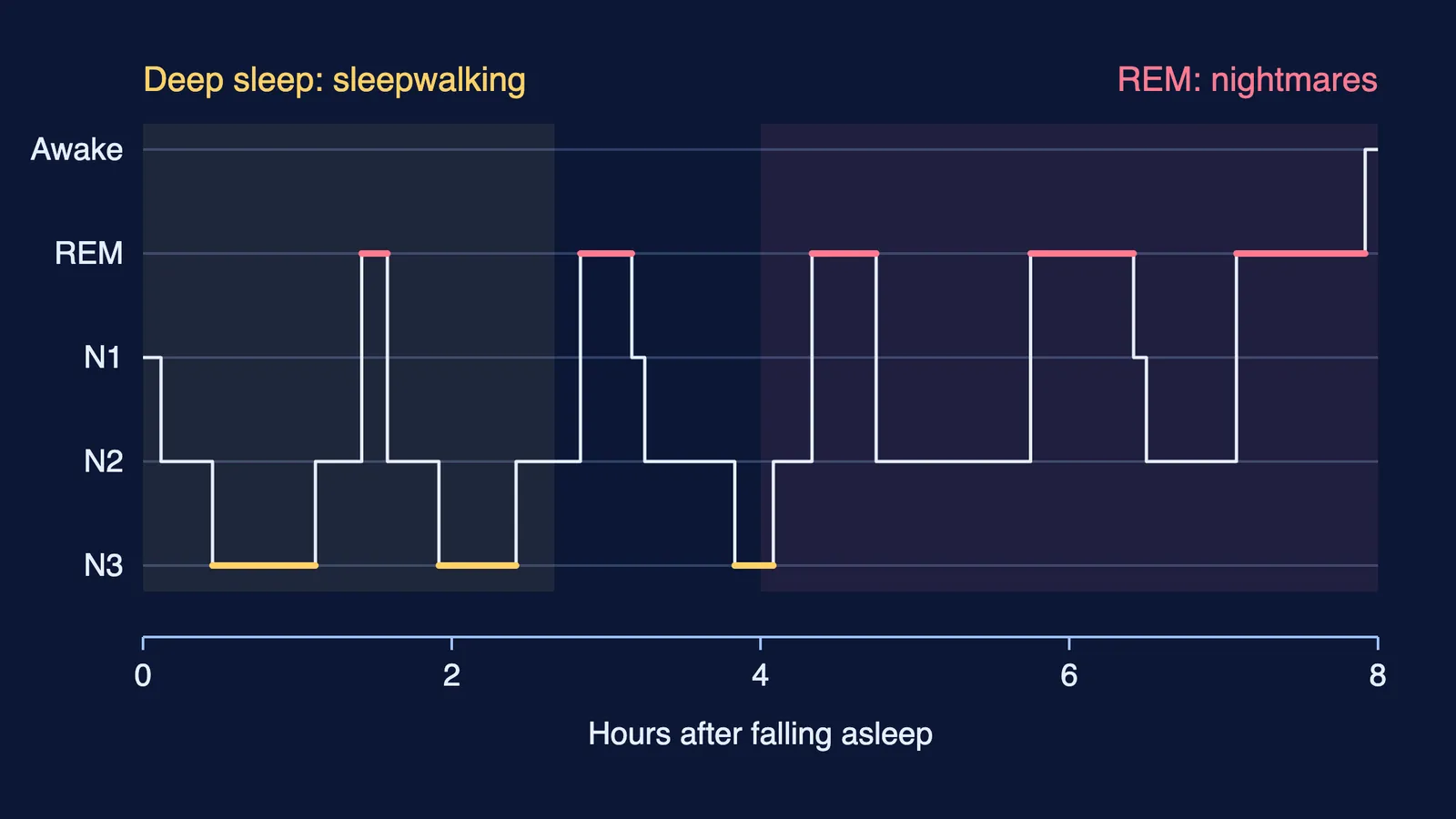
A sleep cycle lasts about 90 minutes on average, and a typical night has four to six of them, according to the Sleep Foundation's guide to sleep stages. Each cycle passes through light sleep (N1, N2), deep slow-wave sleep (N3) and REM (rapid eye movement) sleep.
Most deep sleep comes in the first half, while REM stages get longer in the second half: the first REM stage may last only a few minutes, later ones around an hour (Sleep Foundation). The first REM phase typically begins about 90 minutes after you fall asleep, and REM is when most dreaming happens (Cedars-Sinai).
In REM some muscles are temporarily paralysed, a state called atonia that stops you acting out your dreams (Cedars-Sinai).
Why do we get nightmares, and why near morning?
A nightmare is a vivid, frightening dream that is remembered on waking. A 2021 review in Neurotherapeutics by Ambra Stefani and Birgit Högl classes nightmare disorder as a REM parasomnia (Stefani and Högl, 2021). With more REM late in the night, nightmares arise more often in the second half of the night (Sleep Foundation).
The same review links nightmares to hyperarousal and impaired fear extinction (trouble switching off a learned fear), with past trauma and high stress as risk factors (Stefani and Högl). After a stretch of too little sleep, the body often has a REM rebound that can bring vivid dreams and nightmares, and worrying images on a screen before bed may make nightmares more likely (Sleep Foundation).
Frequent nightmares are uncommon. Finnish adult surveys from 1972 to 2007, cited in the same review, found frequent nightmares in 2.9% of men and 4.4% of women (Stefani and Högl).
Why does sleepwalking happen early in the night?
Sleepwalking is a partial awakening from deep sleep: the person moves about while still mostly asleep (Sleep Foundation's sleepwalking guide). A 2005 review in the International Review of Psychiatry says sleepwalking and night terrors are most likely during the first episode of slow-wave sleep, and lists stress and stimulants among the triggers (Szelenberger and colleagues, 2005). Deep sleep is packed into the early cycles, so that usually means the first few hours.
It is more common in children. A 2016 meta-analysis of 51 studies in PLOS ONE put the lifetime prevalence of sleepwalking at 6.9%, and sleepwalking within the past year at 5.0% of children against 1.5% of adults (Stallman and Kohler, 2016).
Sleep loss makes it more likely. In a 2008 Montreal lab study, 40 sleepwalkers were recorded for one baseline night and again after 25 hours awake: 20 of them (50%) had episodes at baseline and 36 (90%) after the lost night (Zadra, Pilon and Montplaisir, 2008).
Nightmare, night terror or sleepwalking: how can you tell?
Ask when it happened and what was remembered. Nightmares are more common in the second half of the night and sleep terrors in the first. Someone waking from a nightmare tends to be alert and aware of what happened in the dream, while people with sleep terrors very rarely have any awareness of the episode (Sleep Foundation).
Late at night, wakes fully, recalls a frightening story: likely a nightmare (REM).
First hours, screaming or sitting up, hard to comfort, no memory: likely a night terror (deep NREM).
First hours, walking or talking with a blank look, no memory: likely sleepwalking (deep NREM).
What can you do in exam season?
A plan for the weeks before a board exam or JEE Main:
Fix a wake-up time and keep it, weekends included. A consistent sleep schedule is one of the Sleep Foundation's tips against nightmares, and regular nights protect the sleep that helps you keep what you studied.
Skip the all-nighter. Short sleep can bring a REM rebound, and the Montreal study shows what one lost night does to a sleepwalker.
Keep the last stretch before bed free of horror clips and rank-list chatter; see whether a teenager's phone should stay in the bedroom.
If someone at home sleepwalks, remove hazards and lock outer doors. If you find them up, guide them back to bed with a quiet voice rather than shaking them awake (Sleep Foundation).
If late naps push bedtime back, try this one-week plan to reset sleep after naps.
If sleep and the nervous system are on your biology list, the Fermi Concept Library covers every concept in biology, each with its own lesson, so you can revise the ideas behind this post.
When should you get help?
The Sleep Foundation suggests talking to a doctor if nightmares happen more than once a week, affect your sleep, mood or daily life, or began when you started a new medicine (Sleep Foundation). For sleepwalking, it advises raising any concerns with a doctor (Sleep Foundation). If stress is keeping you up, India's Tele MANAS helpline offers free counselling around the clock on 14416 or 1-800-891-4416 (PIB).


