

On this page
Switch off the lights and your room looks black, but it is not empty of signals. A trickle of starlight or streetlight still gets in, and every warm object, including you, is giving off infrared radiation. Night vision devices catch one or the other: image intensifiers multiply the faint light, and thermal cameras read the infrared emission. Here is how each works, with the numbers.
How does night vision work with an image intensifier?
An image intensifier is a vacuum device that detects very low levels of light and amplifies them into an image, as Hamamatsu's image intensifier technical handbook describes it. Inside, three parts sit one behind the other:
Photocathode: converts incoming photons into electrons, the photoelectric effect at work.
Microchannel plate (MCP): a bundle of very thin glass channels; each electron that enters knocks more electrons out of the channel walls, again and again.
Phosphor screen: converts the multiplied electrons back into light that you see.
The same handbook gives the gain of one MCP stage as about 1,000 and of two stages as about 100,000. It lists the P43 phosphor's peak emission at 545 nm, a yellowish green, close to the top of the eye-response curve it plots alongside. That helps explain the classic green picture: the screen's light lands near where your eyes are most sensitive.
The limit follows from the design. An intensifier multiplies photons that arrive; it cannot make them. In a sealed room with no light at all, there is nothing to multiply.
How does a thermal camera see in complete darkness?
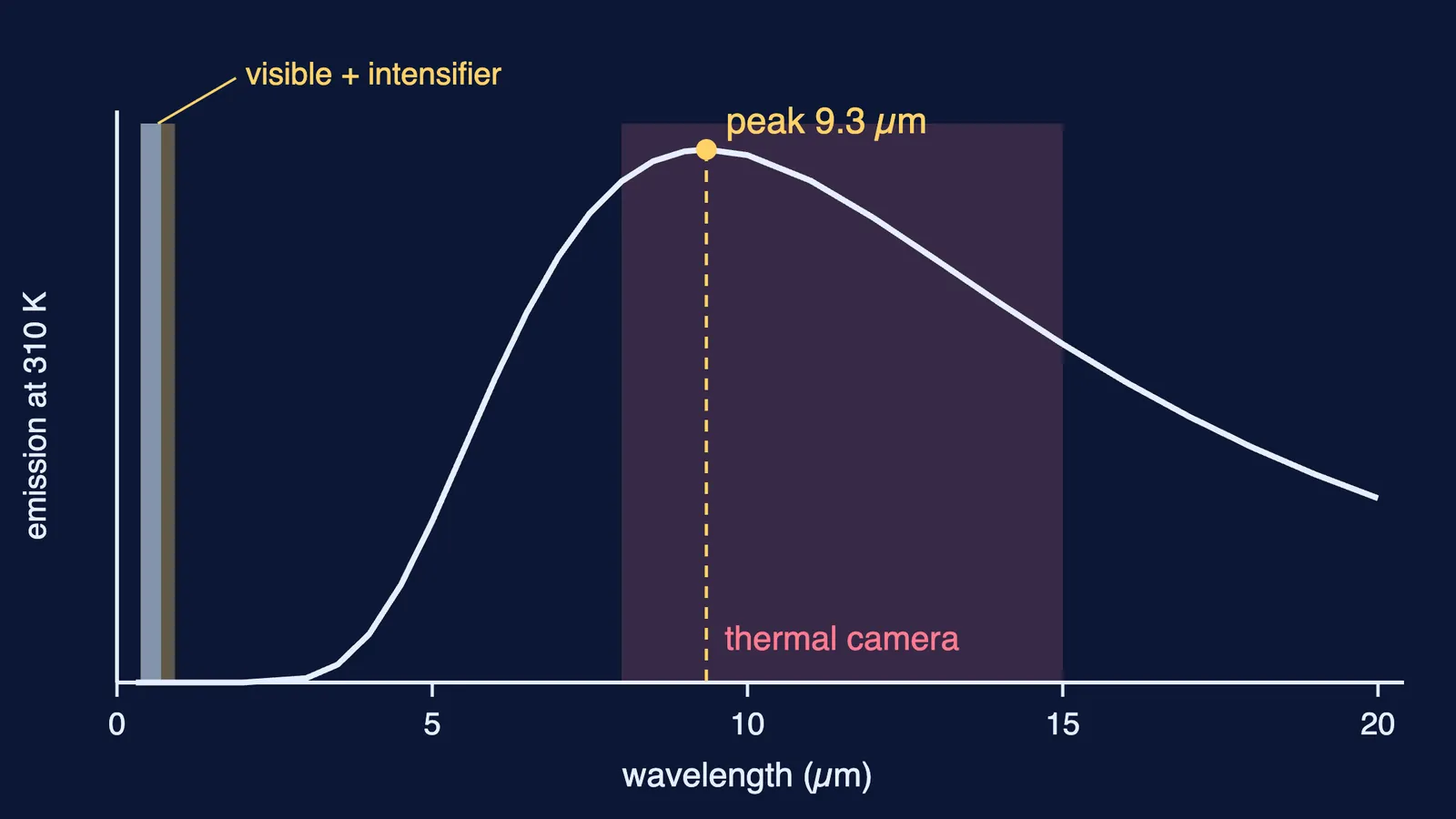
A thermal camera does not need outside light, because warm objects are their own source. NASA's guide to infrared waves explains that objects as cool as humans emit only infrared, which our eyes cannot see but infrared cameras can. The same page says Earth scientists call the band from 8 to 15 µm thermal infrared.
Where in the spectrum does your body glow brightest? Wien's displacement law gives the peak wavelength as λmax = b/T, where b = 2.898 × 10⁻³ m·K according to NIST's CODATA value.
Worked example: why an intensifier cannot see body heat
Take body temperature, 37 °C, as T = 310 K.
λmax = 2.898 × 10⁻³ ÷ 310 = 9.35 × 10⁻⁶ m, about 9.3 µm. That sits inside the 8 to 15 µm thermal band.
Visible light runs from about 380 to 700 nm, according to NASA's visible light page. The body's peak is about 13 times longer than the red end.
Photon energy is E = hc/λ, with hc ≈ 1240 eV·nm (the same 1240 appears in the quantum-efficiency formula of the Hamamatsu handbook). At 9,350 nm, E ≈ 0.13 eV.
The gallium arsenide photocathode in that handbook responds only from 370 to 920 nm. At 920 nm, E = 1240 ÷ 920 ≈ 1.35 eV. A body-heat photon carries roughly a tenth of that, too little to free an electron from the photocathode.
So the two devices are not stronger and weaker versions of one idea. One relies on photoelectrons; the other detects long-wave infrared directly. If the threshold idea in step 5 feels shaky, go back to how Einstein's photoelectric equation is derived. The same emission physics explains how infrared thermometers read temperature without touching you.
What can each one see through?
Glass flips the comparison. In a demonstration from Simon Fraser University's physics department, a hand inside a thin plastic bag is hidden from the eye but clearly visible to an infrared camera, while a hand behind a pane of glass is visible to the eye but its infrared signal does not show. An intensifier works with visible and near-infrared light, which passes through a window; a thermal camera sees the glass, not the room behind it.
Image intensifier or thermal: which one fits the job?
Use this quick check, built from the physics above:
Is there any light at all? If there is none, only thermal works.
Do you need to see through a window? Use an intensifier; glass blocks the thermal band.
Do you want surface detail, such as shapes and markings? An intensifier shows reflected light, so the picture looks like a dim photograph. A thermal camera shows how warm things are, not what colour they are.
Are you looking for something warm in the dark, like an animal in a field? Thermal, because a warm body stands out against cooler surroundings.
Animals solved the same problem with biology instead of electronics; read how owls see at night and fly silently.
Two ideas here, Wien's law and the photoelectric threshold, are worth practising until each step takes one line. Fermi's AI tutor can draw the figure, run the simulation and check your understanding as it goes, and the Fermi Problem Library has worked problems with a step-by-step solver that explains the reasoning.
Next time you watch a green night vision clip, ask which physics made it: multiplied photoelectrons, or the long-wave infrared glow of a warm body.


